


US, Iran Trade Blame Over Fresh Ceasefire Breach
The United States and Iran accused each other of breaching their fragile truce on Thursday following a serious exchange of fire, the most dangerous flare up since the ceasefire took hold in April and a stark reminder of how close the Middle East remains to renewed all out war three months after it began.
The clash, which drew in US ally Kuwait and rattled delicate negotiations to formally end the conflict, unfolded around the strategically vital Strait of Hormuz. Iranian state broadcaster IRIB reported that Iranian forces had fired on four ships attempting to cross the waterway without authorisation. Tehran has blockaded the strait since the war began on February 28.
US forces said they intercepted five attack drones in and around the strait and prevented the launch of a sixth from a ground control station in the southern port area of Bandar Abbas. The strike on Bandar Abbas prompted Iran to retaliate against what IRIB, citing the Revolutionary Guards, described as “the American airbase that served as the source of the attack.”
The Guards did not name the base, but Kuwait, which hosts US troops, said its air defences had responded to incoming fire. Its foreign ministry condemned what it called “the criminal Iranian attacks that targeted the territory of the State of Kuwait with missiles and drones, in a dangerous escalation.”
The US Central Command branded the attack an “egregious ceasefire violation.” Iranian foreign ministry spokesman Esmaeil Baqaei countered that the Islamic republic would “take all necessary measures to defend its national sovereignty,” describing the US strikes as truce violations in turn. A US official told AFP the actions had been “measured” and “intended to preserve the ceasefire,” while Iran’s Guards threatened a “firm response” should attacks resume.
The episode laid bare the fragility of stalled talks aimed at ending a war that erupted with a wave of US and Israeli strikes on Iran. Neither side, however, has shown appetite for a full return to hostilities. Before Thursday’s strikes, Amir, a 27 year old software developer in Tehran, captured the prevailing unease. “I feel like nothing is certain yet,” he said. “The daily question is: Will there be missile strikes tonight?”
At the heart of the proposed settlement lies the reopening of the Strait of Hormuz, whose closure has squeezed global energy markets that depend on the vast volumes of oil and gas normally passing through it. Oil prices climbed on Thursday after news of the strikes, reversing much of the previous day’s decline that had been driven by hopes of a deal.
President Donald Trump struck a combative note, threatening US ally Oman when asked about a possible interim arrangement granting it and Iran joint control of the strait. “No, the strait is going to be open to everybody,” Trump said. “It’s international waters and Oman will behave just like everybody else or we’ll have to blow them up.” Oman, which has mediated in the conflict and itself come under Iranian attack, drew a sharp rebuke from Baqaei, who called the threat “a worrying sign of the normalisation of anarchy and intimidation in international relations.”
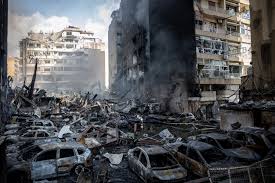
Hundreds of kilometres away, the war’s Lebanese front escalated sharply. A separate ceasefire has done little to halt fighting between Israel and Iran backed Hezbollah. The Israeli army said it conducted a precise strike near Beirut, with Lebanese officials reporting an apartment south of the capital was hit. AFPTV footage showed smoke rising over the edge of Beirut’s southern suburbs, a Hezbollah stronghold.
Israel also launched fresh strikes on Hezbollah infrastructure around Tyre after issuing evacuation warnings. A day earlier it had declared all areas south of Lebanon’s Zahrani River, roughly 40 kilometres from the border, as combat zones. Lebanese authorities said Israeli attacks in the south killed at least 14 people on Thursday, including three children and a soldier.
Lebanon’s health ministry reported the overall death toll had reached 3,269 since the war began, a conflict triggered by Hezbollah missile launches toward Israel in retaliation for the killing of Iran’s supreme leader. The Israeli military said a soldier was killed by a Hezbollah drone near the border, bringing its losses to 23 troops and one civilian contractor. Iran has insisted any agreement to end the war must extend to Lebanon.