
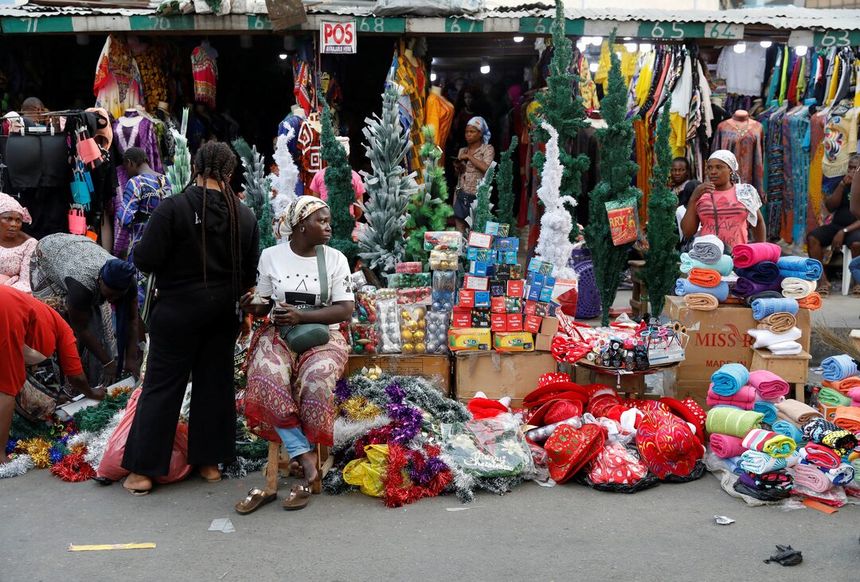
As Christmas draws near, Lagos markets are beginning to glow with festive colours—but behind the tinsel and bright displays lies a more measured mood.
Traders across major commercial hubs say this year’s yuletide season is unfolding with uneven momentum, shaped by rising costs, cautious consumer behaviour and shifting spending priorities.
At the Balogun Business Association (BBA) Market and Oyinlola Ifelodun Market in Festac Town, shop owners told the News Agency of Nigeria that the familiar end-of-year rush has arrived in fragments rather than waves.
For some, business has picked up—slowly but noticeably. Mrs Joy Nwachukwu, a clothing trader at BBA Market, said sales this December have surpassed what she experienced at the same time last year.
“Last year around this period, customers were hardly coming,” she said. “This year is better. Even with the price increases, people are still buying.”
Yet the nature of spending appears to have changed. Traders say many shoppers are prioritising personal purchases over traditional family-focused shopping.
At Oyinlola Ifelodun Market, Mrs Tutu Hunpe, who sells children’s clothing, observed a shift that reflects broader economic pressure.
“We’re seeing more adults buying for themselves instead of focusing on children’s clothes,” she said. “It seems people are making tough choices because of the economy.”
That pattern is echoed across product lines. Mr Chukwudi Obi, a shoe vendor at BBA Market, said most of his recent sales have been adult footwear, a trend he believes signals a more individual-focused celebration this year.
“Most of my customers are buying for themselves,” he said. “People seem more focused on enjoying this Christmas personally than last year.”
However, not all traders are sharing in the modest upswing. Many describe a market weighed down by low patronage and aggressive bargaining, with potential buyers walking away once prices are mentioned.
At BBA Market, Mrs Blessing Dikeh said customers often quote prices far below market reality.
“They just call their own price and leave,” she said. “What they offer is extremely low—something no trader can accept.”
At Oyinlola Ifelodun Market, Mrs Bolaji Disu said rising wholesale costs have made it difficult to meet customer expectations, adding that traders are frequently blamed for price hikes beyond their control.
“People think we are the ones increasing prices,” she said. “But we can’t sell goods at the same price we bought them.”
Even in the festive decorations segment, demand has been subdued. Mrs Joy Chidinma, who sells Christmas ornaments and lights, said prices have remained relatively stable compared to last year, yet foot traffic remains thin.
“Prices of Christmas lights haven’t gone up much,” she said. “But the market is still slow.”
Taken together, the mixed experiences paint a picture of a Christmas season shaped less by excess and more by restraint. While some traders are seeing improvement over last year, many are still waiting for the traditional last-minute rush—hoping that as Christmas Day approaches, Lagosians will loosen their purse strings, even if cautiously.
For now, the markets hum quietly, balancing festive hope with economic reality—mirroring the mood of a city celebrating Christmas under pressure, but not without resilience.