
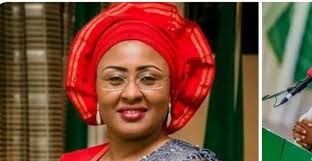
Former First Lady Dr Aisha Buhari has disclosed that she fought off persistent attempts by influential individuals to force her and her children out of the Presidential Villa during her husband’s eight-year tenure as Nigeria’s president.
In a newly published biography titled “From Soldier to Statesman: The Legacy of Muhammadu Buhari,” authored by Dr Charles Omole and launched at the State House Conference Centre in Abuja, Mrs Buhari provided candid revelations about the inner workings of the Buhari administration between 2015 and 2023. President Bola Tinubu and First Lady Senator Oluremi Tinubu attended the book launch.
According to the biography, Mrs Buhari stated that certain powerful figures residing in Aso Villa with their wives and grandchildren attempted to take control of both the presidential office and the domestic affairs of the First Family. “They tried to push everybody out, including me,” she is quoted as saying in the book. “This is my house. You can live wherever you like, but you cannot be in charge of my husband’s office and then also be in charge of me, his wife, inside my house.”
The former First Lady described Aso Villa not merely as a residence but as “an ecosystem” that became populated with relatives, courtiers, and staff members who learned to navigate its corridors of power. She explained that with most of her children studying abroad during President Buhari’s first term, extended family members filled the void and occupied houses across the Villa compound.
Mrs Buhari identified what she considered a critical vulnerability in her husband’s leadership style. The book states that “because of his fondness and attachment to his extended family and old friends, Buhari was vulnerable to all kinds of scheming and manipulations.” She argued that individuals who understood these weaknesses exploited them, ultimately undermining the administration’s objectives.
The former First Lady also addressed what she described as unauthorised control over access to the Villa. She claimed that relatives with no official roles attempted to influence who could meet with the president, whilst longstanding allies from Buhari’s opposition years found themselves “locked out,” with their names allegedly logged by security agents.
One of the most pointed criticisms Mrs Buhari offered concerned the administration’s reluctance to remove underperforming officials. She characterised this as a major structural weakness that hampered the government’s effectiveness throughout its tenure.
According to the biography, Mrs Buhari argued that President Buhari’s hesitation stemmed from multiple factors. “As you age, performance changes,” she noted, suggesting that her husband often felt sympathy for struggling appointees. More significantly, she claimed that Buhari feared being labelled a dictator once again, a concern rooted in his military background and previous time as head of state in the 1980s. “If I remove him, they will say I am this and that,” she quoted him as saying.
Mrs Buhari stated that this anxiety became a protective shield for mediocrity within the administration. The familiar phrase “the devil you know” evolved into a justification for retaining failing officials even when policy implementation stalled, she argued.
The former First Lady outlined her own approach to such matters: if an official is corrupt but delivers at least 50 per cent results, he might be tolerated; if he is corrupt and delivers nothing, he should be removed. She indicated that the Buhari family privately acknowledged that the president’s refusal to dismiss non-performers became a fundamental flaw of his administration.
Mrs Buhari recounted an incident in which security officials suggested she temporarily relocate from Abuja to Daura to allow investigations into certain close associates to proceed without interference. She refused the suggestion. Subsequently, she was informed that President Buhari withdrew emotionally, speaking and eating less.
In what may prove a sensitive revelation for current political relations, Mrs Buhari claimed that even after leaving office, her husband privately requested that President Tinubu refrain from investigating some of his kinsmen because he continued to depend on them for personal needs. For the former First Lady, this episode illustrated the dangers of emotional dependence at the highest levels of governance.
The biography also revealed that Mrs Buhari warned President Tinubu against repeating what she views as the mistakes of the Buhari administration, particularly regarding the retention of underperforming officials. Her remarks were delivered during a period when public discourse about accountability and performance in government remains particularly acute in Nigeria.
The book launch and its revelations come at a time when Nigerians continue to evaluate the legacy of the Buhari years, which were marked by economic challenges, security concerns, and debates about the effectiveness of governance structures. Mrs Buhari’s willingness to speak candidly about internal Villa dynamics offers an unusual insider perspective on presidential decision-making and the informal power structures that operated alongside official government channels.
The former First Lady’s account suggests that the management of personal relationships and extended family influences presented ongoing challenges for policy implementation and administrative efficiency during the Buhari presidency. Her narrative describes a constant negotiation between institutional authority and personal loyalties, between formal office and domestic space, and between performance standards and emotional attachments.
Mrs Buhari’s public statements during her time as First Lady occasionally sparked controversy, most notably when she warned in a 2016 BBC interview that she might not support her husband’s re-election bid if certain changes were not made. Her latest revelations continue this pattern of forthright commentary, providing material for historians and political analysts assessing the Buhari administration’s record.