


Trump Rules Out Military Force on Greenland But Insists US Must Have “Ownership”
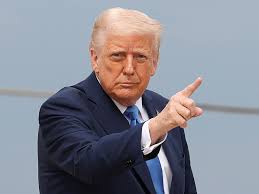
United States President Donald Trump has declared he will not use military force to seize control of Greenland, but maintained that America must still secure “ownership” of the autonomous Danish territory, in remarks that have drawn international attention and raised questions about Washington’s Arctic policy.
Speaking at the World Economic Forum annual meeting in Davos, Switzerland, on Wednesday, Trump sought to clarify his administration’s position on Greenland amid growing speculation about American territorial ambitions in the strategically important Arctic region.
Read Also: Netanyahu Accepts Invitation To Join Trump’s Controversial Board Of Peace
“We probably won’t get anything unless I decide to use excessive strength and force where we would be, frankly, unstoppable, but I won’t do that. Okay. Now everyone’s saying, Oh, good. That’s probably the biggest statement I made, because people thought I would use force,” Trump told world leaders gathered at the summit, according to reports by Agence France-Presse.
The president went on to emphasise his commitment to a non-military approach. “I don’t have to use force. I don’t want to use force. I won’t use force,” he stated.
Despite ruling out the use of force, Trump insisted that the United States must still obtain ownership of Greenland, though he did not elaborate on what mechanisms or negotiations his administration would pursue to achieve this goal. The remarks underscore a continued American interest in the island, which lies between the North Atlantic and Arctic oceans and holds significant geopolitical and economic value.
Greenland is an autonomous territory within the Kingdom of Denmark, with its own government responsible for most domestic affairs while Copenhagen handles foreign policy, defence, and monetary matters. The island has a population of approximately 56,000 people, predominantly indigenous Inuit, and has been under Danish sovereignty for centuries.
Trump’s interest in acquiring Greenland is not new. During his first term as president, which ran from 2017 to 2021, he publicly floated the idea of purchasing the island, a proposal that was swiftly and firmly rejected by both Greenland’s government and Denmark. In August 2019, then-Danish Prime Minister Mette Frederiksen described the notion as “absurd,” a characterisation that reportedly angered Trump and led to the abrupt cancellation of a planned state visit to Denmark.
At the time, Greenlandic officials also made clear that the island was not for sale. “Greenland is not for sale, but Greenland is open for trade and cooperation with other countries, including the United States,” the territory’s Ministry of Foreign Affairs said in a statement.
The renewed discussion of Greenland comes amid heightened global competition for influence in the Arctic, a region that has gained strategic importance due to melting ice caps opening new shipping routes and revealing untapped natural resources, including oil, gas, and rare earth minerals critical to modern technology and defence industries.
For the United States, Greenland holds particular military significance. The island is home to Thule Air Base, a crucial American military installation located in the northwest that serves as a key component of the United States’ early warning system for ballistic missiles and houses radar and satellite monitoring facilities. The base has been operational since the Cold War and remains vital to American national security infrastructure.
Beyond military considerations, Greenland’s mineral wealth has attracted interest from major powers, including China, which has sought to invest in the island’s mining sector. This has raised concerns in Washington and Copenhagen about potential Chinese influence in a territory that sits along vital North Atlantic shipping lanes and within NATO’s operational sphere.
Denmark, a founding member of NATO and a close ally of the United States, has historically maintained a protective relationship with Greenland. However, in recent years, Greenland has pursued greater autonomy and has considered the possibility of full independence, a move that would require economic self-sufficiency currently beyond the territory’s reach, as it relies heavily on annual subsidies from Denmark.
Trump’s remarks in Davos come at a time when his administration is reasserting American priorities on the world stage. The World Economic Forum gathering brings together heads of state, business leaders, and policymakers to discuss pressing global issues, and Trump’s comments on Greenland were part of what observers described as a broader address touching on trade, energy, and American economic strength.
While Trump’s explicit assurance that he would not use force may have been intended to ease tensions and reassure European allies, the continued insistence on American ownership of Greenland leaves open questions about how such an objective might be pursued diplomatically and whether it could strain relations with Denmark and other Nordic countries.
International law experts have noted that territorial acquisition in the modern era typically occurs through negotiated agreements, referendums, or international treaties, and that any attempt to pressure a sovereign nation or its autonomous territories would likely face widespread condemnation and legal challenges.
The Danish government has not yet issued a formal response to Trump’s latest remarks. However, past statements from Copenhagen have emphasised respect for Greenland’s right to self-determination and the strong partnership between Denmark and the United States, including within the NATO framework.
Greenland’s government has similarly reiterated in past statements that decisions about the island’s future belong to the Greenlandic people themselves. “We are open to business, not for sale,” Greenlandic Premier Múte Egede said in 2019, a position that officials have maintained in subsequent discussions about foreign interest in the territory.
Read Also: Trump Threatens 200% Tariffs On French Wine To Pressure Macron Over Global “Board Of Peace” Plan
The issue of Greenland’s future is expected to remain a point of discussion as Arctic geopolitics continue to evolve. With climate change accelerating the melting of polar ice, the region is becoming increasingly accessible and economically viable, drawing the attention of not only the United States but also Russia, China, and European nations with Arctic interests.
Trump’s address at Davos, which AFP reported took place on January 21, 2026, signals that Greenland will likely remain on the agenda of his administration’s foreign policy priorities, even as the president rules out the most dramatic means of pursuing control.
As global powers position themselves for influence in the Arctic, the fate of Greenland and its people will depend on complex negotiations involving sovereignty, security, economic development, and indigenous rights all set against the backdrop of a rapidly changing climate and shifting international order.