
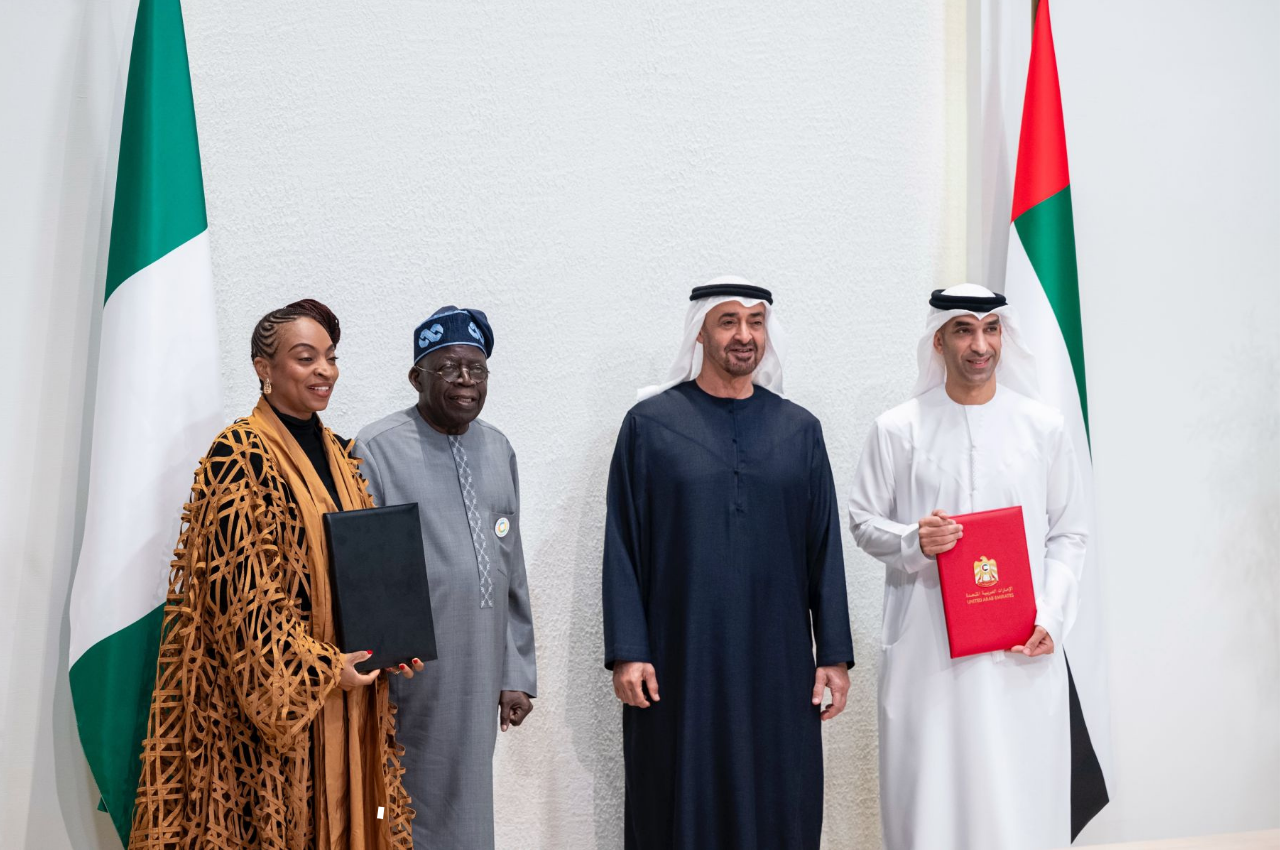
Nigeria and the United Arab Emirates have formalised a major trade agreement aimed at easing market access and reducing costs on thousands of products traded between both countries, marking a significant step in Nigeria’s broader economic and trade diplomacy.
The Federal Government signed a Comprehensive Economic Partnership Agreement (CEPA) with the UAE in January 2026, providing for the elimination of tariffs on a wide range of goods. The agreement was concluded on the sidelines of the Abu Dhabi Sustainability Week held between January 11 and 15.
Read Also: Emirates Airlines Resumes Operations in Nigeria As FG, UAE Settle Lingering Issues
Details of the agreementEmirates Airlines Resumes Operations in Nigeria As FG, UAE Settle Lingering Issues were outlined in a public statement attributed to a member of the Governing Board of the North East Development Commission, Rep. Sam Onuigbo, who spoke in Abuja while commenting on the outcomes of the Abu Dhabi meetings.
Under the CEPA, the UAE is to eliminate tariffs on 7,315 Nigerian products. Of this figure, 2,805 products, representing about 38.3 per cent, are to enjoy immediate duty-free access, while tariffs on the remaining items will be phased out over a period of three to five years. The coverage includes both agricultural and industrial goods.
In a reciprocal arrangement, Nigeria has agreed to eliminate tariffs on 6,243 products imported from the UAE under the same agreement.
“The CEPA was signed in January 2026, and the UAE will eliminate tariffs on 7,315 Nigerian products,” Onuigbo said, adding that the structure of the deal was designed to create expanded commercial opportunities between both countries.
He described the agreement as a “game changer,” particularly for Nigerian businesses seeking access to the UAE market. According to him, the framework would make it easier for Nigerian entrepreneurs with verifiable businesses to establish offices in the Emirates, operate for defined periods, and return to Nigeria with expanded networks and experience.
The agreement was signed in the presence of President Bola Tinubu, Nigeria’s Minister of Industry, Trade and Investment, Dr. Jumoke Oduwole, UAE President Mohamed bin Zayed Al Nahyan, and the UAE Minister of Foreign Trade, Dr. Thani bin Ahmed Al Zeyoud.
Onuigbo, a former member of the House of Representatives who represented Ikwuano/Umuahia North and South Federal Constituency and served as Chairman of the House Committee on Climate Change during the 8th Assembly, also linked the trade pact to Nigeria’s wider economic and energy policy reforms.
He noted that Nigeria’s participation at the Abu Dhabi Sustainability Week coincided with the unveiling of the country’s carbon market framework policy, reflecting ongoing efforts to align economic growth with climate commitments.
“Nigeria is a nation of nearly 250 million people and has had, over the years, the challenge of not having enough energy or power to be able to attain its economic and industrialisation targets,” he said.
According to him, successive policy actions such as the Energy Transition Plan, the enactment of the Climate Change Act, and the signing of the Electricity Act in 2023 shortly after President Tinubu assumed office, underscore the administration’s focus on addressing the country’s long-standing energy deficit.
He added that reliable electricity supply remains central to Nigeria’s industrial development ambitions, noting that power availability is a foundational requirement for manufacturing, investment, and job creation.
Read Also: UAE vs. Nigeria: Rumpus in Aviation Ties Continues
Onuigbo further stated that Nigeria’s engagement with the UAE at the summit was expected to deepen economic cooperation, promote investment flows, and strengthen collaboration on addressing climate change challenges.
He said the overall objective of the President’s international engagements, including the CEPA with the UAE, was to reposition Nigeria as an attractive destination for business and to support economic growth in 2026 and beyond.
The CEPA represents one of the most expansive trade arrangements Nigeria has entered into in recent years, reflecting a growing emphasis on bilateral agreements as tools for market access, export diversification, and industrial development.