
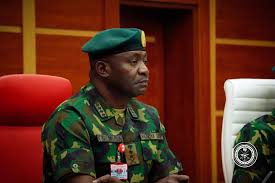
The Federal Government has established an 18-member committee to explore the deployment of military veterans in reclaiming and securing ungoverned spaces across the country, with the dual aim of enhancing national security and opening such areas to economic activities.
The committee, inaugurated on Tuesday at the Ministry of Defence headquarters in Abuja, is charged with repositioning the Nigerian Legion Corps of Commissionaires and Veterans while developing strategies to integrate retired military personnel into efforts to bring remote and lawless territories under effective government control.
Defence Minister, Gen. Christopher Musa (retd.), represented by the Permanent Secretary, Dr Richard Pheelangwa, outlined three core terms of reference for the panel: repositioning the veteran community to support national economic development; deploying veterans to secure ungoverned spaces and place them under sustained oversight and development; and strengthening the operational capacity of the Nigerian Legion Corps of Commissionaires to aid veterans’ reintegration and contribution to security.
In a statement issued on Wednesday by the ministry’s Deputy Director of Information, Enderline Chukwu, on behalf of the Director of Information and Public Relations, the minister described the initiative as a deliberate shift towards a more sustainable security model that addresses both immediate threats and underlying socio-economic factors fuelling instability.
Musa noted that bringing experienced veterans into local security arrangements would complement ongoing military operations, improve intelligence gathering, build community trust, and foster greater local ownership of peace-building efforts.
The committee draws membership from the Joint Services Department of the Ministry of Defence, the Nigerian Legion, Defence Headquarters, the Defence Intelligence Agency, the Nigerian Army, Navy, and Air Force, as well as the offices of the Ministers of Defence and State for Defence.
The move comes against a backdrop of long-standing concerns over vast stretches of Nigerian territory that remain outside effective government authority. Over the past decade and a half, large forested and remote areas – particularly in the North-West, North-East, North-Central, and parts of the South have become havens for armed bandits, insurgents, kidnappers, and other criminal groups.
Read Also: Nigeria Customs Hits ₦7.28 Trillion Revenue Peak; Demands New Security Integration
The Sambisa Forest in Borno State, once a major base for Boko Haram, and expansive woodlands across Zamfara, Katsina, Kaduna, and Niger states have repeatedly featured in reports of mass abductions, cattle rustling, and attacks on rural communities. Successive administrations have launched military operations – including Operation Lafiya Dole, Operation Hadarin Daji, and various joint task forces yet criminal elements continue to exploit the absence of state presence in these zones.
Security experts and civil society organisations have, for years, advocated the use of retired military personnel in community-based security frameworks, arguing that veterans possess tactical experience, local knowledge, and discipline that can ease the burden on serving troops deployed across multiple theatres. The current active force is widely acknowledged to be overstretched, with personnel simultaneously engaged in counter-insurgency, anti-banditry, and internal security operations nationwide.
The Nigerian Legion Corps of Commissionaires, established decades ago to provide employment and welfare support for ex-service personnel, has historically played roles in guarding public facilities and private installations. The present effort seeks to revitalise the corps and expand its mandate to include active participation in securing and developing previously inaccessible areas.
If implemented effectively, the deployment of veterans could mark a significant evolution in Nigeria’s approach to internal security moving from purely kinetic military action to a hybrid model that combines experienced manpower with community engagement and economic revival in long-neglected regions.
The committee is expected to produce recommendations that will guide policy and operational frameworks for the initiative.