

Revenue Allocation: Federal, State, and Local Governments Share N1.97trn
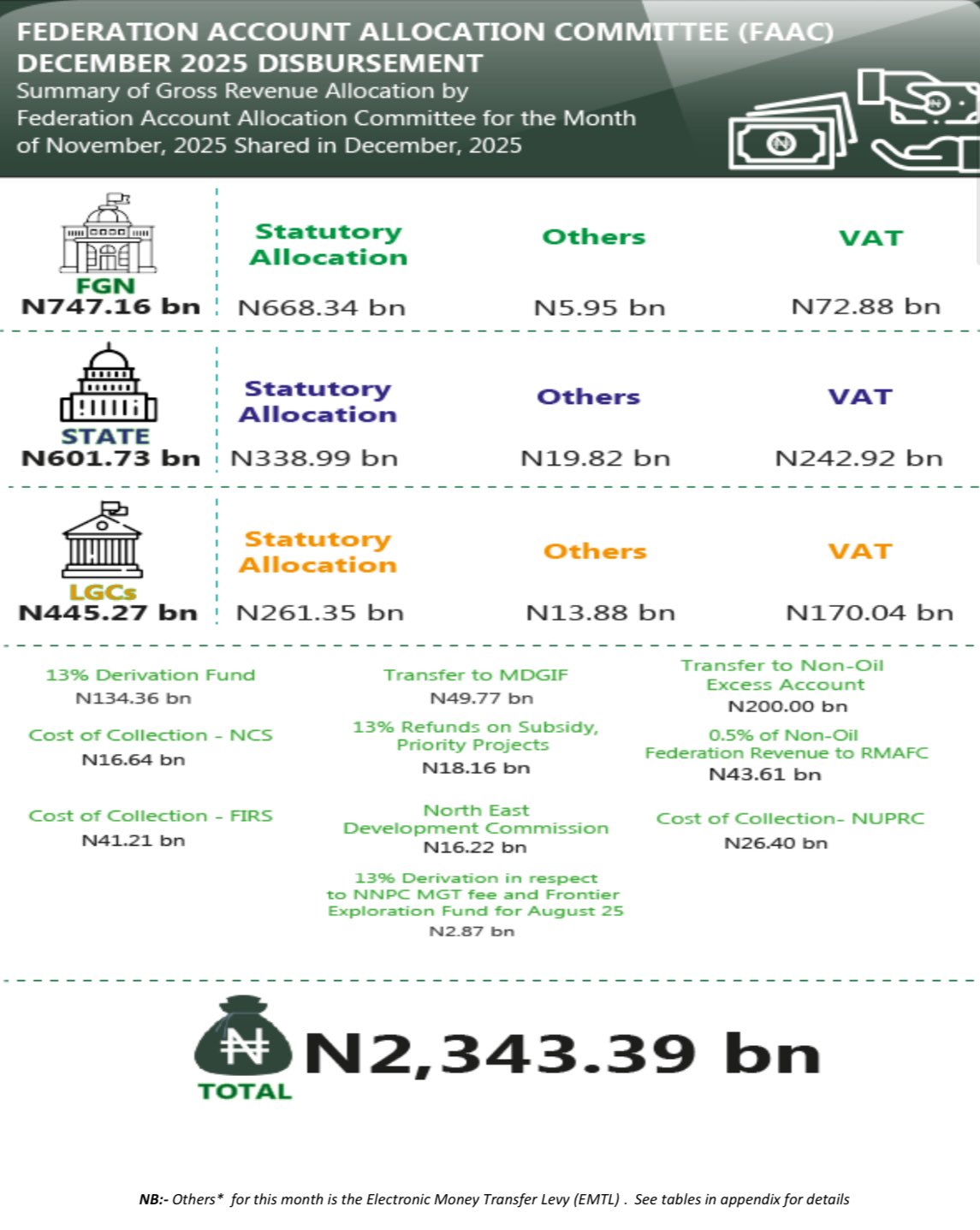
The Federation Account Allocation Committee (FAAC) has shared a total of ₦1.97 trillion for December 2025. This disbursement represents the collective revenue generated by the federation during the final month of last year. The committee distributed these funds among the Federal Government, the 36 states, and 774 local governments. This record-breaking figure reflects a significant surge in petroleum profit taxes and value-added tax collections. Consequently, the three tiers of government now possess substantial liquidity for their 2026 fiscal year operations. The Minister of Finance chaired the crucial meeting held earlier today in the Federal Capital Territory.
A detailed breakdown reveals that the Federal Government received ₦750 billion from the total statutory revenue. Furthermore, the 36 state governments collectively secured approximately ₦620 billion to fund their respective regional projects. The local government councils received ₦410 billion to address grassroots developmental needs and staff salary obligations. Active voice records show that the Nigerian National Petroleum Company Limited contributed significantly to this windfall. Furthermore, the Federal Inland Revenue Service reported a massive increase in non-oil revenue during the holiday season. Conversely, some economic analysts remain cautious about the long-term inflationary impact of such massive liquidity.
In a related development, the committee allocated ₦190 billion as derivation revenue to the oil-producing states. This 13 percent fund aims to mitigate the environmental and social impacts of oil exploration activities. Furthermore, the committee set aside a specific portion for cost of collection to various revenue agencies. The high revenue figure stems partly from the complete removal of the controversial petrol subsidy regime. Consequently, more funds are now entering the federation account instead of subsidizing private fuel consumption. Conversely, the rising cost of living continues to exert immense pressure on the average Nigerian household. The government insists that these increased allocations will eventually fund essential social safety net programs.
Strategic investment in infrastructure and human capital remains the primary expectation for these disbursed public funds. Citizens and civil society groups are calling for increased transparency in how states utilize these billions. Furthermore, the recent Supreme Court ruling on local government autonomy ensures direct payment to council accounts. This fiscal independence seeks to eliminate the previous interference by state governors in local council finances. Consequently, the burden of performance now rests squarely on the shoulders of local government chairmen. In a related development, several states have announced plans to launch massive road construction projects this quarter. The national economy requires a disciplined application of these resources to achieve sustainable industrial growth.
Looking ahead, the Federal Government maintains that its recent fiscal reforms are yielding the desired results. The steady increase in the federation account suggests an improving efficiency in national revenue collection mechanisms. Furthermore, the government intends to utilize its share to service existing domestic and international debt obligations. This move aims to improve Nigeria’s credit rating and attract more foreign direct investment into the country. Conversely, the volatility of global oil prices remains a constant threat to future revenue projections. Consequently, the National Assembly must maintain its oversight role to ensure every kobo delivers public value. Nigeria’s journey toward a ₦100 trillion economy depends on the prudent management of these monthly windfalls.