


Troops Crush ISWAP Cell in Borno; Three Abducted Children Rescued
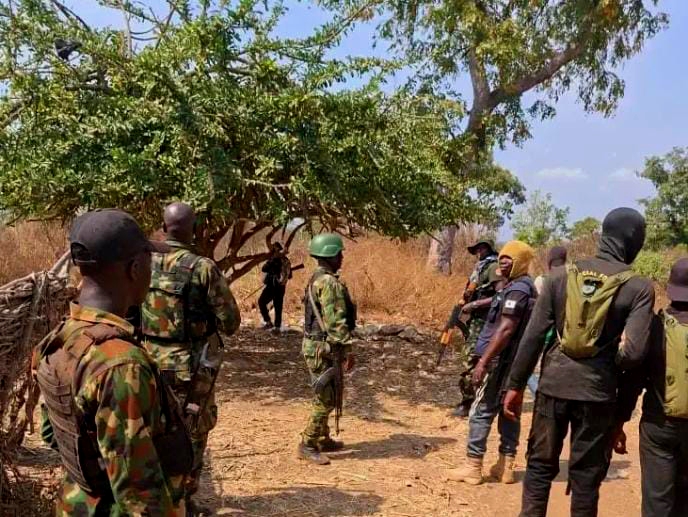
MAIDUGURI — Troops of Operation Hadin Kai (OPHK) have neutralized five Islamic State West Africa Province (ISWAP) fighters during a high-stakes encounter in Borno State. The offensive, executed on Friday, February 20, 2026, occurred near Sabsawa village as the military intensified its dry-season clearance operations. According to Lieutenant Colonel Sani Uba, the OPHK Media Information Officer, the troops utilized “overwhelming firepower” to dismantle the terrorist position. Consequently, the remaining insurgents fled into the dense forest, abandoning their equipment and logistical supplies. This victory underscores the military’s renewed commitment to reclaiming the North East’s troubled hinterlands from non-state actors.
In a related development, Sector 1 troops stationed at Ngurosoye successfully rescued three children during a routine perimeter patrol. The victims, Abba Abba (12), Fatima Abba (8), and Aisha Abba (6), had spent two months in captivity. Preliminary investigations suggest that the children were snatched along the Gubio axis before their relocation to Bula-Daloye. Furthermore, the military has officially handed the siblings over to the Nigeria Police for medical evaluation and family reunification. While it is true that many remain missing, this successful recovery offers a rare glimmer of hope. Indeed, the rescue demonstrates the strategic value of constant, aggressive patrolling in high-risk local government areas.
The “surrender strategy” of the Nigerian Armed Forces continues to yield significant results in neighboring Yobe State. An 18-year-old suspect, identified as Abubakar Abubakar, surrendered to troops in Geidam after deserting his insurgent unit. In a related development, the military is currently profiling the suspect to extract actionable intelligence on hidden IED factories. Granted, the “deradicalization” of young fighters remains a complex social challenge for the Federal Government. Significantly, however, every defection weakens the operational capacity of the ISWAP leadership within the Sambisa Forest fringes. Notably, the OPHK spokesperson confirmed that “hybrid forces,” including local hunters and vigilantes, supported these latest offensive maneuvers.
Significantly, the collaboration between the military and local hunters has denied terrorists the freedom of movement across multiple sectors. Above all, these operations seek to secure the farming corridors ahead of the upcoming planting season in Borno. Subsequently, the Theatre Command has directed all units to maintain an “aggressive posture” against any identified terrorist encampments. Although the insurgency has entered its second decade, the current tactical synergy appears to be yielding tangible territorial gains.
Finally, the focus remains on the total eradication of the “Gubio-Bama” abduction ring that continues to target vulnerable minors. Therefore, the military must ensure that the “freedom of action” denied to terrorists is permanently converted into civilian safety. As a result of these operations, the 2026 security outlook for the North East shows signs of incremental stabilization. Accordingly, the quest for a peaceful and prosperous Borno depends on the sustained proficiency of the frontline troops.