
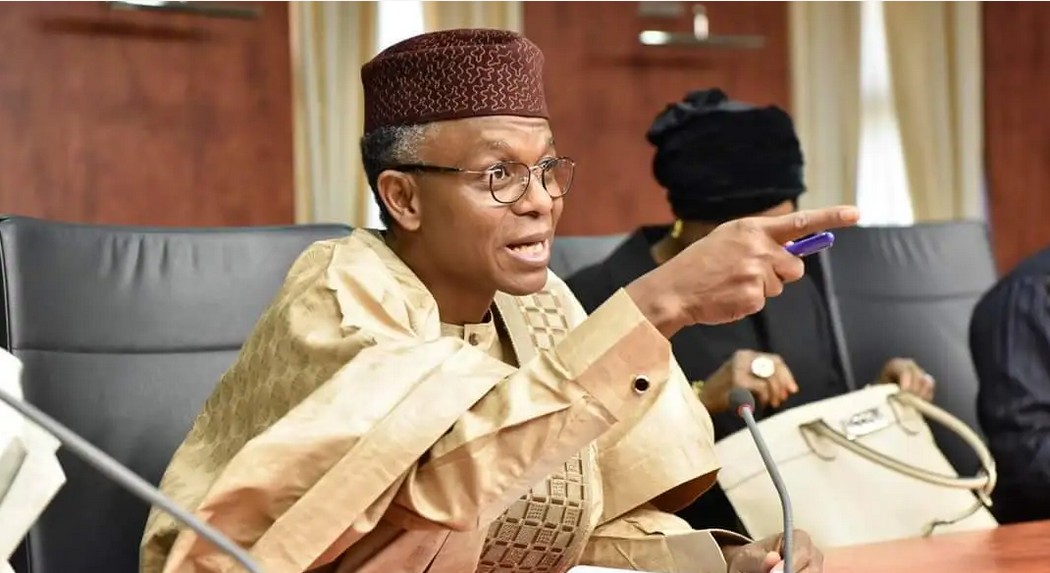
Mr. El-Rufai, a man whose career has been defined by a sharp tongue and an even sharper intellect, now finds himself ensnared by his own rhetoric. The DSS alleges that during a televised interview, he essentially confessed to tapping the phone of Nuhu Ribadu, the National Security Adviser. It is a charge that manages to be both grave and remarkably flimsy.
The crux of the state’s case rests on the Cybercrimes Act of 2024, a piece of legislation that is increasingly being used as a cudgel against dissent. By claiming knowledge of intercepted communications, the DSS argues Mr. El-Rufai is complicit in a breach of national security. Yet, the former governor’s legal team is correct to point out that a “casual remark” on Arise TV does not make a confession. In the Nigerian legal system, a confession must be voluntary, cautioned, and recorded under specific conditions. Live television is many things, but it is rarely a substitute for a police interrogation room.
There is a linguistic sloppiness to the prosecution’s charge sheet that betrays its haste. The use of the word “cohorts” to describe Mr. El-Rufai’s alleged accomplices is more suited to a tabloid headline than a federal indictment. Criminal law demands precision; the DSS has instead opted for a colloquialism. This lack of rigour suggests the agency is more interested in the optics of the arrest than the technicalities of the conviction. It is a familiar pattern in Abuja.
Furthermore, the DSS has failed to produce the “smoking gun” of digital surveillance: the equipment used for the interception. To charge a man with wiretapping without identifying the technology or the specific data seized is akin to charging a man with murder without a body or a weapon. In the absence of such evidence, the prosecution looks less like a pursuit of justice and more like a settling of scores. The rivalry between Mr. El-Rufai and the current security establishment is no secret.
Mr. El-Rufai’s demand for N2 billion in damages is, of course, theatrical. It is a calculated counter-punch designed to signal that he will not go quietly into the night of a detention cell. By framing the trial as a “political witch-hunt,” he is appealing to a public that is already deeply cynical about the independence of the judiciary. He knows that in Nigeria, the court of public opinion often moves faster than the Federal High Court.
The timing of these charges is also curious. Mr. El-Rufai was already being juggled between the EFCC and the ICPC over money laundering allegations. Adding a charge of phone-tapping feels like an attempt to find a lock that fits whatever key the state happens to be holding. If the corruption charges are slow to stick, perhaps a breach of national security will suffice. It is a scattergun approach to prosecution.
This case also highlights the precarious nature of the Cybercrimes Act. When legislation is written with broad, sweeping strokes, it becomes a tool for selective enforcement. If every “casual remark” regarding state secrets made by a politician were treated as a confession, the Nigerian prison system would be even more overcrowded than it already is. Consistency is not a hallmark of the current administration’s legal strategy.
Justice Joyce Abdulmalik now faces a decision that is as much about the rule of law as it is about the limits of state power. If the court allows a televised interview to stand as a primary confession, it sets a precedent that could chill public discourse. Politicians are often guilty of hubris and verbal indiscretion, but these are character flaws, not necessarily crimes. The state must prove the latter without relying solely on the former.
Ultimately, this saga is a reminder that in the upper echelons of Nigerian power, today’s kingmaker is frequently tomorrow’s defendant. Mr. El-Rufai, once an architect of the ruling party’s success, is learning the hard way that the system he helped build has a long memory and a short fuse. The law is being used here not as a shield for the state, but as a sword for its temporary occupants.