
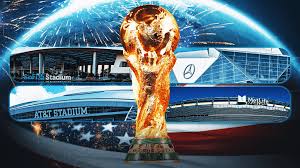
FIFA has officially confirmed the six-team line-up for the inter-confederation play-off tournament that will determine the final two spots at the 2026 FIFA World Cup, with DR Congo named as Africa’s representative and Nigeria’s last avenue to the tournament firmly closed.
The world football governing body issued an accreditation notice to journalists on Wednesday, outlining the tournament format and listing the confirmed participating nations. The document named Bolivia, Congo DR, Iraq, Jamaica, New Caledonia, and Suriname as the six qualifiers for the play-off competition, making no reference to any revision of the qualified teams or any pending appeal that could alter the list.
For Nigeria, the confirmation amounts to the definitive end of a qualification campaign that ultimately unravelled at its final hurdle, leaving the Super Eagles watching from outside as the continent’s last representative prepares for a shot at the tournament co-hosted by Canada, Mexico, and the United States.
The Nigeria Football Federation had entered a formal protest following the CAF inter-confederation play-off tie against DR Congo in November 2025. The decisive match ended 1-1 at full time, with Nigeria subsequently losing the tie on penalty kicks. The NFF challenged the outcome on the grounds that DR Congo had fielded ineligible players during the fixture, an allegation that, if proven, would ordinarily carry severe consequences under FIFA’s eligibility rules and could result in a match being awarded by default to the opposing side.
The appeal was a calculated attempt by Nigerian football authorities to overturn a result that had denied the Super Eagles a place in the play-off tournament and, by extension, at the World Cup proper. Had the protest succeeded, Nigeria would have taken DR Congo’s place among the six nations competing for the two remaining World Cup berths.
FIFA’s Wednesday communication, however, carried no indication that any such amendment was under consideration or had been granted. By publishing the confirmed list of six nations with DR Congo intact and without qualification or caveat, the governing body effectively signalled that the original result of the November tie stands. The absence of any official acknowledgment of the NFF’s appeal within the document, or of any provisional status attached to DR Congo’s inclusion, strongly suggests the protest did not succeed in altering the outcome.
In its accreditation communication, FIFA described the play-off tournament in the following terms: “The FIFA World Cup 2026 Play-Off Tournament will see six teams fight it out for the final two places at the FIFA World Cup 2026, to be staged in Canada, Mexico and the United States across 16 host cities.”
The governing body further stated, “All of the six teams have now been decided, with Bolivia, Congo DR, Iraq, Jamaica, New Caledonia and Suriname confirmed as qualifiers.”
The language was unambiguous. The use of the phrase “all of the six teams have now been decided” leaves no interpretive space for a seventh nation, nor does it suggest any team’s participation remains subject to ongoing adjudication.
The tournament is scheduled to begin on Thursday, March 26, with New Caledonia facing Jamaica in the opening fixture. Bolivia will then take on Suriname in the second opening-round match. The two winners from those contests will each advance to play a decisive second-round match on Tuesday, March 31.
DR Congo, as Africa’s representative, enters the competition at the second round. The Leopards will face whichever team emerges victorious from the New Caledonia versus Jamaica fixture, with the winner of that encounter claiming one of the two remaining spots at the 2026 World Cup.
The format is a compressed knockout structure with enormous stakes. A single match separates DR Congo from a World Cup berth, and the same is true for each of the remaining five participants.
Nigeria’s absence from the 2026 World Cup, if confirmed by the finality of FIFA’s communication, will represent a significant setback for the country’s football ambitions. The Super Eagles have historically been among Africa’s most recognisable World Cup participants, having qualified for the tournament in 1994, 1998, 2002, 2010, 2014, 2018, and 2022. Missing consecutive World Cups, or even a single edition, carries meaningful implications for the federation’s revenue, the players’ profiles, and the broader standing of Nigerian football on the continental and global stage.
The November play-off defeat to DR Congo was particularly painful in its manner. A 1-1 draw had kept the tie finely balanced before the penalty shootout handed the Congolese the advantage. Penalty shootouts, by their nature, offer no straightforward attribution of fault and no clean narrative of dominance. Nigeria was not outplayed over 90 minutes; the tie was decided in moments of individual nerve and fortune.
The NFF’s subsequent decision to challenge the result through an eligibility protest reflected the federation’s determination to exhaust every available avenue. Challenging an opponent’s player eligibility is a recognised legal route within FIFA’s regulatory framework, and it has produced successful outcomes in other competitions in the past. The rules around player eligibility for national teams, particularly relating to nationality requirements, the eligibility windows for players who have previously represented one nation and wish to switch to another, and documentation requirements, are areas where disputes do occasionally arise.
However, the burden of proof in such cases is substantial, and the timeline for resolving them is often constrained by tournament schedules. FIFA’s apparent finality on the matter, as reflected in the Wednesday accreditation notice, suggests either that the evidence presented by the NFF did not meet the threshold required, that the appeals process has run its course without a finding in Nigeria’s favour, or that the governing body has not yet formally communicated a decision but has already proceeded with tournament logistics on the assumption that the original result stands.
For DR Congo, the inter-confederation play-off represents a significant moment. The Leopards qualified from Africa through the CAF play-off route, which involved the November tie against Nigeria. Reaching the World Cup itself would mark a notable achievement for Congolese football. The country has appeared at the FIFA World Cup only once, in 1974, when it participated as Zaire, becoming the first sub-Saharan African nation to qualify for the tournament’s final stage. A return to the global stage more than five decades later would carry deep symbolic weight for the country and its football community.
The team faces a two-match journey to secure that return. The identity of their opponent on March 31 will only be known after the conclusion of the New Caledonia versus Jamaica match on March 26. New Caledonia, an island territory in the South Pacific under French sovereignty, qualifies through the OFC, the Oceania Football Confederation. Jamaica represents the CONCACAF zone, while Bolivia and Suriname bring South American and Caribbean representation respectively. Iraq qualifies through the Asian Football Confederation.
The 2026 FIFA World Cup will be the first edition to feature 48 nations in the final tournament, expanded from the 32-team format that has been in place since 1998. The expansion increases the number of available berths for all confederations, with Africa’s allocation rising from five to nine guaranteed spots. The additional two places on offer through the inter-confederation play-offs are shared among the confederations that did not secure their full complement of spots through direct qualifying routes.
The expanded tournament will be spread across 16 host cities in the United States, Canada, and Mexico, making it the largest World Cup in the competition’s history by both participating nations and host locations. The final is scheduled to be held at MetLife Stadium in New Jersey, New York.