
Nigeria’s economy does not move in straight lines. It accelerates, stalls, pivots, and surprises. For institutional investors, portfolio managers, and FDI strategists operating in or around Africa’s largest economy, that unpredictability is not just a nuisance. It is a material risk. The question heading into 2026 is no longer whether Nigeria faces structural headwinds. It does. With the US-Israel-Iran war going on in the Middle East, the oil-dependent economy is highly volatile. The real question is which risks are priced in, which ones are not, and where the asymmetric opportunities sit for investors who can read the data before the consensus catches up.
What if there’s a way to study and monitor these economic indicators? MetricsHour’s Geopolitical Risk Index was built precisely for this moment.
Why 2026 Is the Critical Window
Nigeria enters 2026 carrying the weight of compounding fiscal decisions made between 2023 and 2025. The removal of fuel subsidies, naira unification, and a series of monetary tightening cycles reshaped the macro baseline. But policy shifts of that magnitude do not resolve cleanly within a single fiscal year. Their consequences stack, interact, and express themselves across a multi-year horizon. Three macro variables will define Nigeria’s risk profile through 2026: debt trajectory, currency behavior, and regional stability differentials. Analysts who track only one of these in isolation will consistently misread the full picture.
Debt-to-GDP: The Trajectory That Matters More Than the Ratio
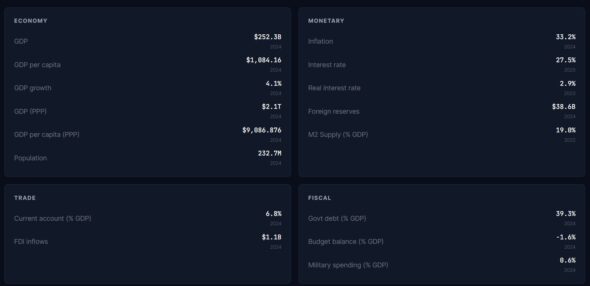
Nigeria’s headline debt-to-GDP ratio has historically appeared manageable compared to global peers. That framing misleads. The more revealing metric is the debt service-to-revenue ratio, which has climbed sharply as interest obligations consume a rising share of federation account receipts.
MetricsHour’s macro intelligence framework models forward debt trajectories under multiple fiscal scenarios. In a baseline projection, Nigeria’s debt-to-GDP continues on an upward path through 2026, driven by ongoing deficit financing, infrastructure bond issuances, and concessional borrowing from multilateral lenders. In stress scenarios, the trajectory steepens if oil revenue underperforms and the naira depreciates further against the dollar.
For institutional investors with Nigerian sovereign exposure, the distinction between baseline and stress-test outcomes is not academic. It determines duration positioning, credit spread expectations, and the viability of yield-seeking strategies in Nigeria’s domestic bond market.
The platform’s high-resolution data visualizations allow users to toggle between these stress-test scenarios in real time. MetricsHour is a modern Bloomberg alternative for emerging markets. An investor can shift from a moderate oil price assumption to a bearish one and immediately observe how debt service ratios respond, how fiscal headroom contracts, and where the sovereign credit inflection points emerge. That kind of interactive scenario modeling is where predictive intelligence separates itself from static reports.
Currency Volatility Clusters: Reading the Naira’s Signal
The naira’s post-unification trajectory has been volatile. That is not surprising. What matters for 2026 planning is understanding the structure of that volatility, specifically, whether it is converging toward a new equilibrium or cycling through recurring stress clusters.
MetricsHour’s currency volatility analysis identifies clustering patterns in exchange rate behaviour. These clusters, periods where volatility compresses or spikes in measurable cycles, carry forward-looking information. They reveal the moments when speculative pressure builds, when CBN intervention becomes probable, and when carry trade positions become exposed.
For equity traders and portfolio managers with naira-denominated assets, this intelligence is actionable. Knowing that a currency volatility cluster is forming two or three months ahead of its peak allows for hedging adjustments, repatriation timing decisions, and asset allocation shifts that protect downside without fully exiting Nigerian market exposure.
FDI strategists evaluating manufacturing, agriculture, or infrastructure plays also use currency trajectory data to model real return scenarios. A project that generates strong naira-denominated cash flows looks very different at 1,500 to the dollar versus 1,900. MetricsHour’s 2026 projections account for both paths.
Regional Stability Scores: The Risk Is Not Uniform
One of the most persistent errors in Nigerian macro analysis is treating the country as a single risk environment. It is not. The security, governance, and economic conditions in Lagos differ fundamentally from those in Kaduna, Borno, or the Niger Delta. MetricsHour’s regional stability scores disaggregate national risk into state-level and geopolitical zone-level assessments. These scores incorporate security incident frequency, infrastructure investment flows, local government fiscal health, agricultural output disruption, and community tension indicators.
For 2026, the platform’s analysis points to divergence widening between Nigeria’s southwestern commercial corridor and several northern and southeastern zones where instability has suppressed productive activity. This divergence has direct implications for sector-specific investment. Consumer-facing businesses, logistics networks, and agribusiness operations face structurally different risk profiles depending on their geographic footprint within Nigeria.
Risk management consultants advising multinational clients on Nigerian market entry need this granularity. A stability score for Nigeria as a whole tells you very little. A stability score for the specific states where a client’s operations, supply chains, or distribution networks are concentrated tells you something you can act on.
How MetricsHour Builds the Framework
The Geopolitical Risk Index at the core of this analysis draws on structured data feeds covering macroeconomic indicators, political event monitoring, commodity price inputs, exchange rate behavior, and security datasets. These inputs are processed through a quantitative model that weights variables by their historical correlation to economic disruption outcomes.
What makes the framework predictive rather than descriptive is its forward projection architecture. MetricsHour does not just show you what has happened. It models what is likely to happen under defined conditions, and lets users stress-test those conditions interactively.
The platform’s visual interface presents these projections through high-resolution maps, time-series charts, and scenario comparison dashboards. A policy analyst can overlay Nigeria’s debt trajectory onto its regional stability heat map and examine how fiscal pressure in Abuja correlates with governance deterioration at the state level. A portfolio manager can pull currency volatility cluster data alongside equity sector performance to identify which industries historically outperform during naira stress periods.
This is macro intelligence designed for decision-making, not background reading.
The Strategic Case for Positioning Now
The investors and analysts who move early on accurate macro intelligence consistently outperform those who wait for consensus. By the time Nigeria’s 2026 risk picture becomes obvious to the broader market, the best positioning opportunities will have passed.
MetricsHour exists to close that information gap. The Nigeria Economic Risk Map is not a prediction of doom or a case for optimism. It is a structured, data-driven framework that maps where the risks concentrate, where they are overstated, and where informed capital can move with confidence.
For institutional investors, FDI strategists, high-net-worth individuals, and financial advisors navigating Nigeria’s macro landscape, that framework is not optional. It is the foundation of credible decision-making heading into 2026.
Explore the Nigeria Economic Risk Map on MetricsHour and run your own stress-test scenarios today.