

US Flag Flies at Venezuelan Embassy After Seven Years
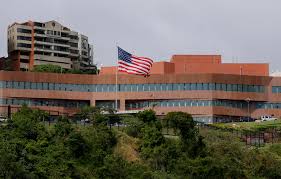
The United States flag flew above the American embassy in Caracas on Saturday for the first time in seven years, marking the restoration of diplomatic relations following the capture of former Venezuelan President Nicolas Maduro and a dramatic shift in bilateral ties between Washington and Caracas.
Laura Dogu, the US Charge d’Affaires and the embassy’s most senior diplomat, announced the flag-raising ceremony through a post on X, stating that the ceremony occurred “exactly seven years after it was removed” on March 14, 2019.
“A new era has begun. We’re staying with Venezuela,” Dogu wrote, accompanying her message with a photograph of the Stars and Stripes being hoisted outside the diplomatic compound.
The flag had been lowered in March 2019, two months after Venezuela severed diplomatic ties with the United States over Washington’s refusal to recognize Maduro’s disputed re-election in 2018. That election, widely condemned by international observers and regional governments, was characterized by allegations of voter manipulation, opposition exclusion, and irregularities that undermined its legitimacy.
The restoration of diplomatic relations follows a January special forces raid conducted by US military personnel that resulted in approximately 100 deaths and led to the capture of Maduro and his wife, who were subsequently flown to New York to face drug trafficking charges in US federal court.
The Trump administration has asserted that it now effectively controls Venezuela and its vast natural resources following the removal of Maduro, who had governed the South American nation since 2013 after the death of his predecessor Hugo Chavez. Venezuela possesses the world’s largest proven oil reserves, estimated at over 300 billion barrels according to data from the Organization of the Petroleum Exporting Countries, making it a strategic energy asset despite years of economic collapse and infrastructure deterioration under Maduro’s governance.
Since Maduro’s capture, Venezuela has been led by Delcy Rodriguez, who previously served as Maduro’s vice president. Rodriguez has assumed interim leadership as the country navigates a political transition backed by the United States.
President Donald Trump’s administration and Rodriguez have signed multiple energy and mining agreements designed to open Venezuela’s resource sector to private investment and grant the United States access to the country’s oil reserves. These agreements represent a significant departure from the economic isolation that characterized US-Venezuela relations during Maduro’s tenure.
On Friday, Rodriguez publicly urged Trump to completely lift the economic sanctions that the United States had imposed on Venezuela over the past seven years. Those sanctions, implemented in stages beginning in 2017, targeted Venezuela’s oil sector, financial institutions, and key government officials in response to human rights abuses, democratic backsliding, and allegations of narcotics trafficking involving senior regime figures.
Since January, the United States has begun easing the oil embargo that had severely restricted Venezuela’s ability to export crude and access international financial markets. Washington has issued operating licenses to a handful of multinational energy corporations, allowing them to resume operations in Venezuela under specific conditions and oversight frameworks designed to ensure compliance with US regulations.
The sanctions regime had contributed to Venezuela’s economic collapse, which saw the country’s gross domestic product shrink by more than 75 percent between 2013 and 2021 according to estimates from international financial institutions. Hyperinflation, widespread poverty, the breakdown of public services, and a humanitarian crisis that drove more than seven million Venezuelans to flee the country marked the Maduro years as among the most catastrophic periods in Latin American economic history.
The January raid that resulted in Maduro’s capture represented a significant escalation in US intervention in Latin America, departing from the diplomatic and economic pressure strategies that Washington had previously employed. Details surrounding the operation remain limited, but sources close to the US government have indicated that it involved coordination with Venezuelan opposition figures and military defectors who had grown disillusioned with Maduro’s authoritarian rule.
Maduro faces charges in the United States related to narco-terrorism, drug trafficking, and conspiracy to import cocaine into American territory. US prosecutors have accused Maduro and members of his inner circle of collaborating with Colombian guerrilla groups and Mexican cartels to facilitate the movement of narcotics through Venezuelan territory and into international markets. Maduro has consistently denied these allegations, characterizing them as fabrications designed to justify US interference in Venezuela’s internal affairs.
The restoration of diplomatic ties and the reopening of the US embassy signal a new chapter in relations between the two countries, which had been marked by mutual hostility, economic warfare, and political confrontation throughout Maduro’s presidency. Venezuela had expelled US diplomats in 2019, and the Trump administration had recognized opposition leader Juan Guaido as the country’s legitimate president, a position supported by dozens of countries but ultimately unsuccessful in dislodging Maduro from power.
The US embassy in Caracas had operated with minimal staff under the protection of third countries following the 2019 break in relations. The full restoration of diplomatic operations is expected to facilitate the normalization of consular services, visa processing, and official communication between the two governments.
Venezuela’s political future remains uncertain as the country transitions from decades of socialist governance under Chavez and Maduro toward a US-backed interim administration. The economic agreements signed between Washington and Rodriguez are expected to attract foreign investment into Venezuela’s oil sector, which has suffered from chronic underinvestment, corruption, and the exodus of technical expertise during the crisis years.
However, questions remain regarding the legitimacy of the current transitional government, the timeline for elections, and the extent to which ordinary Venezuelans will benefit from the new economic arrangements. Human rights organizations and international observers have called for transparency, accountability, and inclusive political processes to ensure that Venezuela’s transition does not replicate past patterns of authoritarianism and resource mismanagement.
The flag-raising ceremony on Saturday serves as a powerful symbol of the dramatic reversal in US-Venezuela relations, but the path toward political stability, economic recovery, and democratic governance remains fraught with challenges that will require sustained international engagement and domestic reconciliation.