
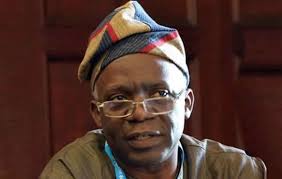
Human rights lawyer Femi Falana has criticised what he described as the financial barriers embedded in Nigeria’s electoral system, saying the high cost of contesting political office is shutting out ordinary citizens from meaningful participation.
Speaking during a public discussion on electoral reforms that gained traction on Thursday, Falana said national conversations around elections should not be limited to the electronic transmission of results, but should also address the deeper structural and financial obstacles facing aspirants.
“All the young people are talking about, many people, is about electronic transmission of results from the polling unit to the, you know, non-localisation centre to the central server of INEC. It’s gone beyond that,” he said.
Falana argued that the legal and political framework surrounding elections now favours only the wealthy and those backed by powerful networks.
“If you look at that law, it’s saying if you want to contest for the Presidency of Nigeria, you must have 10 billion naira or I think 5 billion naira. That already excludes professors, workers, lawyers and the majority of Nigerians who are not billionaires,” he said.
Under Nigeria’s Electoral Act 2022, the maximum election expenses allowed for a presidential candidate is ₦5 billion, while donations to a candidate are capped at ₦50 million from any individual or entity. Although the law does not state that an aspirant must personally possess ₦5 billion, critics have long argued that the spending threshold reflects an electoral system tilted in favour of the rich.
Falana also said many Nigerian laws are drafted and sustained in ways that reflect elite political interests rather than broad public inclusion.
“So the law is not neutral. It’s made by people in the National Assembly, who though are representing us, but who at the end of the day are representing the bourgeoisie,” he said.
He added, “So, when you say rule of law, you say whose law? Whose rule? So, hence we go to court to defend just law.”
The senior lawyer said laws considered unjust should be challenged both in court and in the public sphere, insisting that legal action alone is not enough without a wider social demand for fairness and justice.
“So, I didn’t start defending the rule of law as a lawyer… I went to court, not for judgement, not just to ask for judgement in my cases. I want justice,” he said.
Falana’s remarks echo concerns he has raised in previous election cycles over the commercialisation of political ambition in Nigeria. During the 2022 primary season, the ruling All Progressives Congress fixed its presidential expression of interest and nomination forms at ₦100 million, while the Peoples Democratic Party pegged its own at ₦40 million, both of which drew criticism from civil society groups, lawyers and pro-democracy advocates.
Although the Independent National Electoral Commission has not publicly responded to Falana’s latest comments, the commission has consistently maintained that it operates within the framework provided by the Constitution and the Electoral Act.
With early conversations around the 2027 elections gradually taking shape, Falana’s intervention is likely to revive debate over whether Nigeria’s democratic system is expanding access or simply becoming more expensive for those outside elite political circles.