
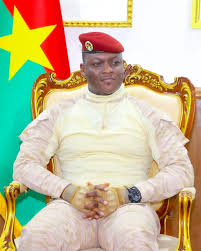
Captain Ibrahim Traore, the military ruler of Burkina Faso, has told his citizens to abandon any expectation of democratic governance, delivering the most explicit rejection yet of civilian rule since he seized power nearly four years ago.
Speaking during a lengthy interview broadcast on RTB, the state television network, on Thursday, Traore made no attempt to soften his position. “We’re not even talking about elections, first of all,” he said. “People need to forget about the issue of democracy. Democracy isn’t for us.”
The 38-year-old captain, who came to power through a September 2022 coup after overthrowing a previous junta, went further by describing democracy itself as a lethal instrument. “Wherever they try to establish democracy in the world, it’s always accompanied by bloodshed,” he said, citing Libya as a cautionary example. He offered no detailed alternative system but said, “We have our own approach. We’re not even trying to copy anyone else. We’re here to completely change the way things are done.”
The remarks represent the formal burial of a democratic transition timeline that Burkina Faso had, at least nominally, committed to. Traore initially pledged to restore democratic rule by July 2024, but two months before that deadline, the junta announced it would extend its rule for another five years. That extension effectively places Traore at the head of government without electoral mandate until at least 2029.
The dismantling of democratic structures has proceeded in stages. The Independent National Electoral Commission was dissolved in July 2025, after the government described the agency as too expensive. Then, in January 2026, Traore’s government scrapped more than 100 political parties and seized their assets, with parliament and all political activity having previously been suspended after Traore took power. The United Nations has urged Burkina Faso to reverse the ban on political parties and halt what it describes as the repression of civic space.
The security situation underpinning Traore’s grip on power remains dire. Fatalities tripled in the three years since Traore came to power, reaching 17,775 by last May, compared with 6,630 recorded deaths in the three years prior, according to analysis by the US-based Africa Center for Strategic Studies. Additionally, a report by Human Rights Watch published Thursday said more than 1,800 civilians have been killed in Burkina Faso since Traore seized power.
Traore has suppressed dissent throughout his rule, cracking down on the opposition, media, and civil society groups, with his government even accused of punishing critics by sending them to the front lines of the war against Islamist militants.
Despite the repression, Traore has attracted a substantial following across the continent for his pan-Africanist vision and criticism of Western influence. Burkina Faso, alongside its junta-led neighbours Mali and Niger, has moved away from Western partnerships, particularly with France, turning instead to Russia for military assistance, though the jihadist violence has continued unabated across the Sahel region.