
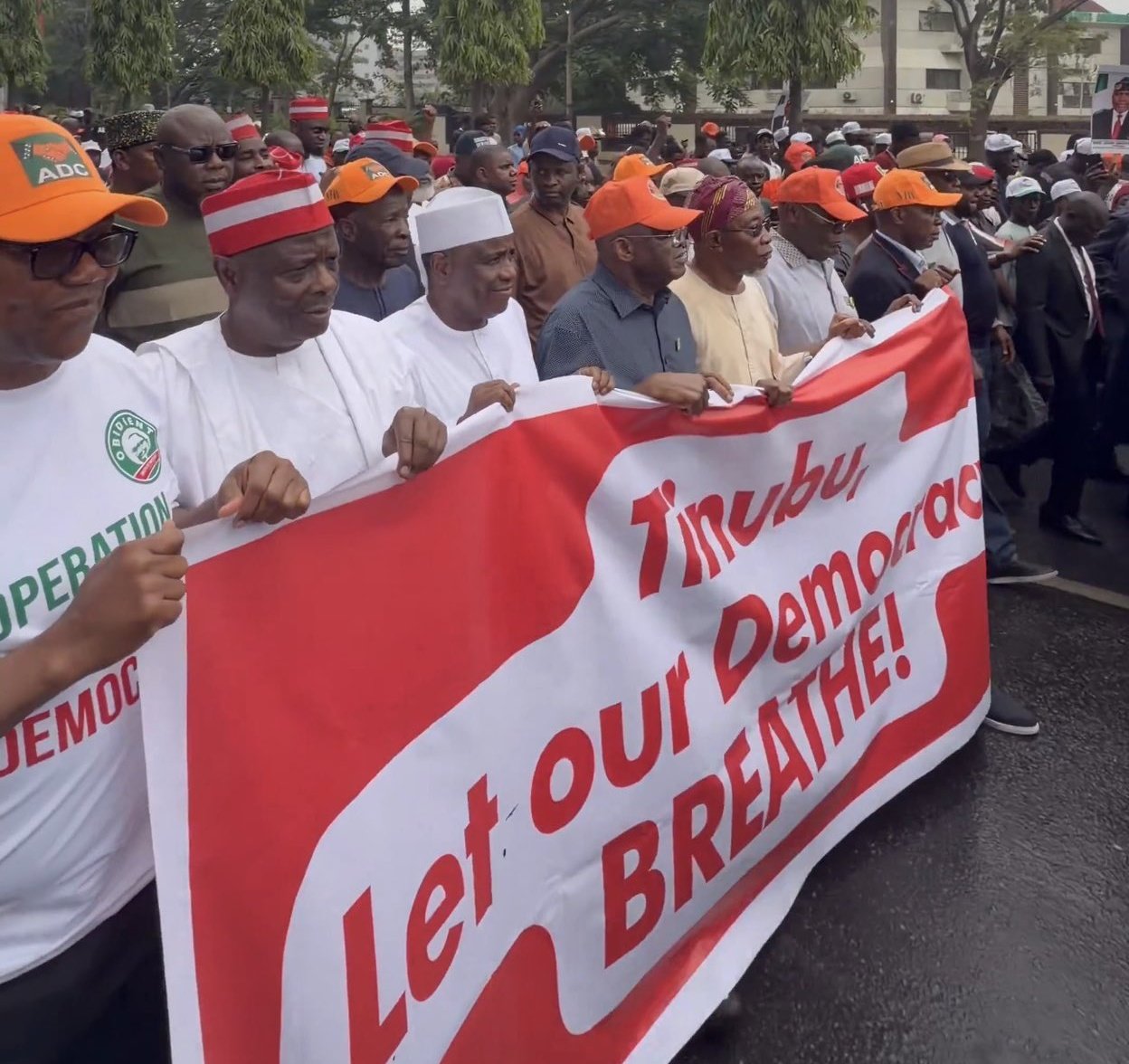
A formidable coalition of Nigeria’s opposition leaders took to the streets of Abuja on Wednesday, March 8, 2026, to protest what they describe as the “capture” of the electoral umpire by the ruling party. Under the banner of the African Democratic Congress (ADC), former Vice President Atiku Abubakar and Peter Obi led a high-powered march that included former Rivers Governor Rotimi Amaechi, Rabiu Kwankwaso of Kano, and former Senate President David Mark. The “Save Nigeria Democracy” protest, which began at the Maitama Roundabout and moved toward the Independent National Electoral Commission (INEC) headquarters, marks the most significant show of opposition unity since the 2023 general elections.
The protesters accused INEC of functioning as an extension of the All Progressives Congress (APC), alleging that the commission is being systematically weakened to facilitate a one-party state. Peter Obi, speaking to supporters through a megaphone, declared that the coalition would not stand by while the “unity, peace, and security” of the country are compromised by partisan electoral management. Placards reading “Hands off our courts” and “Tinubu, let our democracy breathe” punctuated the long line of demonstrators. The march effectively shuts down major arteries of the capital, serving as a loud rejection of the current political trajectory.
Atiku Abubakar, who recently reaffirmed his commitment to the ADC as the primary vehicle for the 2027 polls, used the occasion to warn against an “enthronement of a dictatorship.” The former Vice President’s presence alongside Rotimi Amaechi and Rauf Aregbesola, both former APC stalwarts, highlights a major realignment in Nigerian politics. These leaders, once bitter rivals, have found common ground in their shared grievances against the central government’s influence over state institutions and the judiciary.
The timing of the protest is significant, coinciding with escalating internal crises within the ADC itself. Critics of the movement suggest that this public display of unity is a tactical attempt to drown out the party’s leadership disputes and legal battles. However, for the thousands of supporters trailing the motorcade, the focus remained squarely on INEC. Addressing the crowd from a van, Rotimi Amaechi urged Nigerians to remain vigilant, claiming that the independence of the ballot is the only remaining safeguard against total state capture.
INEC has yet to issue a formal response to the specific allegations of partisanship raised by the coalition. The commission has previously insisted that its operations remain independent and transparent, despite the frequent criticisms from opposition figures. Nevertheless, the sight of traditional political foes like Kwankwaso and David Mark marching under a single banner provides a visual confirmation of the “Save Democracy” movement’s growing reach. The protest suggests that the 2027 campaign cycle has begun in earnest, with the opposition choosing the streets as its first battlefield.
As the protesters reached the vicinity of the INEC headquarters, the atmosphere remained tense but peaceful. The coalition leaders have vowed that this is merely the first in a series of nationwide actions designed to force electoral reforms. Whether this diverse group of heavyweights can maintain their fragile alliance until the next general election remains the central question of Nigerian politics. For today, however, the streets of Abuja belonged to a unified opposition demanding a “breathing space” for the nation’s democratic process.