
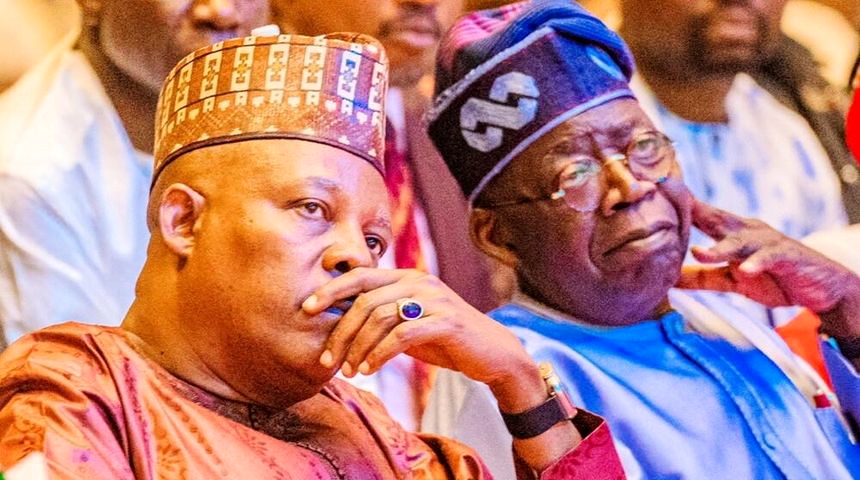
President Bola Tinubu has formally retained Vice President Kashim Shettima as his running mate for the 2027 presidential election. The decision effectively kills months of heavy intra-party scheming and intense speculation regarding the structure of the ruling party’s next ticket. The All Progressives Congress confirmed the continuation of the pairing after the vice president submitted Tinubu’s formal expression of interest and nomination forms at the party headquarters in Abuja. The presidency is prioritising political continuity over a highly disruptive regional cabinet reshuffle.
The decision to stick with the incumbent vice president bypasses a delicate geopolitical problem. Removing Shettima would have severely fractured the ruling party’s core support base across the Northeast, an area vital to balancing the country’s complex electoral maths. For months, rival political factions had quietly lobbied the villa to swap out the former Borno State governor for alternative northern candidates. By maintaining the status quo, Tinubu is signaling that internal party stability outweighs the tactical temptation to re-engineer his inner circle.
The political confirmation comes as the administration intensifies the defense of its economic policies. Shettima used the submission ceremony to rally party stakeholders, insisting that Tinubu’s difficult macroeconomic decisions are actively stabilizing the nation’s fragile finances. The vice president argued that the controversial deregulation of the currency and energy markets has set the country on a path toward sustainable recovery. The ruling party intends to run its entire re-election campaign on the rigid logic of these structural adjustments.
The opposition has already launched sharp preemptive strikes against the renewed incumbency ticket. Rival coalitions argue that the administration’s economic performance has dramatically worsened domestic poverty metrics over the last three years. Opposition leaders have repeatedly seized on double-digit inflation and a volatile national currency to declare the “Renewed Hope” agenda a failure. The confirmation of the Tinubu-Shettima ticket gives the opposition a fixed, familiar target for their economic critiques heading into the primary season.
Maintaining the Muslim-Muslim ticket configuration will likely reignite familiar secular debates across the southern region. During the previous electoral cycle, the pairing faced severe institutional pushback from religious bodies and civil society groups concerned with fair representation. However, the party leadership believes that the incumbent advantages of federal power will successfully override these historical grievances. Abuja is betting that concentrated executive execution can completely decouple voter choice from raw identity politics.
The ruling party must now navigate the formal processes of its upcoming presidential primaries. While the endorsement from the national working committee effectively secures the ticket’s internal nomination, regional congresses must still ratify the choice. The administrative focus shifts to managing the fallout among ambitious party chieftains who have been sidelined by this early consensus. With its leadership structure finalized, the administration must now prove to an exhausted electorate that its painful economic reforms can deliver real relief before the ballots open.