

Chelle Names Uzoho Super Eagles No.1, Drops Clubless Nwabali
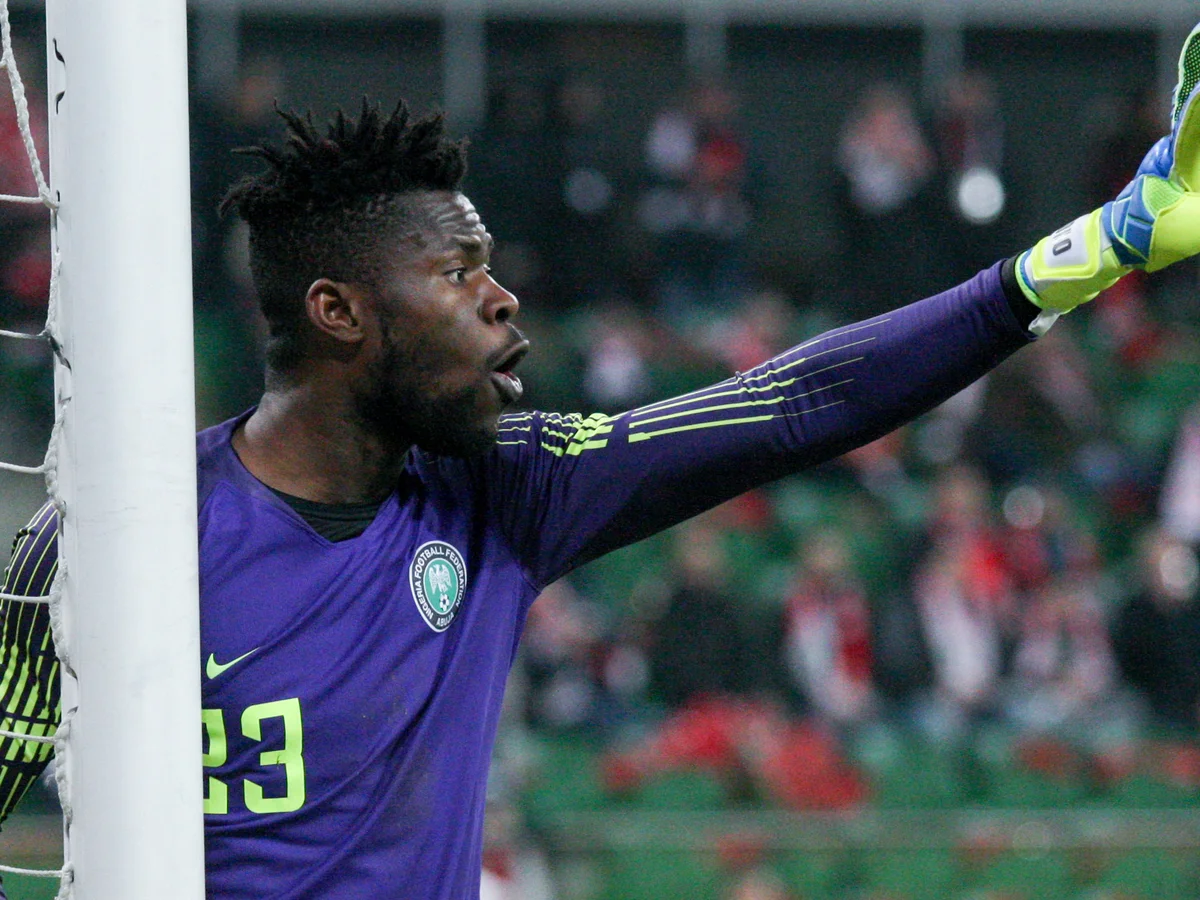
The Super Eagles head coach has made a decisive call on his goalkeeping department, favouring experience and availability as the team prepares for crucial competitive fixtures later this month.
New Super Eagles head coach Eric Chelle has designated Francis Uzoho as Nigeria’s first-choice goalkeeper following the current inactivity of Stanley Nwabali, who remains without a club after terminating his contract with South African side Chippa United.
The decision, confirmed by team insiders familiar with the coach’s thinking, positions the 26-year-old Uzoho as the man between the sticks when Nigeria returns to action later this month for international engagements. Chelle, who officially assumed duties as head coach of the senior national team in early 2025, has moved quickly to establish clarity in a position that has witnessed significant flux since the departure of long-standing first-choice Maduka Okoye from the national team setup.
Nwabali’s situation has been the primary catalyst for the change. The 28-year-old shot-stopper, who emerged as Nigeria’s hero during the 2023 Africa Cup of Nations in Côte d’Ivoire where the Super Eagles secured a bronze medal finish, terminated his contract with Chippa United under circumstances that remain unclear. Since leaving the South African club, he has been unable to secure a new employer, leaving him without competitive match action for an extended period.
For Chelle, the prospect of heading into critical World Cup qualifying matches with a goalkeeper lacking regular first-team football presented an unacceptable risk. Nigeria currently languishes in fifth place in Group C of the African qualifiers for the 2026 FIFA World Cup, having managed only three points from their opening four matches. The Super Eagles have drawn three and lost one of those fixtures, leaving them with a mountain to climb if they are to secure automatic qualification for the global showpiece.
Uzoho, who serves as second-choice goalkeeper at his Cypriot club, brings considerable international experience to the role. The former Deportivo La Coruña shot-stopper has been a fixture in the Super Eagles setup since 2017, accumulating 34 senior international caps. He was the second-choice goalkeeper behind Nwabali during the 2023 AFCON campaign, where Nigeria finished third after defeating South Africa in the bronze medal match.
His journey to the national team has not been without challenges. Uzoho endured significant criticism following high-profile errors during the 2026 World Cup qualifying campaign, particularly in matches against Lesotho and Zimbabwe where his mistakes proved costly. However, Chelle’s assessment appears to prioritise current availability and match readiness over past performance, with Uzoho at least featuring regularly for his club side Omonia Nicosia, unlike the clubless Nwabali.
The goalkeeping equation would have looked significantly different had circumstances surrounding Maduka Okoye unfolded otherwise. The Udinese goalkeeper, who currently plies his trade in Italy’s Serie A, would have been the automatic choice for the number one jersey based on his club pedigree and performances. Okoye has established himself as a regular starter for Udinese, featuring prominently in one of Europe’s top five leagues.
However, sources within the Nigeria Football Federation indicate that Chelle took strong exception to Okoye’s conduct during the lead-up to the 2023 Africa Cup of Nations. The 25-year-old goalkeeper was invited for the tournament but reportedly made his participation conditional on being guaranteed the first-choice position. When informed that he would not be automatically preferred ahead of Nwabali, who had excelled in qualifying matches, Okoye declined the invitation entirely.
For Chelle, who has built a reputation for demanding respect for the national team and its technical decisions, this act of insubordination remains a significant stumbling block. The Franco-Malian coach is understood to view the episode as a direct challenge to his authority and the principle that no player should be bigger than the team. Consequently, despite Okoye’s undoubted quality and current form, the goalkeeper finds himself outside Chelle’s plans for the immediate future.
The situation echoes similar tensions that have periodically arisen in Nigerian football, where players have occasionally sought to negotiate terms of participation. Chelle’s firm stance signals a determination to establish clear hierarchies and expectations within the squad, prioritising collective discipline over individual talent.
Adding another dimension to the goalkeeping conversation is Arthur Okonkwo, the Wrexham goalkeeper who has recently completed his switch of nationality from England to Nigeria. The 23-year-old, who came through the Arsenal academy system, has enjoyed a productive spell in English football, helping Wrexham secure promotion before establishing himself in League One.
Okonkwo’s decision to represent Nigeria at senior level represents a significant coup for the Nigeria Football Federation, which has actively pursued players of Nigerian descent plying their trade in Europe. The goalkeeper qualifies through his Nigerian parentage and formally submitted his request to switch allegiance from England, for whom he represented at youth levels, to Nigeria earlier this year.
However, his availability for competitive fixtures remains constrained by FIFA regulations. While Okonkwo can feature in friendly internationals immediately, he must await formal approval of his one-time switch application from FIFA before he can participate in competitive matches such as Africa Cup of Nations qualifiers or World Cup qualifying fixtures. The approval process typically takes several weeks and requires certification from all relevant football associations that the player has not represented his previous country in a competitive senior fixture.
For Nigeria’s upcoming matches, which carry significant competitive weight given the precarious World Cup qualifying situation, Okonkwo will therefore be ineligible unless FIFA processes his application with extraordinary speed. The more realistic scenario places him in contention for subsequent international windows, potentially positioning him as a long-term challenger to Uzoho once his eligibility is confirmed.
Nigeria’s goalkeeping department has attracted intense scrutiny over the past decade, with the national team struggling to find a consistently reliable occupant for the position since the retirement of Vincent Enyeama. The former Lille goalkeeper, who earned 101 caps for Nigeria and captained the side, set a standard that subsequent custodians have found difficult to match.
Enyeama’s successors have included Ikechukwu Ezenwa, Daniel Akpeyi, and the late Carl Ikeme, who was forced into early retirement following a leukaemia diagnosis. Each has had moments of competence interspersed with high-profile errors, contributing to a perception of vulnerability that has undermined Nigeria’s defensive solidity in major tournaments.
Nwabali’s emergence during the 2023 AFCON offered hope of a permanent solution. The former Chippa United goalkeeper delivered a series of assured performances, including a penalty shootout heroics against South Africa in the semi-finals that endeared him to Nigerian supporters. His calm demeanour and shot-stopping ability appeared to have solved the long-standing problem.
His current contractual predicament has therefore disrupted what many viewed as a settled position. Without a club, Nwabali cannot maintain match sharpness, and his prolonged absence from competitive action raises legitimate questions about his readiness for international football. Chelle’s decision, while potentially temporary should Nwabali secure a new club and regain form, reflects the practical realities of squad selection at the highest level.
The Super Eagles’ immediate focus rests on reviving their World Cup qualifying campaign. Drawn in Group C alongside South Africa, Benin Republic, Zimbabwe, Rwanda, and Lesotho, Nigeria’s start has been nothing short of disastrous. The team has drawn with Lesotho, Zimbabwe, and South Africa while losing to Benin Republic, leaving them with just three points from a possible twelve.
The group standings place Nigeria fifth, with only the group winners securing automatic qualification for the 2026 World Cup. Rwanda currently leads the group with seven points, followed by South Africa and Benin Republic on seven and six points respectively. Nigeria’s margin for error has effectively evaporated, with each remaining fixture carrying the weight of a final.
Chelle, appointed following the departure of Finidi George after a brief and turbulent tenure, faces the immediate challenge of restoring confidence and cohesion to a squad brimming with individual talent but lacking collective effectiveness. His decision on the goalkeeping position represents just one of several critical calls required as he assembles his squad for the upcoming international window.
Uzoho now carries the burden of leading from the back in these high-stakes encounters. His experience, including appearances at the 2018 World Cup in Russia and multiple Africa Cup of Nations tournaments, provides a foundation. However, his propensity for occasional lapses will remain a concern until he demonstrates sustained reliability at international level.
The broader goalkeeping picture suggests that competition for the position will intensify. Should Okoye resolve his differences with the coaching staff, his club pedigree at Udinese makes him a compelling candidate. Okonkwo’s emergence adds another dimension, offering youth and physical presence. Nwabali’s situation remains fluid, with the possibility of a new club potentially reviving his claims.