


Coupling Failure Forces Abuja-Kaduna Train Collision Near Asham
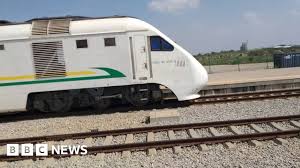
Several passengers sustained injuries on Monday morning after a rear locomotive detached from an Abuja-Kaduna train and collided with a passenger coach near Asham, marking the latest operational setback on Nigeria’s busiest standard gauge rail corridor.
The Nigerian Railway Corporation confirmed that the incident occurred at approximately 10:30 a.m. near Asham, between Kubwa and the Asham stations, involving train KA2, which had departed Rigasa Railway Station in Kaduna earlier that morning bound for Idu Railway Station in Abuja.
According to Kayode Opeifa, Managing Director and Chief Executive Officer of the Nigerian Railway Corporation, preliminary investigations indicated that a coupling mechanism failure caused the rear locomotive to make contact with the coach immediately behind it.
“Some passengers sustained injuries and were promptly attended to and taken to a nearby medical facility for proper medical care. No fatalities were recorded,” Opeifa stated in a release issued on Monday. “Emergency response protocols were immediately activated, and relevant technical teams have been mobilized to the location.”
The train arrived at Idu Station in Abuja at approximately 10:39 a.m., running 38 minutes behind schedule due to the time required to remove the affected rear locomotive and coach SP 0006 from the active track.
According to a preliminary report signed by Funke Arowojobe, Director of Public Affairs and Family Assistance at the National Safety Investigation Bureau, the train had been operating within its scheduled service window of 7:15 a.m. to 10:01 a.m. when the incident occurred.
The report stated that the train arrived at Jere Railway Station at approximately 8:52 a.m. and departed again at 8:59 a.m. after a rear locomotive was attached to provide additional operational support for the onward journey to Abuja.
“Shortly after leaving Jere Station, the rear locomotive reportedly detached while the train was travelling along a downward gradient toward the Asham section,” Arowojobe stated. “The detached locomotive then rolled forward and collided with the rear portion of the train, resulting in what officials described as a serious operational incident.”
At the time of the occurrence, the train consisted of two locomotives positioned at the front and rear, a power car, two business class coaches and six standard passenger coaches. A total of 429 passengers were onboard, alongside 46 crew members and 24 security personnel assigned to the service.
Passenger accounts posted on social media described scenes of panic and confusion inside the train as the collision occurred.
“We heard a loud bang and the train jolted to a stop, flinging people across. Passengers got hit and most are bleeding and severely injured,” stated Sada Malumfashi, a passenger on the affected train, in a post on social media platform X. “Train delayed for some 30 minutes and resumed to Kubwa. No communication from @info_NRC on anything.”
The National Safety Investigation Bureau confirmed that it had deployed investigators to the scene to conduct a comprehensive investigation into the incident in line with established safety procedures under the Railways Investigation of Accidents and Incidents Regulation 2024.
“The NSIB is currently at the location to conduct a comprehensive investigation into the incident in line with established safety procedures,” Opeifa stated, assuring the public that safety remains the corporation’s top priority.
The incident occurred on the same section of track where a major derailment took place on August 26, 2025, raising questions about the operational reliability of the Asham corridor and the effectiveness of infrastructure maintenance protocols along the 186-kilometre standard gauge line.
The August 2025 derailment involved train AK1, powered by locomotive CDD5c2 2701, and resulted in 21 passengers sustaining varying degrees of injuries when the forward locomotive and adjoining coaches derailed and overturned at approximately 11:09 a.m. An NSIB preliminary report released in September 2025 attributed that incident to poor infrastructure maintenance and operational lapses, noting that defective sleepers and point switches had been flagged in an earlier derailment at the same location just 13 months prior.
“The occurrence was the second derailment at Asham Station within 13 months,” the NSIB stated in its September 2025 preliminary report. “Some sleepers damaged in the previous incident were only patched, rather than being properly replaced.”
The NSIB had issued several immediate safety recommendations following the August 2025 incident, including immediate replacement of all derailment affected sleepers to ensure track stability, replacement of all point switches at Asham Station and across the Abuja-Kaduna route with reliable Original Equipment Manufacturer parts, addressing all caution zones along the corridor to reduce the risk of further accidents, regular refresher training for NRC personnel to maintain high safety and operational standards, and restoration of all defective monitoring and communication equipment to OEM standards, including CCTV systems, clocks, and signalling systems.
The Abuja-Kaduna rail corridor, officially inaugurated on July 26, 2016, by President Muhammadu Buhari, was constructed by the China Civil Engineering Construction Corporation at a cost of $874 million, with $500 million provided through a concessionary loan from China’s EXIM Bank and the remainder funded by the Nigerian Federal Government. The line was designed to operate at speeds between 200 kilometres per hour and 250 kilometres per hour, reducing travel time between the federal capital and Kaduna to approximately one hour.
The rail line spans 186 kilometres from Idu, near Abuja, to Rigasa in Kaduna, traversing nine stations and serving as a critical transportation artery connecting the Federal Capital Territory to northwestern Nigeria. The corridor has become a vital economic and social lifeline for thousands of civil servants, professionals, traders and students who rely on it for daily and weekly travel between the two cities.
However, the railway’s operational history has been marked by significant security and safety challenges that have periodically disrupted services and eroded public confidence in the system’s reliability.
On March 28, 2022, approximately 970 passengers travelling on an evening Kaduna-bound train were attacked by armed terrorists near Katari, Kaduna State, in what became one of the most devastating security breaches on Nigeria’s rail infrastructure. The attackers bombed the track, causing the train to derail, before opening fire on passengers. At least eight people were confirmed killed in the initial attack, with reports later suggesting the death toll may have risen to 10 or more. An additional 63 passengers were officially declared abducted, though some reports placed the number as high as 168.
Among those killed in the March 2022 attack were Amin Mahmoud, a youth leader of the ruling All Progressives Congress, Dr. Chinelo Megafu, a medical doctor who tweeted “I’m in the train, I have been shot. Please pray for me” shortly before her death, Tibile Mosugu, a rising lawyer and son of a Senior Advocate of Nigeria, and Barrister Musa Lawal-Ozigi, Secretary-General of the Trade Union Congress.
The Nigerian Railway Corporation suspended operations on the route on March 29, 2022, the day after the attack. Services remained suspended for eight months before gradually resuming in December 2022 after security upgrades were implemented along the corridor.
The abducted passengers were released in batches over the course of several months, with reports from family sources suggesting that each victim paid approximately N100 million in ransom to secure their freedom, bringing total ransom payments to over N6 billion. The last group of 23 hostages was released in October 2022, almost six months after the attack.
Ibrahim Abdullahi, also known as Mande, identified as the mastermind of the March 2022 train attack, was arrested by police operatives from the Kaduna State Criminal Investigation Department on January 12, 2024, at the Abuja-Kaduna road flyover by Rido Junction. Olumuyiwa Adejobi, Force Public Relations Officer, stated that Abdullahi confessed to being the leader of a kidnapping syndicate terrorizing the Kaduna-Abuja highway and had participated in various kidnapping incidents, including the abduction at Greenfield University and almost all the kidnappings along the Abuja-Kaduna highway.
The March 2022 attack occurred in the broader context of the Nigerian bandit conflict and took place two days after a bandit raid at Kaduna International Airport, in which two personnel from the Nigerian Airspace Management Agency were killed and several other workers were kidnapped.
Following the resumption of services in December 2022, the NRC implemented enhanced security measures, including deployment of armed security personnel on all trains, installation of CCTV systems at stations and inside coaches, and coordination with the Nigerian Air Force and Army to provide aerial surveillance and ground patrols along vulnerable sections of the corridor.
Despite these security enhancements, the August 2025 derailment exposed persistent infrastructure and maintenance challenges that continue to threaten operational safety. The NSIB preliminary report on that incident revealed that personnel had undergone only initial training with no formal refresher courses to update their skills, and critical monitoring and communication equipment including CCTV systems, clocks, and signalling systems were defective or non-functional at the time of the derailment.
The Abuja-Kaduna railway serves as a critical component of Nigeria’s broader railway modernization program, which aims to replace the existing narrow gauge system with the wider standard gauge system while allowing high-speed train operations. The line is the first segment of the ambitious Lagos-Kano Standard Gauge Railway project, which was awarded to CCECC in 2006 for $8.3 billion.
The 186-kilometre Abuja-Kaduna segment was selected as the pilot implementation because it connects the federal capital to a major commercial hub in northwestern Nigeria, providing a vital link for both passenger and freight movement. The line features single standard gauge tracks of 1,435 millimetres, nine stations, and was designed to accommodate both fast passenger trains capable of carrying up to 5,000 commuters and cargo trains capable of transporting 800 tonnes of goods.
The railway modernization program has since expanded to include the Lagos-Ibadan standard gauge line, which was inaugurated on June 10, 2021, as the first double-track standard gauge line in West Africa, and the Warri-Itakpe Railway, which was commissioned during the Buhari administration alongside the Abuja Rail Mass Transit system.
The Abuja-Kaduna corridor has witnessed significant growth in passenger demand, driven by rising fuel prices, road congestion, and lingering security concerns about the alternative Abuja-Kaduna highway, which has long been plagued by armed robberies and kidnapping incidents. The highway spans approximately 200 kilometres and traverses four local government areas of Kaduna State, connecting the federal capital to Nigeria’s northwest region, the country’s most populous geopolitical zone.
On March 6, 2026, just 10 days before Monday’s coupling failure incident, the Nigerian Railway Corporation announced an expansion of services on the Abuja-Kaduna corridor, adding more trips to meet growing passenger demand. The new schedule increased the number of trips on peak days, Fridays, Sundays, Saturdays, and Mondays, to three trips daily, while Tuesdays and Thursdays operate two trips daily.
The expansion was described by transport officials as part of a “reset year” for rail operations in 2026, during which lessons from past accidents and disruptions would be applied to new timetables, maintenance regimes, and passenger engagement strategies.
However, Monday’s incident, occurring less than two weeks after the service expansion and at the exact location where infrastructure failures caused the August 2025 derailment, has raised urgent questions about whether the Nigerian Railway Corporation adequately addressed the systemic maintenance and operational challenges identified in the NSIB’s preliminary report before expanding services.
Dr. Kayode Opeifa, who assumed the position of Managing Director of the Nigerian Railway Corporation under the current administration, has repeatedly emphasized safety as the corporation’s top priority and has advocated for stronger collaboration between state governments and the Railway Police Command to enhance security along rail corridors.
Speaking during an interview on Channels Television’s Sunrise Daily programme on March 7, 2026, Opeifa noted that the Railway Police currently operates across 26 states and stressed that state governments should see the unit as part of their security architecture and support it accordingly.
“The history of the Nigerian Railway Corporation is the history of Nigeria itself,” Opeifa stated, adding that the security of railway infrastructure is closely tied to the security of mobility corridors across the country.
Opeifa also disclosed plans to electrify major rail corridors within the next five years, beginning with Warri and Lagos, where the availability of gas could support power generation for electric rail operations.
The National Safety Investigation Bureau, established under the NSIB Act 2022 and formerly known as the Accident Investigation Bureau, is a multimodal transport agency charged with promoting transport safety and conducting objective, comprehensive, and accurate investigations into transport accidents and incidents in aviation, marine, rail, and road sectors in Nigeria. The agency operates independently and reports to the President of Nigeria through the Federal Minister of Aviation and Aerospace Development.
Captain Alex Badeh Junior, who assumed the position of Director-General and Chief Executive Officer of the NSIB in December 2023, has emphasized the bureau’s commitment to transparent and independent investigations aimed at identifying the root causes of transport accidents and issuing safety recommendations to prevent future occurrences.
The bureau operates under the Railways Investigation of Accidents and Incidents Regulation 2024, which establishes a standardized process for investigating railway accidents and incidents with due consideration for the unique operational structure and geographic scope of the Nigerian railway system while referencing international norms in rail safety investigation.
As of the time of this report, the Nigerian Railway Corporation had not issued an official statement on the specific number of passengers injured in Monday’s incident or provided details on the condition of those evacuated to medical facilities. The corporation also did not immediately respond to questions about whether services on the Abuja-Kaduna corridor would be suspended pending the outcome of the NSIB investigation.
The coupling failure incident represents the third significant operational disruption on the Abuja-Kaduna corridor within the past four years, following the March 2022 terrorist attack and the August 2025 derailment, underscoring persistent challenges in maintaining operational safety and infrastructure reliability on Nigeria’s flagship standard gauge railway line.
Analysts have noted that unless urgent and comprehensive reforms are implemented, including strict adherence to Original Equipment Manufacturer maintenance standards, regular personnel training, restoration of critical safety equipment, and systematic replacement of defective infrastructure components, the Nigerian Railway Corporation risks further eroding public trust in the rail system at a time when demand for safe, reliable, and affordable transportation alternatives has never been higher.
The convergence of security threats, infrastructure decay, and operational lapses has created a complex challenge for railway authorities, who must balance the imperative to expand services to meet growing demand against the equally critical need to ensure that every journey on Nigeria’s rail network is undertaken with the assurance of passenger safety.