
Diezani Alison-Madueke’s Corruption Trial Opens in London Monday
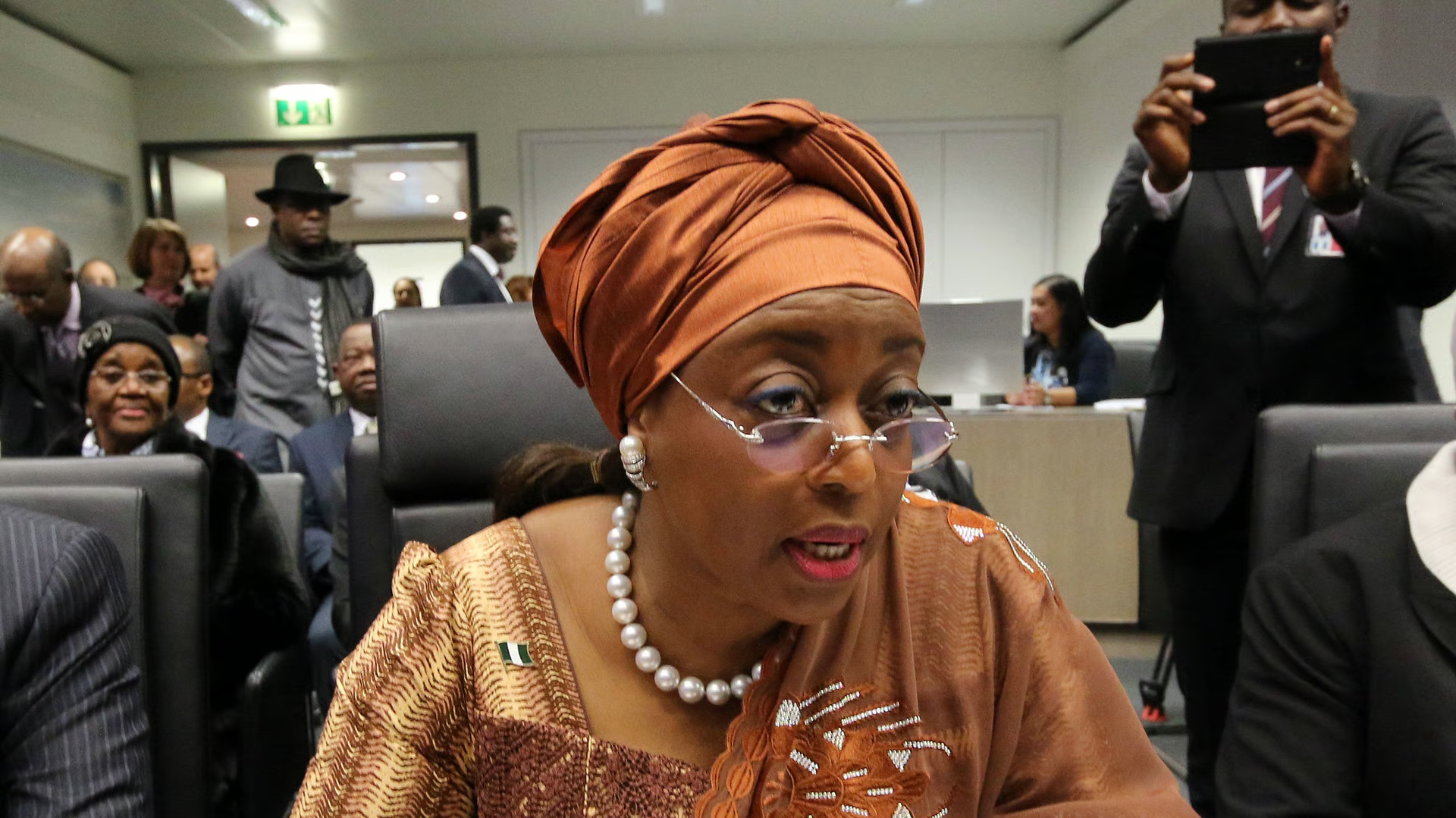
The long-anticipated corruption trial of Diezani Alison-Madueke, Nigeria’s former Minister of Petroleum Resources and the first woman to preside over the Organisation of the Petroleum Exporting Countries, is scheduled to commence in a London court on Monday.
Alison-Madueke, now 65, stands accused of five counts of accepting bribes and one count of conspiracy to commit bribery, all allegedly committed during her tenure as Nigeria’s chief petroleum minister between 2010 and 2015 under the administration of former President Goodluck Jonathan.
According to the indictment, Alison-Madueke is accused of accepting “financial or other advantages” from individuals connected to two energy groups between 2011 and 2015. The alleged bribes include the use of several London properties, refurbishment work on those properties, staff costs, furniture, chauffeur-driven cars, a private jet flight to Nigeria, and £100,000, equivalent to approximately $137,000, in cash.
Additional counts allege that she received bribes in the form of school fees for her son, luxury products from high-end retailers including Harrods and Louis Vuitton, and further private jet flights.
The indictment states that accepting these bribes constituted “improper performance” of her duties as oil minister.
Alison-Madueke appeared at a London court last week for preliminary proceedings, which included technical matters and jury selection, ahead of the trial. The proceedings are expected to last between 10 and 12 weeks.
Read Also: Former OPEC President Diezani Alison-Madueke Appears In UK Court Over Major Corruption Charges
Two other individuals, Doye Agama and Olatimbo Ayinde, are also being prosecuted on bribery charges linked to the case.
Alison-Madueke has been on bail since her initial arrest in London in October 2015. She has consistently denied the charges against her.
In 2023, she was formally charged with offences of accepting bribes by the National Crime Agency. “We suspect Diezani Alison-Madueke abused her power in Nigeria and accepted financial rewards for awarding multi-million-pound contracts,” the NCA, which targets international and serious and organised crime, stated at the time.
Earlier in 2023, the NCA disclosed that it had provided evidence to United States prosecutors, enabling them to recover assets totalling $53.1 million linked to Alison-Madueke’s alleged corruption. The recovered assets included luxury real estate in California and New York, as well as a 65-metre superyacht named the Galactica Star, according to an announcement by the US Department of Justice on March 27.
Born into a well-off family in the oil city of Port Harcourt in 1960, Alison-Madueke studied architecture in Britain and the United States before joining the Nigerian subsidiary of oil giant Shell, where she built a career in the petroleum industry.
Her entry into politics saw her appointed as Minister of Transportation in 2007 under President Umaru Yar’Adua. She later served as Minister of Mines and Steel Development in the same administration.
Following the death of Yar’Adua, when Goodluck Jonathan assumed the presidency, Alison-Madueke was appointed Minister of Petroleum Resources in April 2010. Her tenure in this position, which oversees Nigeria’s vast and economically critical oil sector, lasted until 2015.
Read Also: Trump Praises British Troops After Backlash Over Remarks Downplaying NATO’s Role In Afghanistan
In 2014, she made history by becoming the first female president of OPEC, a position she held for approximately one year. Her time at the helm of the global oil cartel came during a period of significant volatility in international oil prices and shifting global energy politics.
Nigeria’s petroleum sector has long been central to the country’s economy, accounting for the bulk of government revenue and foreign exchange earnings. The Ministry of Petroleum Resources, which Alison-Madueke headed for five years, is one of the most powerful and strategically important government offices in Nigeria, with oversight of the Nigerian National Petroleum Corporation and the regulation of oil and gas operations in the country.
However, the sector has also been plagued by allegations of corruption, mismanagement, and lack of transparency, issues that successive administrations have struggled to address. The petroleum ministry’s role in awarding contracts, granting licences, and overseeing billions of dollars in oil revenues has made it a focal point of scrutiny by anti-corruption agencies both in Nigeria and internationally.
Alison-Madueke’s arrest in October 2015 came just months after she left office following the electoral defeat of President Jonathan by Muhammadu Buhari, who campaigned heavily on an anti-corruption platform. Her arrest was part of a broader international investigation into alleged corruption in Nigeria’s oil sector.
Since then, the case has drawn significant attention both in Nigeria and abroad, reflecting the international dimensions of corruption cases involving high-ranking officials and the increasing cooperation between law enforcement agencies across borders.
The trial beginning Monday represents a significant moment in the pursuit of accountability for alleged corruption involving Nigerian public officials, particularly given Alison-Madueke’s prominence and the scale of the allegations against her.