

FIFA Pushes Auto-Red Cards for Mouth-Covering Players in Racism Fight
FIFA Plans Tough New Rules On Mouth-Covering Ahead Of 2026 World Cup
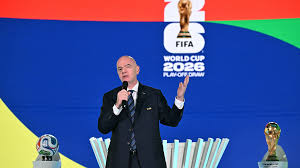
Football’s governing body is considering one of its most direct interventions yet in the fight against racism on the pitch, with FIFA president Gianni Infantino publicly advocating for the automatic sending off of any player who conceals their mouth while communicating with an opponent, a proposal triggered by the ongoing racism controversy surrounding Benfica forward Gianluca Prestianni.
The suggestion, made by Infantino during an appearance on Sky News, came as the International Football Association Board (IFAB) met on Saturday to deliberate on the state of the game. IFAB is the body responsible for setting and amending the Laws of Football, and its meetings carry significant weight in determining what actions referees can take on the field.
“If a player covers his mouth and says something, and this has a racist consequence, then he has to be sent off, obviously,” Infantino said. “There must be a presumption that he has said something he shouldn’t have said, otherwise he wouldn’t have had to cover his mouth. I simply do not understand — if you don’t have something to hide, you don’t hide your mouth when you say something. That’s it, as simple as that. And these are actions that we can take and we have to take in order to be serious about our fight against racism.”
The remarks were aimed squarely at an incident that has stirred considerable controversy in European club football. During a UEFA Champions League group stage fixture, Prestianni, an Argentine teenage prospect representing the Portuguese club Benfica, was accused of directing a racist slur at Real Madrid’s Brazilian forward Vinicius Junior while shielding his mouth with his shirt. Vinicius, who has been one of the most prominent voices in football calling attention to racial abuse on and off the pitch, has previously drawn global attention to what he has described as a persistent and unaddressed problem at the highest levels of the game in Europe.
UEFA moved swiftly to act ahead of the second leg of the Champions League tie, handing Prestianni a provisional suspension pending the outcome of a formal investigation. Under UEFA’s disciplinary framework, a player found guilty of racist conduct can be banned for a minimum of ten matches. Prestianni has denied racially abusing Vinicius.
The episode sits within a broader and deeply troubling history of racism in European football. For more than two decades, European governing bodies, clubs, national associations, and anti-racism campaigners have grappled with the persistence of racist abuse in football stadiums and, increasingly, on the pitch itself. High-profile incidents involving players such as Vinicius Junior, who has faced abuse in Spain on multiple occasions including from spectators, opposing players, and even pundits, have repeatedly forced the question of institutional accountability. Critics have argued that sanctions, when applied, have often been too light to serve as credible deterrents.
Vinicius himself has been outspoken in demanding that football’s governing bodies do more. His public statements have drawn both support and backlash, and the broader debate about racism in European football, particularly in the Spanish top flight, has drawn international attention. Real Madrid’s legal department has filed complaints in multiple racism cases on his behalf.
The mouth-covering gesture itself has attracted growing scrutiny in recent years as a deliberate tactic. When a player obscures their lips from the view of cameras, lip readers, and match officials, the ability to verify what was said is severely compromised. Infantino’s proposal appears designed to remove the incentive for this behaviour entirely by making the act of covering one’s mouth, under certain circumstances, sufficient grounds for dismissal.
FIFA is expected to table formal measures at its next Congress, scheduled for the coming month in Vancouver, Canada. The Congress could sanction the implementation of rules governing mouth-covering behaviour at the 2026 FIFA World Cup, which the United States, Canada, and Mexico are jointly hosting. The World Cup, as the most watched sporting event on the planet, would provide an immediate and high-profile platform for any new rules to take effect.
Beyond the mouth-covering question, Infantino also introduced a more nuanced dimension to the discussion: the possibility of differentiating punishments based on whether offenders offer a public apology. “Maybe we should also think about not just punishing, but also somehow allowing, changing our culture, allowing players or whoever does something to apologise,” he said. “You can do things that you don’t want to do in a moment of anger (and) apologise and then the sanction has to be different, to move one step further and maybe we should think about something like that as well.”
The idea reflects a tension that has long existed within the debate around racism in sport: the balance between punitive deterrence on one hand and rehabilitation and cultural change on the other. Proponents of restorative approaches argue that penalties alone have not eliminated racist conduct, and that public accountability through apology may have a greater effect on long-term behaviour. Critics, however, maintain that allowing reduced sanctions in exchange for apologies risks creating an escape route for offenders who are not genuinely remorseful, and that it signals insufficient seriousness about the severity of racial abuse.
For Vinicius, the Prestianni incident is one in a long line of confrontations that have made him a central figure in the global conversation about racism in football. The Brazilian forward’s willingness to name the problem publicly, and to call out what he has characterised as inadequate responses from governing bodies, clubs, and media, has won him the vocal support of fellow players across leagues and nations. It has also placed intense scrutiny on UEFA and FIFA to demonstrate that their anti-racism commitments go beyond symbolic gestures.
Whether the proposals outlined by Infantino in Vancouver will translate into enforceable rules, and whether they will apply at the club level through UEFA and national associations or only at FIFA competitions, remains to be determined. What is clear is that the Prestianni-Vinicius incident has moved the conversation from the stadium terraces, where racist abuse has too often been treated as a crowd management problem, to the pitch itself, where the conduct of players is directly within the jurisdiction of match officials and governing bodies.*