


Nigerian LNG Diverts to Asia as Price Gap Widens
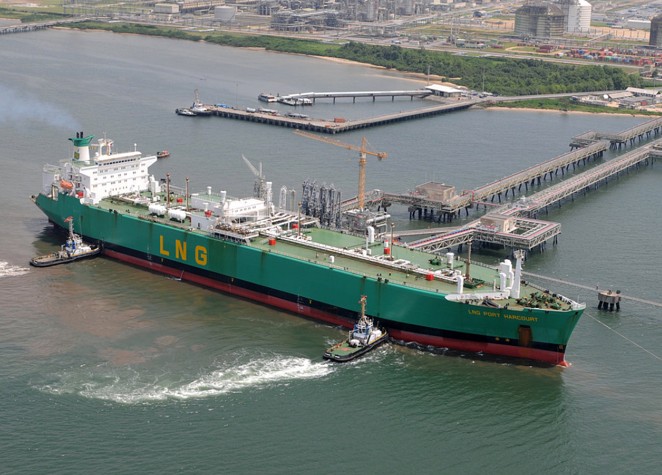
A shipment of liquefied natural gas (LNG) from Nigeria has been diverted from its European course to Asia, as traders move to capitalise on a massive price premium in the Pacific. Shipping data from Kpler shows the tanker BW Brussels, which loaded at the Bonny Island terminal on February 27, abandoned its westward route toward France on March 3. It is now navigating the Cape of Good Hope toward Asian markets. This tactical shift is a direct response to the “Atlantic–Pacific arbitrage,” where Asian buyers are outbidding European rivals by as much as $10 per unit to secure dwindling global supplies.
The price explosion in Asia is driven by the paralysis of Qatari exports. As the U.S.-Israel-Iran war continues to block the Strait of Hormuz, 20% of the world’s LNG remains trapped in the Persian Gulf. Consequently, the Japan-Korea Marker (JKM), the Asian benchmark, surged 68% last week to $25.39 per million British thermal units (mmBtu). While European prices also rallied to $15.47, the $10 spread makes Asia the far more lucrative destination for “flexible” cargoes like those from Nigeria.
Asian nations are currently in a “scramble” to replace lost Middle Eastern volumes. India and Bangladesh have reportedly issued emergency tenders for prompt cargoes to prevent domestic energy collapses. Because Qatar provides over 80% of its shipments to Asian buyers, the current blockade has left a massive hole in the region’s energy balance. Analysts at S&P Global Energy note that Asian buyers are now the most aggressive players in the spot market, willing to pay a “conflict premium” that Europe, with its slightly higher storage levels, has yet to match.
The diversion highlights the shifting mechanics of the global gas trade. Modern LNG contracts often include “flexible destination” clauses, allowing traders to redirect ships mid-voyage if a better price emerges elsewhere. For Nigeria LNG (NLNG), these signals are a double-edged sword: while they maximise revenue for the company, they underscore the extreme volatility of a market no longer anchored by stable Middle Eastern supply. If the JKM–TTF spread persists, more Atlantic-bound tankers from the United States and West Africa are expected to follow the BW Brussels east.
Europe remains a secondary priority for now, despite its own supply anxieties. While the Title Transfer Facility (TTF) in the Netherlands offers deep financial liquidity for hedging, it cannot compete with the sheer desperation of Asian utilities facing immediate blackouts. Kpler’s Go Katayama suggests that the Atlantic Basin is now effectively an “open shop” for the highest bidder. This redirection of gas toward Asia will likely force European governments to accelerate their own emergency procurement strategies before their winter storage begins to deplete.
For Nigeria, the BW Brussels is a floating barometer of the new geopolitical reality. With the Strait of Hormuz closed and Qatari production effectively sidelined, Nigerian gas has become a premium global asset. The move toward the Cape of Good Hope signals that the “price of war” in the Middle East is being paid in the counting houses of the Far East. As long as the blockade remains, the global LNG map will continue to be redrawn in favour of the Pacific.