
“No More Factionalism”: PDP Caretaker Committee Declares Victory After Ibadan Court Judgment
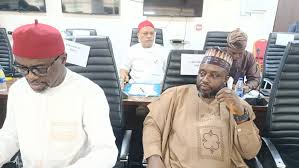
The Abdulrahman Mohammed-led Peoples Democratic Party National Caretaker Committee has announced plans to reopen the party’s national secretariat, Wadata Plaza, on Monday, declaring an end to the leadership crisis that has paralysed Nigeria’s main opposition party for months.
The announcement came on Thursday following the Independent National Electoral Commission’s quarterly meeting with leaders of political parties in Abuja, where the faction aligned with Minister of the Federal Capital Territory, Nyesom Wike, reasserted its claim to legitimate control of the party structure.
Senator Samuel Anyanwu, acting National Secretary of the Mohammed-led faction, told journalists that the secretariat, which has remained locked since November 19, 2025, would be repossessed by the caretaker committee after a series of court rulings in their favour.
“We wrote to the police. Remember that the police sealed the place and then the other group went to court to ask the police to open it. The matter was dismissed because they have no locus. So by Monday, we are taking over the office,” Anyanwu said.
The Nigeria Police Force had sealed Wadata Plaza following violent clashes between supporters of the Taminu Turaki-led National Working Committee and those backing Mohammed as factional acting National Chairman. The closure marked the lowest point in a bitter power struggle that has threatened the electoral viability of the PDP ahead of crucial elections.
Anyanwu dismissed suggestions of factionalism within the party, insisting that the PDP remains united under Mohammed’s leadership. He cited their attendance at the INEC meeting as evidence of the caretaker committee’s recognition as the legitimate party leadership.
“Yes, we had issues, court issues, and last week Friday, as a matter of fact, the Federal High Court in Ibadan made it very clear that the problem of PDP is over because the so-called convention of November 15 and 16, 2025 is a nullity,” Anyanwu stated.
According to him, the court ruled that no other person should parade themselves as members of the National Working Committee, affirming that only the National Caretaker Committee, led by Mohammed, possesses full powers to speak for and administer the party.
The leadership crisis in the PDP has deep roots in the party’s 2023 electoral losses and subsequent internal realignments. The party, which governed Nigeria from 1999 to 2015, has struggled to recover its footing since losing the presidency to the All Progressives Congress in 2015 and again in 2023. Internal divisions have been exacerbated by disagreements over party direction, control of state chapters, and allegations of external interference.
The dispute escalated dramatically in November 2025 when rival factions attempted to hold separate meetings, leading to the physical confrontation that prompted police intervention. The Turaki-led faction organised a national convention on November 15 and 16, 2025, which the Mohammed faction has consistently challenged as illegal and unconstitutional.
The recent Federal High Court judgment in Ibadan, which Anyanwu referenced, appears to have strengthened the caretaker committee’s position by nullifying the November convention and the decisions taken there. This ruling follows a pattern of court interventions that have characterised PDP’s internal conflicts over the past two decades.
Anyanwu expressed confidence that party members are relieved by what he described as a return to normalcy. “For those who were afraid that PDP would not have candidates in the forthcoming elections, it is now settled that the party would field candidates for all positions,” he said.
He emphasised that the caretaker committee comprises experienced party administrators who have managed the PDP for much of its 25-year existence, suggesting they are well-positioned to stabilise the party and prepare for upcoming electoral contests.
“You can see something different because you have old hands who have been in this party, who have been managers of this party for a long time, for the last 25 years. We are still involved. So, we are going to fast-track everything,” Anyanwu said.
The acting National Secretary also addressed the party’s preparations for the FCT area council elections scheduled for February, stating that the caretaker committee would work vigorously for electoral victory.
“We are going to hit the ground running with our campaign until February 18, the last day for campaign,” he said.
On INEC’s registration of two new political parties, bringing the total number of registered parties in Nigeria to 21, Anyanwu welcomed the development as positive for the country’s democracy.
“For us, it’s a good development. What it means now is that we have 21 political parties in Nigeria, which is a good development,” he stated.
The PDP’s current troubles reflect broader challenges facing opposition politics in Nigeria. Since its formation in 1998 ahead of the return to civilian rule in 1999, the party dominated Nigerian politics for 16 years, controlling the presidency and most state governments. Its loss of power in 2015 marked a historic democratic transition, but also triggered internal crises over blame, direction, and leadership.
The party’s constitution provides mechanisms for resolving leadership disputes, primarily through conventions and court processes. However, the frequency of judicial interventions in PDP affairs has raised questions about internal democracy and the role of the judiciary in party administration.