


North Korea Fires 10 Ballistic Missiles Toward Sea of Japan
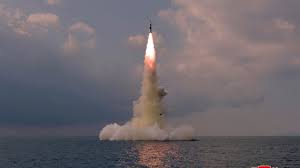
North Korea launched approximately 10 ballistic missiles toward the Sea of Japan on Saturday, according to Seoul’s Joint Chiefs of Staff, in what analysts describe as a calculated provocation timed to coincide with ongoing US-South Korea military exercises and heightened global tensions in the Middle East.
The missiles were fired from the Sunan area near Pyongyang at around 1:20 pm local time and traveled approximately 350 kilometres before falling into the East Sea, the South Korean military confirmed. The Joint Chiefs of Staff said South Korean and US intelligence authorities were conducting detailed analysis of the missiles’ specifications and trajectory.
“The South Korean military is ready to respond overwhelmingly to any provocation,” the JCS stated, describing the launches as a serious breach of regional security.
Japan’s defence ministry separately confirmed the launches, reporting that the missiles reached a maximum altitude of approximately 80 kilometres and landed outside Japan’s exclusive economic zone near the eastern coast of the Korean Peninsula. No damage to vessels or aircraft was reported.
Seoul’s presidential Blue House condemned the missile tests as a direct violation of United Nations Security Council resolutions and demanded that Pyongyang immediately cease such destabilizing actions. The statement ordered all relevant government agencies to maintain heightened military readiness, particularly as the launches occurred during the Freedom Shield joint military exercises between South Korea and the United States.
The timing and scale of Saturday’s missile barrage represent one of North Korea’s most significant military provocations in recent months and underscore Pyongyang’s determination to assert its presence on the global stage despite ongoing diplomatic overtures from Washington.
The launches came just hours after South Korean Prime Minister Kim Min-seok publicly stated that US President Donald Trump viewed a potential meeting with North Korean leader Kim Jong Un as desirable. Trump’s administration has signaled renewed interest in high-level engagement with Pyongyang, with discussions underway for a possible summit during the president’s scheduled visit to Beijing in late March 2026.
During a trip to Asia in October 2025, Trump declared he was “100 percent” open to dialogue with Kim Jong Un, though North Korea initially ignored the overture. After months of silence, Kim Jong Un recently indicated that the two nations could establish better relations if Washington accepted North Korea’s status as a nuclear power, a condition the US has consistently rejected.
The US and its allies have spent decades attempting to dismantle North Korea’s nuclear weapons program through a combination of diplomatic summits, economic sanctions, and international pressure, but these efforts have yielded limited results. North Korea conducted its first nuclear test in 2006 and has since expanded its arsenal to include intercontinental ballistic missiles capable of reaching the continental United States, according to assessments by US and South Korean intelligence agencies.
Saturday’s missile launches occurred against the backdrop of the Freedom Shield military drills, which began on Monday and involve approximately 18,000 South Korean troops alongside US forces. The exercises, scheduled to run until March 19, are designed to enhance combined defense readiness and interoperability between the two allied militaries.
North Korea has historically condemned such drills as rehearsals for invasion and has used them as justification for weapons tests and military displays. Pyongyang launched a devastating surprise attack on South Korea in June 1950, triggering a three-year conflict that ended in an armistice rather than a peace treaty, leaving the two nations technically still at war.
Earlier this week, Kim Yo Jong, the influential sister of Kim Jong Un and a senior official within North Korea’s ruling Workers’ Party, warned that the joint exercises could provoke “unimaginably terrible consequences.” She described the drills as occurring at “a critical time when global security structure is collapsing rapidly, and wars break out in different parts of the world,” an apparent reference to ongoing conflicts in the Middle East and Eastern Europe.
North Korea has publicly condemned what it described as the “illegal act of aggression” by the US and Israel against Iran, aligning itself rhetorically with Tehran and accusing Washington of demonstrating its “rogue” character through military interventions abroad.
Analysts noted that the number and timing of Saturday’s missile launches were strategically calculated to maximize international attention.
“Global attention is currently focused on the war in the Middle East, and North Korea has historically carried out military provocations when it wants to draw attention to its presence,” Hong Sung-pyo, a senior researcher at the Korea Institute for Military Affairs, told Agence France-Presse. “And that motive likely underlies this launch as well.”
North Korea has also recently intensified efforts to modernize its naval forces, conducting missile tests from the Choe Hyon destroyer and claiming progress in equipping its navy with nuclear weapons capability. This development has raised concerns among regional security experts, particularly given potential Russian technical assistance to Pyongyang’s weapons programs.
“North Korea has been devoting greater resources to its navy, with possible support from Russia. But Kim will have noticed that the US was able to sink most of the Iranian navy within a week,” said Leif-Eric Easley, a professor of international relations at Ewha University in Seoul. “So Pyongyang is likely to conduct tests and issue rhetoric about nuclear command, control, and delivery systems to suggest it could inflict unacceptable harm if its naval forces come under attack.”
The missile launches represent the latest chapter in North Korea’s pattern of using weapons tests to demonstrate military capability, extract diplomatic concessions, and assert relevance amid shifting global power dynamics. Pyongyang has conducted hundreds of missile tests over the past two decades, refining its ballistic missile technology and expanding its nuclear arsenal despite international condemnation and sanctions.
United Nations Security Council resolutions prohibit North Korea from conducting ballistic missile tests of any range, as such missiles can be used to deliver nuclear warheads. However, enforcement of these resolutions has been complicated by divisions among permanent Security Council members, particularly as China and Russia have used their veto power to block new sanctions in recent years.
Saturday’s launches also highlighted the fragility of diplomatic efforts to reduce tensions on the Korean Peninsula. Despite periodic signals of openness to dialogue from both Pyongyang and Washington, substantive progress toward denuclearization has remained elusive. Previous summit meetings between Kim Jong Un and Trump in Singapore in 2018 and Hanoi in 2019 ended without concrete agreements, and North Korea has since accelerated its weapons development programs.
South Korea’s government, led by a conservative administration that has taken a harder line on North Korean provocations, has strengthened military cooperation with the United States and Japan in response to Pyongyang’s growing missile and nuclear capabilities. The trilateral security partnership has conducted joint naval exercises and expanded intelligence-sharing arrangements to counter what officials describe as an evolving North Korean threat.
As of the time of this report, neither the United States nor the United Nations Security Council had issued formal responses to Saturday’s missile launches. South Korean defense officials indicated that monitoring of North Korean military activities would continue at elevated levels throughout the duration of the Freedom Shield exercises.
The international community remains divided on how best to address North Korea’s weapons programs, with some governments advocating for renewed engagement and others pushing for stricter enforcement of existing sanctions. Saturday’s missile barrage is likely to intensify debate over whether diplomatic outreach or pressure tactics offer the more viable path toward stability on the Korean Peninsula.