
NSCDC Intensifies Kwara Security
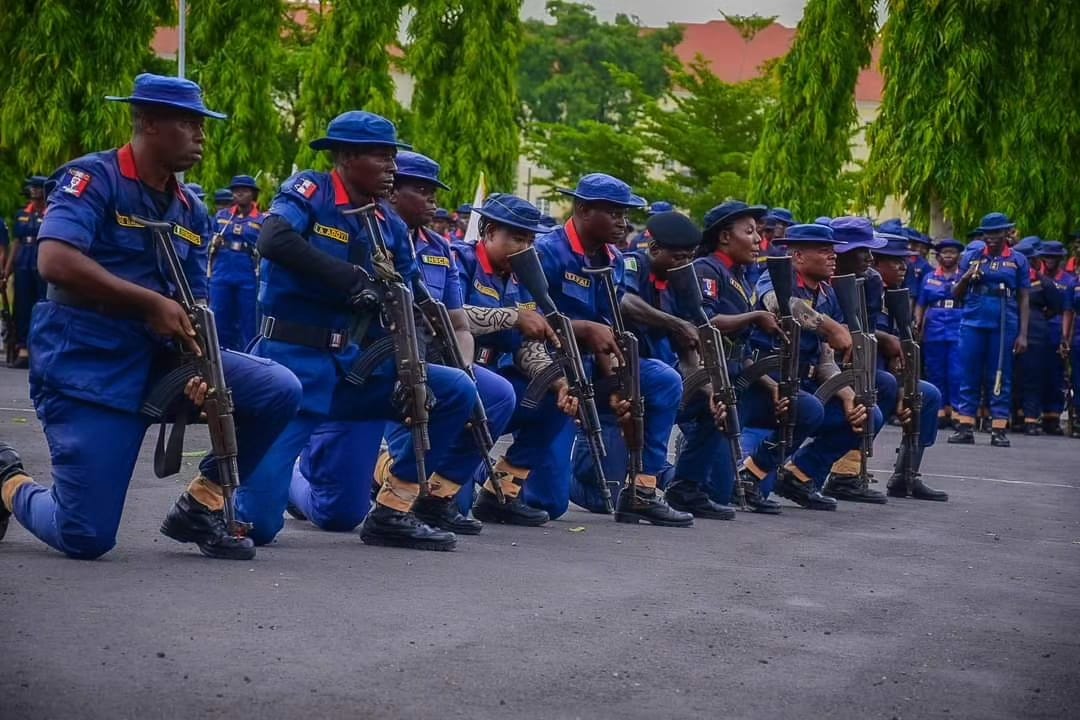
A new era of heightened vigilance has dawned in Kwara State as the Nigeria Security and Civil Defence Corps rolls out a comprehensive 24-hour surveillance operation, prioritising the protection of critical national assets and public safety amid persistent regional threats.
The initiative, unveiled by Kwara State Commandant Bala Bawa Bodinga in Ilorin on Thursday, comes shortly after his assumption of command duties. According to reports, Bodinga’s deployment was sanctioned by NSCDC Commandant-General Ahmed Abubakar Audi as part of a broader strategic overhaul aimed at bolstering operational efficiency across the country.
Bodinga outlined the blueprint as an intelligence-led approach blending overt patrols with covert tactics to safeguard infrastructure and restore public trust. “I was directed by the Commandant-General to take charge of operations here and ensure that critical national assets and infrastructure are adequately protected,” he stated in public remarks.
He emphasised discretion in operational details, noting, “Not all security tactics, measures and plans are meant to be disclosed. But by the grace of God, all necessary mechanisms have been put in place to protect critical national assets and infrastructure in Kwara State, as well as lives and property.”
Surveillance efforts have zeroed in on Ilorin metropolis, with non-stop monitoring particularly at night. “We have commenced 24-hour surveillance within Ilorin metropolis. You can move around Ilorin at night and you will find our officers maintaining constant surveillance. There has not been a single night without patrol since I assumed duty,” Bodinga affirmed.
In response to localised unrest, additional forces have been dispatched to Kaiama, a hotspot for recent disturbances. “We have sent more men to Kaiama and the situation there is under control,” he confirmed.
Security provisions extend to religious sites, with mandatory coverage for Friday Jumu’ah prayers and Sunday church services. “All Jumu’ah prayers on Fridays must have adequate security coverage. The same arrangement applies to churches during Sunday services and other major gatherings. Worship centres must be safe for our people,” Bodinga declared.
Collaboration forms a key pillar, with Bodinga highlighting ongoing engagements with other agencies. “I am already in contact with heads of other security agencies in the state to strengthen intelligence sharing and joint operations,” he said.
Manpower enhancement through training is also prioritised. “As someone trained in intelligence and operations, I understand the importance of continuous training,” he noted, adding, “Some of these trainings cannot be announced publicly, but our officers will be well trained technically and professionally for effective service delivery.”
VIP protection protocols have been activated, though with a call for patience. “All modalities for VIP protection have been activated. We are ready to respond to requests, but we ask for time to fully deploy our resources,” Bodinga stated.
He urged residents to provide actionable intelligence, promising visible improvements. “With the support of other security agencies and the people of Kwara State, we will deliver improved security. Give us a little time, and you will see a new face of security in this state,” he assured.
The PUNCH further reported that Bodinga officially assumed the Kwara command on Monday, February 16, 2026, succeeding Dr Umar J.G. Mohammed, who held the position for about two years. This transition aligns with Audi’s nationwide reshuffle to fortify security frameworks.
The NSCDC’s roots trace back to May 1967, during the Nigerian Civil War, when it originated as the Lagos Civil Defence Committee to educate and shield civilians from air raids. It evolved into a national entity by 1970, gaining formal statutory recognition through the NSCDC Act of June 2003, signed by then-President Olusegun Obasanjo. Amendments in 2007 expanded its paramilitary role, including asset protection and internal security support. Today, with an estimated 80,000 personnel headquartered in Abuja, the corps complements military and police efforts in disaster response, vandalism prevention, and community safety.
Commandant-General Audi, born on September 30, 1967, in Laminga, Nasarawa Local Government Area of Nasarawa State, brings a wealth of experience. A holder of advanced degrees, including a PhD, he joined the NSCDC in 1996 post-national service, rising through ranks from divisional officer to commandant roles. Appointed in February 2021 by then-President Muhammadu Buhari, succeeding Abdullahi Gana Muhammadu, Audi has spearheaded reforms in training, intelligence, and inter-agency ties, earning the Order of the Federal Republic (OFR) and membership in the National Institute (mni).
Kwara State itself, carved out on May 27, 1967, by General Yakubu Gowon’s military regime, amalgamated the former Ilorin and Kabba provinces of the Northern Region. Initially dubbed West Central State, it was renamed Kwara a Hausa term for the River Niger. Spanning 32,500 square kilometres, the state has seen territorial adjustments: in 1976, losing Igala divisions to Benue State; in 1991, ceding southeastern parts to Kogi State and northwestern Borgu to Niger State. Predominantly savanna with southern forests, Kwara bridges Nigeria’s north and southwest, historically influenced by the Oyo Empire, Fulani conquests in the early 19th century, and British colonial incorporation into Northern Nigeria in 1900.
This historical tapestry underscores Kwara’s strategic vulnerability. Recent data from the Armed Conflict Location & Event Data Project (ACLED) indicates escalating insecurity: from January 1 to November 7, 2025, at least 207 fatalities and over 177 abductions, mainly in northern LGAs. A February 3, 2026, massacre in Woro and Nuku villages near Kaiama claimed at least 162 lives, with attackers—variously linked to Boko Haram, Lakurawa, or Islamic State affiliates—burning structures and kidnapping residents after demands for sharia compliance were rebuffed. President Bola Tinubu attributed it to “Boko Haram” factions, amid warnings of southward spillover.
Crime trends in Ilorin, the state capital, show mixed patterns per Kwara State Police Command records from 2018-2022. Using semi-average analysis, culpable homicide, armed robbery, grievous harm, theft, housebreaking, cultism, fraud, forgery, and assault declined, while false pretence, cheating, and kidnapping rose. National Bureau of Statistics data for 2017 logged 830 offences in Kwara: 279 against persons (including 78 assaults, 47 grievous harms), 526 against property (253 thefts, 80 armed robberies), and 25 against lawful authority. In 2020-2021, ACLED tallied 21 security incidents, resulting in 13 deaths, averaging under one per 100,000 inhabitants based on population estimates.