
PDP Crisis: Makinde Group Calls for Wike Camp’s Reunion
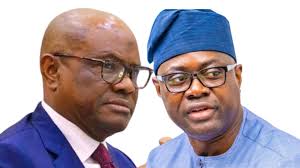
A political support group loyal to Oyo State Governor Seyi Makinde has called on members of a factional caretaker committee aligned with Minister of the Federal Capital Territory Nyesom Wike to abandon their parallel structure and return to the Peoples Democratic Party’s constitutional leadership.
The Seyi Makinde Disciples, through its convener Mr Laja Adeoye, made the appeal on Thursday in Lagos during an interview with the News Agency of Nigeria, expressing optimism that the party’s protracted leadership crisis could be resolved through reconciliation and dialogue.
Adeoye urged members of the caretaker committee led by Mohammed Abdurahman and Senator Samuel Nwanyanwu to embrace peace and reintegrate into the party structure recognized by the PDP constitution, insisting that the National Caretaker Committee lacked legal and constitutional legitimacy.
“We are hopeful that all the issues within the party will soon be put behind us. The PDP remains a big family with room for everyone,” Adeoye stated. “The National Caretaker Committee is not recognised by the law or the party’s constitution, and that position has been clearly stated. The Wike camp now has the opportunity to return home. The PDP is opening its doors to suspended national officers willing to reintegrate.”
He added that reconciliation would succeed if returning members demonstrated remorse and a willingness to work collectively with other party stakeholders.
“If they return with remorse and a willingness to work with others, reconciliation will succeed and the party will move forward,” Adeoye said.
The appeal comes amid a deepening leadership dispute that has split the PDP into rival factions since late 2025, with one camp led by Makinde and Bauchi State Governor Bala Mohammed supporting the Kabiru Turaki-led National Working Committee, and another faction aligned with Wike backing a parallel caretaker committee.
The crisis has its roots in long-standing disagreements over the party’s leadership direction following its defeat in the 2023 general elections. Tensions escalated in November 2025 when the PDP held a national convention in Ibadan, Oyo State, which produced the Turaki-led National Working Committee. The convention was opposed by Wike’s faction, which disputed the legitimacy of the process and subsequently announced the formation of a caretaker committee.
Adeoye referenced a recent Court of Appeal ruling delivered on Tuesday in Ibadan, which he said provided encouragement for intensified dialogue and reconciliation efforts within the party.
“The Appeal Court in Ibadan urged all parties to accommodate one another. That is a positive signal for the future of the party,” he said, adding that the court had indirectly set aside actions taken by some suspended members of the National Working Committee, including the formation of the caretaker committee.
The Court of Appeal had on Tuesday upheld an earlier ruling by Justice James Omotosho of the Federal High Court in Abuja, which nullified the November 15 to 16, 2025, PDP national convention held in Ibadan. The convention produced the Kabiru Turaki-led National Working Committee, which had been backed by Makinde and Mohammed but was subsequently invalidated by the court.
The appellate court also upheld the suspension of three principal officers linked to the Wike faction, including National Secretary Senator Samuel Nwanyanwu. The ruling has added legal complexity to the leadership dispute, with both factions interpreting the judgment to support their respective positions.
Adeoye, however, argued that rather than deepening divisions, the court’s pronouncement should serve as an opportunity for reconciliation among aggrieved party members.
He emphasized that unity among key leaders such as Makinde and Mohammed would be critical to rebuilding the party’s electoral capacity ahead of future elections, particularly the 2027 general elections.
“Unity with leaders such as Seyi Makinde and Bala Mohammed will help rebuild the party ahead of future elections,” Adeoye said. “The party remains determined to strengthen the opposition and mobilise Nigerians ahead of the 2027 general elections.”
The leadership crisis has compounded the PDP’s challenges as Nigeria’s main opposition party. Since losing the presidency in 2015 to the All Progressives Congress, the PDP has struggled to maintain internal cohesion and electoral competitiveness. The party’s performance in the 2023 elections, where presidential candidate Atiku Abubakar finished second behind the APC’s Bola Tinubu, was marred by internal divisions, particularly a rift between Atiku’s camp and the G5 governors led by Wike, who refused to campaign for the party’s presidential candidate.
Wike’s subsequent appointment as FCT Minister in President Tinubu’s APC-led administration further strained relations within the PDP, with many party members accusing him of working against the opposition’s interests. His continued influence over a faction of the party has been a source of ongoing tension, particularly as he remains a PDP member despite serving in an APC government.
The factional dispute has also played out in several state chapters, with parallel congresses and competing claims to leadership legitimacy hampering the party’s organizational capacity. The Board of Trustees has constituted a reconciliation committee to mediate between the warring factions, though progress has been slow.
Commenting on Lagos State politics, Adeoye said the PDP was intensifying efforts to reclaim political power and provide what he described as people-centred governance.
“In Lagos State, the time has come for leadership that will make the state’s wealth work for the common people,” Adeoye stated. “The PDP will return Lagos to its people. The APC-led government has not adequately accounted to residents. We will provide transparent leadership and deliver massive development across Lagos State.”
Lagos has remained an APC stronghold since 1999, when the Alliance for Democracy captured the state under the leadership of Bola Tinubu, who governed until 2007. The state has remained under the control of Tinubu’s political structure through successive governors, including Babatunde Fashola, Akinwunmi Ambode, and current Governor Babajide Sanwo-Olu.
The PDP has struggled to make significant electoral inroads in Lagos despite fielding candidates in every gubernatorial election since 1999. In the 2023 gubernatorial election, the PDP’s candidate Abdul-Azeez Olajide Adediran, popularly known as Jandor, finished third behind the APC’s Sanwo-Olu and the Labour Party’s Gbadebo Rhodes-Vivour, securing approximately 62,000 votes compared to Sanwo-Olu’s over 760,000 votes, according to results announced by the Independent National Electoral Commission.
Adeoye expressed confidence that with unity among party leaders and sustained voter mobilization, the PDP could reposition itself and mount a credible challenge in future elections.
“With unity among leaders and support from voters, the party can reposition itself and mount a strong challenge in future elections,” he said.
The PDP leadership crisis remains unresolved, with both factions continuing to claim legitimacy. The party’s ability to reconcile its internal divisions will likely determine its capacity to function as an effective opposition ahead of the 2027 general elections and beyond.