
PDP NEC Fixes 2027 Presidential Primary for May 23
The Peoples Democratic Party has formally commenced its 2027 electoral preparations with the release of a comprehensive primary election timetable, setting its presidential nomination contest for May 23, 2026. The decision, reached during the party’s 106th National Executive Committee meeting held Wednesday in Abuja, signals an attempt by the Nyesom Wike-aligned leadership to consolidate control over the party’s machinery despite ongoing legal and factional challenges.
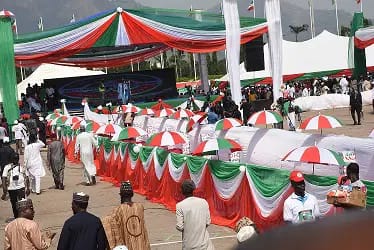
The NEC, which convened at the party’s national secretariat in the Wuse District of the Federal Capital Territory, approved a staggered primary schedule beginning with the submission of the party’s membership register to the Independent National Electoral Commission on April 10, 2026. Legislative primaries will follow in early May, with State Assembly nominations fixed for May 2, National Assembly selections for May 9, and governorship primaries scheduled for May 16, before culminating in the presidential contest on May 23.
“The NEC noted with satisfaction the successful conduct of the ward and local government congresses across the country and expressed confidence that the state congresses scheduled to hold this weekend would be conducted peacefully, transparently and in strict compliance with the constitution and guidelines of the party,” the communique stated. The statement was signed by Jungudo Mohammed, National Publicity Secretary of the Caretaker Committee, and distributed to journalists following the seven-hour closed-door session.
The timetable aligns the PDP’s internal processes with INEC’s revised electoral framework, which mandates that notice of election be issued no later than 300 days before polling day. For the 2027 general elections, expected to occur in February of that year, this statutory requirement establishes a deadline of approximately late April 2026 for formal electoral notification. The PDP’s April 10 submission date provides a narrow compliance margin, reflecting the compressed timeline the party faces following prolonged internal disputes.
Wednesday’s meeting reinforced the authority of the Alhaji Abdulrahman Mohammed-led Caretaker Committee, which has administered party affairs since the suspension of the previous National Working Committee in 2024. The NEC expressed “full support” for the committee’s stewardship, praising its efforts in “stabilizing the party and guiding its affairs during this transitional period.” The body also formally endorsed recent Court of Appeal judgments that affirmed the committee’s legitimacy, though specific case references were not detailed in the communique.
The leadership’s position directly confronts the faction led by Tanimu Turaki, a Senior Advocate of Nigeria and former Minister of Special Duties, which has pursued parallel legal challenges questioning the Caretaker Committee’s constitutional standing. The NEC’s statement contained an explicit appeal to this dissident group to abandon further litigation, particularly any intention to escalate matters to the Supreme Court.
“The strength of the PDP lies in its ability to resolve internal disagreements through dialogue, mutual respect and adherence to party structures,” the communique asserted. “NEC urges all parties to refrain from pushing further litigation in the guiding interest of unity, stability and the future of the party.” This diplomatic language masked a firm insistence on the cessation of legal hostilities that have paralysed the party’s decision-making capacity for eighteen months.
The PDP’s internal fracture originated in the aftermath of the 2023 general elections, when the party recorded its poorest electoral performance since the return to democratic governance in 1999. Disputes over the causes of this defeat, particularly regarding the presidential campaign’s strategic direction and the role of the G5 governors led by Wike, metastasised into a full-blown organisational crisis. The G5 faction, comprising governors who withheld support from the party’s presidential candidate Atiku Abubakar over perceived regional inequities in leadership selection, has since assumed dominant positions within the Caretaker Committee structure.
Wike, currently serving as Minister of the Federal Capital Territory in the All Progressives Congress administration of President Bola Tinubu, has maintained de facto control of the PDP’s operational apparatus despite his cabinet position. His influence was evident in Wednesday’s meeting outcomes, with NEC members drawn predominantly from state chapters aligned with his political network. The minister’s dual role as APC cabinet member and PDP power broker has generated sustained controversy regarding potential conflicts of interest, though his supporters argue this positioning enhances the party’s federal government access.
The NEC approved several administrative reforms intended to modernise party operations, most notably the expansion of electronic membership registration. This initiative, described as necessary to “modernize the party’s membership database and strengthen grassroots participation,” responds to longstanding criticisms of the PDP’s antiquated record-keeping systems. INEC had previously flagged irregularities in the party’s membership documentation during the 2022 pre-primary verification process, contributing to post-election litigation that consumed party resources.
The technological upgrade carries particular significance given the compressed primary schedule. With only six weeks between the April 10 registration submission and the May 2 State Assembly primaries, the party must complete database verification and delegate selection processes that previously required several months. Political operatives familiar with the party’s administrative capacity have expressed scepticism regarding this timeline’s feasibility, noting that the PDP has not conducted a comprehensive membership audit since 2016.
Wednesday’s meeting also addressed security concerns arising from recent congress activities. The NEC “strongly condemned” an attack by unidentified hoodlums on party members during ward congresses in Oyo State, describing the incident as “unfortunate and unacceptable.” The communique called upon “security agencies to thoroughly investigate the incident and ensure that those responsible are brought to justice.” Oyo State has experienced elevated political tensions following the impeachment of local government chairmen and disputes over the succession to former Governor Seyi Makinde’s political network.
The NEC’s intervention in Oyo reflects broader anxieties regarding primary election violence, which has historically plagued Nigerian party politics. The 2022 PDP presidential primary in Abuja required substantial security deployment following threats of disruption by rival campaign teams, while state-level primaries in Rivers, Lagos, and Delta states have experienced violent incidents in recent electoral cycles. The party’s leadership appears determined to preempt similar disruptions in 2026, though the communique offered no specific security protocols beyond general appeals for peaceful conduct.
The meeting concluded with a formal announcement of the party’s National Convention, scheduled for March 29 and 30, 2026, where delegates will select a new National Working Committee to replace the Caretaker Committee. This event will effectively determine the party’s leadership architecture for the 2027 electoral cycle, with chairmanship and secretary positions carrying particular influence over presidential candidate selection processes. The Wike faction is expected to consolidate its control through this convention, barring successful legal intervention by the Turaki group.
The convention date places the PDP’s leadership selection approximately eight weeks before the primary elections commence, a tighter schedule than the party has historically employed. The 2017 convention that produced the Uche Secondus-led NWC occurred nearly eighteen months before the 2019 general elections, while the 2021 convention preceded the 2023 polls by sixteen months. This compression reflects both the delayed resolution of the current crisis and the compressed INEC timeline for 2027.
Reactions from the Turaki faction were not immediately available Wednesday evening, though sources close to the group indicated that legal consultations regarding Supreme Court appeals were continuing regardless of the NEC’s statement. The faction has consistently argued that the Caretaker Committee’s tenure exceeded constitutional limits established by the PDP’s own governing documents, a position that received initial support from a Federal High Court judgment subsequently overturned on appeal.
The PDP’s 2027 timetable now establishes the most concrete electoral roadmap since the party’s 2015 defeat ended its sixteen-year hold on federal power. Whether this schedule can be implemented amid continuing factional hostility, or whether the party can present a unified front capable of challenging the APC’s incumbency advantage, remains contingent upon developments in the coming weeks. The NEC’s call for reconciliation, issued from a position of demonstrated institutional control, sets the parameters for whatever negotiations may follow.