
Rivers Crisis: Tinubu Brokers Late-Night Peace Meeting Between Fubara And Wike In Abuja
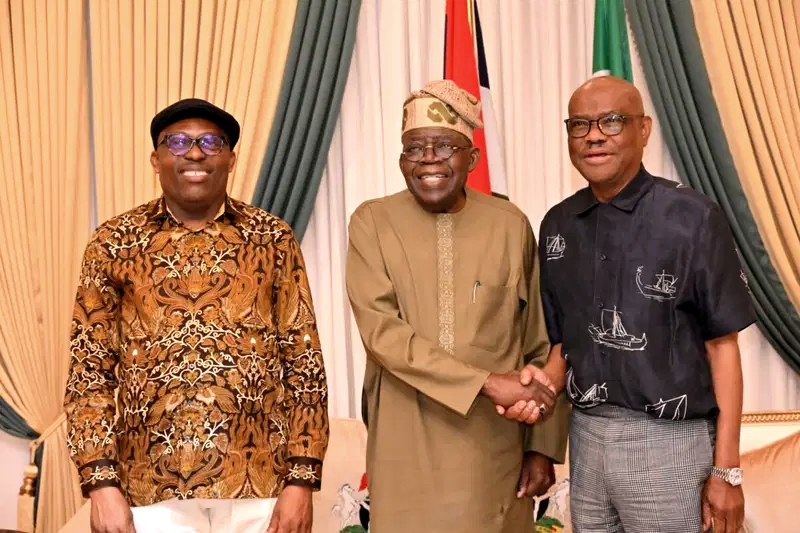
Fresh signs of possible reconciliation have emerged in the prolonged political crisis rocking Rivers State, following a late-night intervention by President Bola Tinubu in Abuja.
Presidency sources confirmed that Tinubu convened a closed-door meeting involving Rivers State Governor, Siminalayi Fubara; Minister of the Federal Capital Territory (FCT), Nyesom Wike; and other influential political stakeholders from the state. The meeting, held at the Presidential Villa, was aimed at easing tensions and charting a pathway toward political stability in the oil-rich state.
Although official details of the discussions were not made public, sources described the talks as frank and conciliatory, focusing on resolving outstanding grievances and restoring functional governance in Rivers State.
In a significant development after the meeting, Governor Fubara was reportedly seen accompanying Wike to his residence in Guzape, Abuja, a move widely interpreted by political observers as a symbolic gesture of rapprochement.
Unconfirmed reports further claimed that Fubara appealed directly to the former governor and pledged to exercise restraint in political decisions that could be interpreted as confrontational or disrespectful, signalling a possible thaw in relations between the two long-feuding allies-turned-rivals.
The crisis between Fubara and Wike erupted shortly after the governor assumed office, spiralling into one of the most intense political standoffs in the state’s history. The rift led to a deep split within the Rivers State House of Assembly, with lawmakers aligning into rival factions loyal to either camp.
The standoff triggered impeachment threats against the governor, multiple court actions, and repeated disruptions of legislative activities, raising serious concerns over governance, security, and investor confidence in the state.
Political analysts have linked the conflict largely to a struggle for control over party structures, political influence, and the direction of governance in Rivers State, a key economic hub in Nigeria’s Niger Delta region.
Despite several earlier reconciliation efforts by party leaders, elders, and stakeholders within the ruling party, the dispute persisted, threatening to destabilise the state’s political landscape.
President Tinubu’s direct involvement is therefore viewed as a decisive move to halt further escalation, restore unity within the political class, and safeguard governance ahead of future political and electoral activities.
Observers say sustained dialogue and adherence to any agreements reached will be critical to ensuring lasting peace in Rivers State.