


She Sold Her Hair Dryer to Mail His Manuscript—Then Watched it Win the Nobel Prize
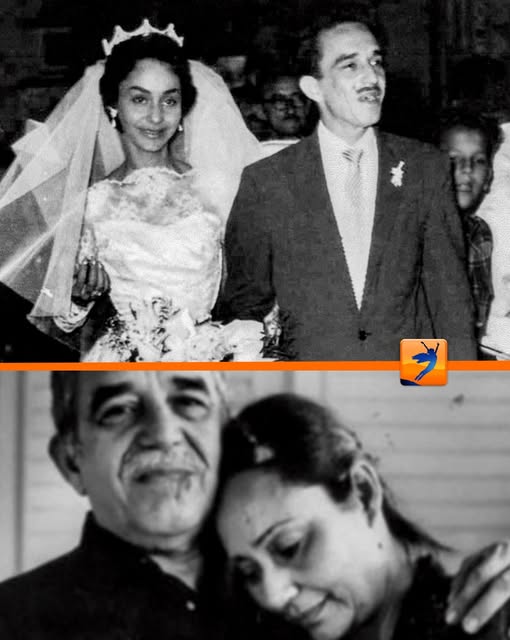
Gabriel García Márquez was 13 years old when he saw Mercedes Barcha at a school dance in Colombia and said to his friend. “I’m going to marry that girl.”
She was beautiful, confident, untouchable. He was a scholarship boy from a family that scraped by. She was the pharmacist’s daughter, poised and privileged, a world apart. So, like all dreamers denied by reality, he set out to prove himself worthy.
Eighteen years slipped by. He drifted from city to city, chasing stories and chasing hope, always broke, always scribbling, never forgetting the girl he’d vowed to marry.
By 1958, at last a respected journalist, he came back for her. This time, she said yes. They married, raised two sons, and built a life overflowing with everything but money.
García Márquez wrote. Published novels. Earned critical praise but almost no income. Mercedes stretched every peso, managed the household, and believed in her husband’s talent when the bank account suggested she shouldn’t.
Then, in 1965, as he drove toward Acapulco, inspiration struck like lightning. The whole novel unfurled in his mind, vivid and complete, as if conjured from another world. Seven generations of Buendías. A town named Macondo. Magic tangled with reality. Love, war, and solitude stretch across a hundred years.
He turned the car around and drove straight home.
“I need to write this book,” he told Mercedes. “It’s going to take a long time, and we’re going to run out of money.”
She looked at him steadily. “Write it.”
For eighteen months, García Márquez disappeared into his study. Every day, all day, possessed by the story of Macondo. He quit journalism. Stopped earning entirely. Their savings evaporated. Mercedes became the mastermind of their survival. She faced down landlords, soothed creditors, and bargained with utility companies. She sold their only treasure, the car. She built a fortress around his writing, keeping every crisis at bay. She hushed their sons when Papa was working. She would not let reality shatter the dream.
Friends whispered that they were mad. The family pleaded for him to quit and find real work. Why pour time into a novel when his children’s feet were bare?
But Mercedes never wavered. Not once.
In 1966, the manuscript was finished. Nearly 500 pages. One Hundred Years of Solitude—the story he’d carried inside him, now real, typed, ready to send to the publisher in Buenos Aires. They stood in their apartment holding the finished work, exhausted and triumphant. Then they tried to mail it.
Mailing the manuscript from Mexico City to Argentina cost a fortune. The pages weighed heavily in every sense. They scraped together every last peso in their apartment.
Not enough. Mercedes did not pause. She moved through their home, collecting what little remained: jewelry, a radio, kitchen gadgets. And her hair dryer, a small luxury she had cherished, was one of her last treasures. She sold it all. They carried the money to the post office, wrapped up the manuscript—five hundred pages born of eighteen months’ labor and years of hardship—paid the postage, and placed their whole future in the hands of a postal clerk.
Walking out of the post office, completely broke, not a single peso left, Mercedes turned to her husband and said: “Now all that’s left is for the novel to turn out badly.”
She meant it as a joke, but it was also the truth. They had wagered everything on a box of words. One Hundred Years of Solitude was published in June 1967.
Within weeks, the novel erupted into the world. The first edition vanished, then the second, then the third. Translations multiplied. Critics hailed a masterpiece. Readers everywhere fell under the spell of the Buendías, of Macondo, of this magical, heartbreaking, astonishing story. It’s now sold over 50 million copies in 46 languages. It’s taught in universities worldwide. It’s considered one of the greatest novels ever written in any language.
In 1982, largely because of this book, Gabriel García Márquez won the Nobel Prize in Literature. Poverty vanished overnight. They bought a beautiful home in Mexico City, traveled the world, and never again feared an empty wallet. But García Márquez never forgot the price that had been paid, or who had paid it. For the rest of his life, in every interview, he credited Mercedes as “the real author” of One Hundred Years of Solitude. He said she created the conditions that allowed him to write it. He called her the strongest person he’d ever known. They stayed married for 56 years, until his death in 2014. Mercedes died in 2020 at 87.
Their love story began with a 13-year-old boy vowing to marry a girl who barely saw him. It survived eighteen years of longing, eighteen months of desperate poverty, and a moment in a post office when their whole world was exchanged for postage stamps. It endured through global fame, Nobel Prizes, and decades of partnership because Mercedes Barcha believed in a penniless writer’s dream when no one else dared to. The hair dryer money bought postage for a manuscript. But Mercedes’s faith purchased something far greater: the space for genius to flourish. The freedom for art to breathe. The conviction that love, beauty, and stories are worth every risk. The world received One Hundred Years of Solitude because one woman dared to sell her hair dryer and wager everything on her husband’s impossible dream.
And if you wonder what love truly looks like, this is the answer: Love is standing in a post office, pockets empty and heart pounding, surrendering a package that could be filled with nothing but disappointment, and whispering, “Write it anyway.”
__
Author: Human Angels
Original Source: Culled from We Are Human Angels, We Inspire Change: A Complete Course for Angelic Humans (2016)
Publisher: Human Angels.
Rights & Permissions: This story is republished here with acknowledgment of the original source. All rights remain with the author and publisher.
Editorial Note:
This story has been culled from We Are Human Angels, We Inspire Change: A Complete Course for Angelic Humans to highlight the richness of selflessness, sacrifice and unwavering belief. It is presented here for educational purposes.