
Trump Unveils Controversial ‘Board Of Peace’ At Davos As Allies Balk And 35 Nations Sign On
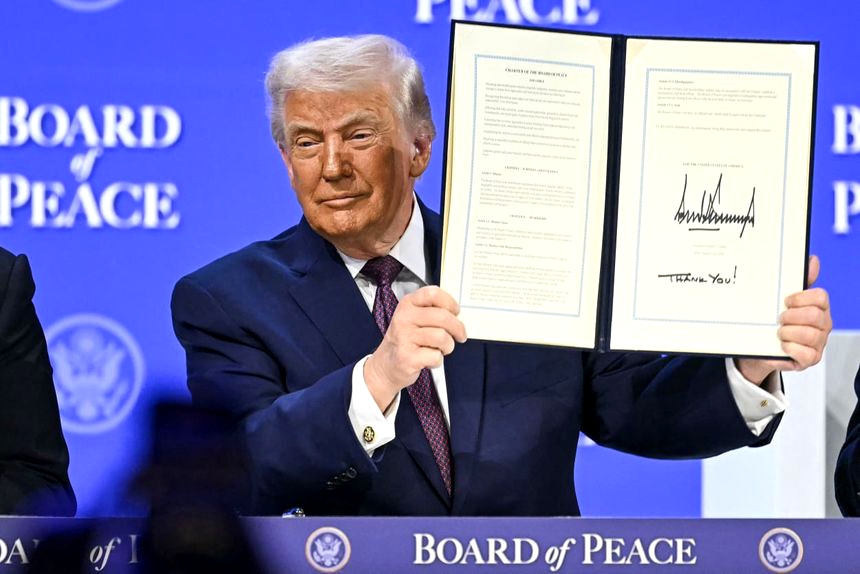
US President Donald Trump on Thursday formally launched his much-anticipated “Board Of Peace” at the World Economic Forum in Davos, unveiling a new global conflict-resolution body that has already sparked controversy among allies and critics alike.
The launch ceremony featured leaders and senior officials from 19 countries, who joined Trump on stage to sign the founding charter of the organisation. Trump, who will serve as the Board’s inaugural chairman, described the signatories as “very popular leaders — in some cases not so popular,” adding, “That’s the way it goes in life.”
Originally conceived as a mechanism to oversee peace efforts in Gaza following the Israel-Hamas war, the Board’s mandate has since expanded to include the resolution of international conflicts worldwide. This broader scope has raised concerns among diplomats and analysts that Trump intends the body to rival the United Nations, although he insisted it would work “in conjunction” with the UN.
Under the draft charter, membership runs for three-year terms, but countries willing to contribute $1 billion can secure permanent seats — a provision critics have described as creating a “pay-to-play” alternative to the UN Security Council. Trump will also wield sweeping powers, including the authority to veto decisions and remove members.
Allies Divided, Key Powers Absent
While several US-aligned governments participated, major Western allies Britain and France declined to attend, openly expressing scepticism about the initiative. The UK confirmed it would not take part in the signing ceremony.
The list of invitees and early supporters has also stirred controversy. Trump revealed that Russian President Vladimir Putin had been invited and had agreed in principle to join, though the Kremlin later said Putin was still reviewing the proposal — a development that has alarmed Ukraine and some NATO allies amid Russia’s ongoing war.
Israeli Prime Minister Benjamin Netanyahu, who faces an International Criminal Court arrest warrant over the Gaza conflict, has said he will join the Board but was absent from the Davos ceremony.
35 Countries Commit
According to a senior White House official, around 35 countries have formally accepted invitations out of roughly 50 issued so far. Early supporters span the Middle East, Europe, Asia and Latin America, with many leaders maintaining close political or personal ties to Trump.
Middle Eastern partners form a significant bloc, alongside countries recently involved in US-brokered diplomacy. Armenia and Azerbaijan both joined following a peace agreement last year, while the inclusion of Belarus — led by President Alexander Lukashenko — has drawn sharp criticism due to human rights concerns and its alignment with Moscow.
Read Also: Putin Invited to Trump’s ‘Board of Peace’ on Global Conflicts, Gaza Reconstruction
Full List Of Countries That Have Accepted Invitations
Middle East & North Africa:
Israel, Saudi Arabia, United Arab Emirates, Bahrain, Jordan, Qatar, Egypt, Morocco
Europe:
Turkey, Hungary, Kosovo, Armenia, Azerbaijan, Belarus
Asia:
Pakistan, Indonesia, Uzbekistan, Kazakhstan, Vietnam
Latin America:
Paraguay
US Secretary of State Marco Rubio, addressing the ceremony, said the Board’s immediate priority was ensuring that any Gaza ceasefire becomes “enduring.” Trump added that Hamas must disarm under the next phase of negotiations or face “the end of them.”
The launch comes as Trump continues to express frustration over failing to secure a Nobel Peace Prize, despite repeatedly claiming credit for ending multiple global conflicts.
Following the Davos event, Trump is scheduled to meet Ukrainian President Volodymyr Zelensky to discuss prospects for a ceasefire — a deal that remains elusive and could become the Board of Peace’s most consequential test.