

Trump Withdraws Canada’s Invitation to Board of Peace After Carney’s Davos Rebuke
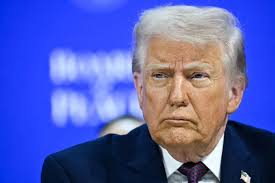
President of the United States Donald Trump has withdrawn an invitation for Canada to join his newly launched Board of Peace initiative, hours after formally unveiling the body and days after Canadian Prime Minister Mark Carney delivered a sharply worded speech at the World Economic Forum in Davos criticizing powerful nations for weaponizing economic integration.
The reversal followed Carney’s address at the annual Davos gathering, in which he warned against what he described as the erosion of the rules-based international order and urged middle powers to chart an independent course in global affairs.
In that speech, Carney criticized “powerful nations using economic integration as weapons and tariffs as leverage,” and called on countries to accept what he characterized as “the end of a rules-based global order.”
Read Also: Trump Rules Out Military Force on Greenland But Insists US Must Have “Ownership”
Trump announced the withdrawal in a public message aimed directly at the Canadian leader, posted on his Truth Social platform on Thursday, January 23, 2026.
“Please let this Letter serve to represent that the Board of Peace is withdrawing its invitation to you regarding Canada’s joining, what will be, the most prestigious Board of Leaders ever assembled, at any time,” Trump wrote in the post addressed to Carney.
The move marked an abrupt reversal of course. Just last week, Carney’s office had confirmed that the Canadian prime minister had been invited to serve on the board and that he planned to accept the invitation.
In Davos, Carney’s remarks reportedly drew a rare standing ovation from attendees at the World Economic Forum, according to observers present at the event.
The Canadian prime minister said Canada, which recently signed a trade deal with China, could demonstrate how “middle powers” might work together to avoid being “victimized by American hegemony.”
Carney praised the strengths of middle powers in his special address at Davos 2026, positioning Canada and similar nations as potential leaders in a shifting global landscape where traditional power structures are being challenged.
Trump responded forcefully to those comments while also speaking at the Davos forum. He argued that Canada “lives because of the United States” and that Carney should show appreciation for Washington’s historical support and security guarantees.
“Remember that, Mark, the next time you make your statements,” Trump said, addressing the Canadian prime minister directly during his own remarks in Switzerland.
The withdrawal of Canada’s invitation came just hours after Trump officially launched the Board of Peace, an initiative he initially described as a mechanism to help cement and maintain a ceasefire in Gaza.
According to Trump, permanent membership on the board carries significant financial obligations. “Permanent members must help fund the board with a payment of $1 billion each,” he stated.
Speaking in Switzerland on Thursday, Trump outlined what he described as the expansive scope of the body’s ambitions and authority.
“Once this board is completely formed, we can do pretty much whatever we want to do,” he said, adding, “And we’ll do it in conjunction with the United Nations.”
The board’s establishment was reportedly endorsed by a United Nations Security Council resolution as part of Trump’s broader Gaza peace plan, linking the initiative to ongoing efforts to stabilize the Middle East.
However, U.N. spokesperson Rolando Gomez clarified on Thursday that United Nations engagement with the board would be strictly limited to that specific context, suggesting the world body may seek to maintain distance from the initiative’s broader ambitions.
Read Also: Netanyahu Accepts Invitation To Join Trump’s Controversial Board Of Peace
Current member nations of the Board of Peace include Argentina, Bahrain, Morocco, Pakistan and Turkey. Other traditional U.S. allies including Britain, France and Italy—have indicated they will not join the initiative for now, raising questions about the body’s ultimate composition and international legitimacy.
The public spat between Trump and Carney represents a significant deterioration in U.S.-Canada relations, historically among the closest bilateral partnerships in the world. The two countries share the world’s longest undefended border, are deeply integrated economically through the United States-Mexico-Canada Agreement (formerly NAFTA), and have been military allies through NATO and NORAD for decades.
However, relations have experienced periodic tensions, particularly during Trump’s previous presidency from 2017 to 2021, when his administration imposed tariffs on Canadian steel and aluminum and engaged in contentious renegotiations of the North American Free Trade Agreement.
The current dispute comes amid broader shifts in global trade alignments. Canada’s recent signing of a trade deal with China, mentioned by Carney in his Davos address, represents a significant geopolitical move that appears to have contributed to tensions with Washington.
Carney’s emphasis on “middle powers” reflects a growing discourse among nations like Canada, Australia, South Korea, and various European states about their role in an increasingly multipolar world order. These countries, while lacking the military or economic heft of superpowers, often position themselves as defenders of international institutions and multilateral cooperation.
The Canadian prime minister’s warnings about the weaponization of economic integration echo concerns voiced by various international leaders about the use of trade sanctions, tariffs, and financial exclusion as tools of geopolitical competition. These debates have intensified amid ongoing trade tensions between the United States and China, Western sanctions on Russia following its invasion of Ukraine, and disputes over technology transfers and supply chain security.
Carney’s reference to “the end of a rules-based global order” represents a stark acknowledgment of the challenges facing the post-World War II international system, built around institutions like the United Nations, World Trade Organization, and International Monetary Fund. Critics of that system argue it has failed to adapt to changing power dynamics, while defenders maintain it remains essential for preventing conflict and fostering cooperation.