
US Blacklists Nigerians Over Rising Anti-Christian Violence
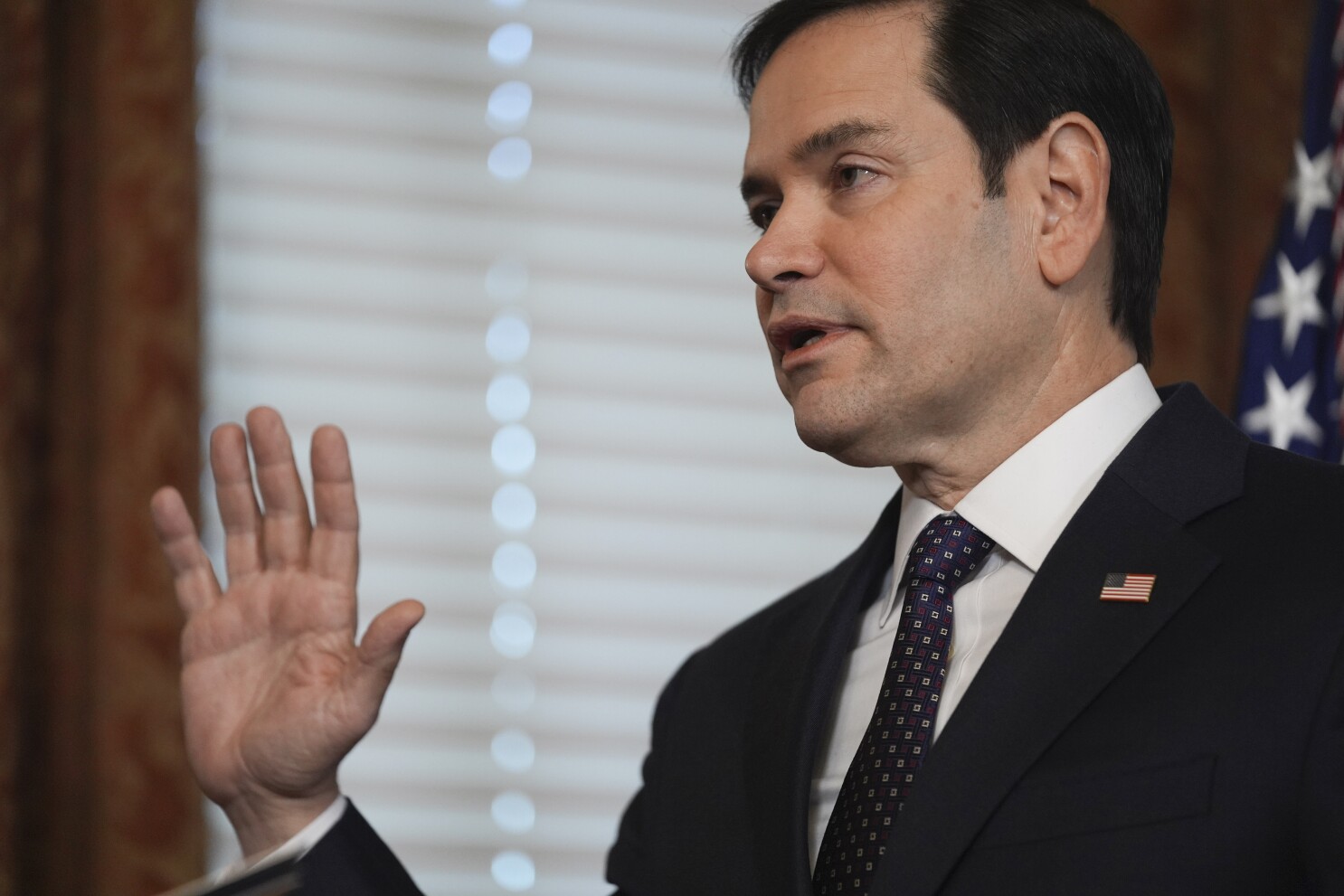 Secretary of State Marco Rubio is sworn by Vice President JD Vance in the Vice Presidential Ceremonial Office in the Eisenhower Executive Office Building on the White House campus, Tuesday, Jan. 21, 2025, in Washington. (AP Photo/Evan Vucci)
The United States has imposed fresh visa restrictions on Nigerians accused of involvement in the rising wave of attacks against Christians, signaling a tougher diplomatic stance on religious violence in the country.
The move was announced on Wednesday, December 3, 2025, by U.S. Secretary of State Marco Rubio, who described the policy as a direct response to what he called the “mass killings and violence against Christians by radical Islamic terrorists, Fulani ethnic militias, and other violent actors in Nigeria and beyond.”
The restrictions follow Nigeria’s recent designation as a “Country of Particular Concern” under the International Religious Freedom Act, a classification reserved for nations accused of severe violations of religious liberty.
Under Section 212(a)(3)(C) of the U.S. Immigration and Nationality Act, individuals found to have “knowingly directed, authorized, funded, supported, or carried out violations of religious freedom” will be denied U.S. visas. In some cases, the sanctions may also extend to immediate family members.
The announcement came after a high-level briefing held on December 2, 2025, in Washington, D.C., where members of the House Appropriations and Foreign Affairs Committees met with religious freedom advocates to review Nigeria’s worsening security situation. Central to the discussions was the abduction of 303 students and 12 teachers from St. Mary’s Catholic School in Papiri community, Niger State, on November 22, 2025.
Testifying at the briefing, experts including Sean Nelson of ADF International and Vicky Hartzler, Chair of the U.S. Commission on International Religious Freedom, said more than 7,000 Christians were killed for their faith in 2025 alone—an average of 35 deaths daily. They added that over 50,000 Christians have been killed since Boko Haram’s insurgency began in 2009.
Earlier, on November 20, 2025, the House Foreign Affairs Africa Subcommittee held a hearing on what it described as “systematic and accelerating violence” against Christians, particularly in Nigeria’s Middle Belt. Lawmakers were told that nearly 9,500 people—mostly Christians—were killed between May 2023 and May 2025, with more than 500,000 persons displaced.
A resolution sponsored by Rep. Chris Smith (H.Res. 866) accused the Nigerian government of “complicity” and faulted what it described as official denial of religious targeting. The resolution named Boko Haram, the Islamic State West Africa Province (ISWAP), and Fulani militant groups as key perpetrators, while also citing the existence of death-penalty blasphemy laws in 12 northern states as evidence of institutional religious intolerance.
The U.S. government has also drawn attention to the Miyetti Allah Cattle Breeders Association of Nigeria (MACBAN) and its affiliate, Miyetti Allah Kautal Hore, which some U.S. lawmakers want designated as “Entities of Particular Concern”—a category that includes groups such as the Taliban. MACBAN has rejected the allegation and urged the U.S. Congress to withdraw the recommendation, insisting it represents legitimate pastoralists, not militias.
Nigeria, with an almost even split between about 110 million Christians and Muslims, has long struggled with a deadly mix of religious extremism, land disputes, cattle rustling and banditry. Christian farming communities in the north-central region have been particularly vulnerable.
Since Boko Haram’s infamous 2014 abduction of 276 schoolgirls from Chibok, more than 19,000 churches have reportedly been destroyed across northern Nigeria. On November 17, 2025, another 25 schoolgirls were kidnapped from a school in Maga, Kebbi State, underscoring the persistence of the crisis.
President Bola Tinubu’s administration has continued to reject claims of systemic religious persecution, maintaining that the violence is part of a broader national security challenge driven by terrorism, banditry and criminal gangs.
However, with the new U.S. visa restrictions placing Nigeria alongside countries such as Iran, Russia and North Korea under similar sanctions regimes, diplomatic pressure is mounting on Abuja to demonstrate stronger action in protecting religious communities and prosecuting perpetrators.