
US Steps Up Intelligence, Arms Support to Nigeria in Fight Against Islamic State
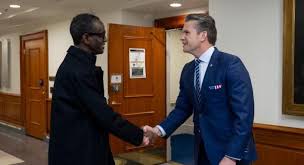
The United States military is expanding materiel deliveries and intelligence sharing with Nigeria as part of a broader American strategy to work with African militaries in targeting Islamic State-linked militants across the continent, the deputy commander of the US Africa Command has disclosed.
Lieutenant General John Brennan told news agency AFP that the Pentagon has also maintained open lines of communication with militaries in the junta-led Sahel countries of Burkina Faso, Niger, and Mali, despite the political upheavals that have strained relations between those nations and the West.
The increased cooperation with Abuja comes against the backdrop of Washington’s diplomatic pressure on Nigeria over jihadist violence in the country, but also as the US military adopts what Brennan described as a “more aggressive” approach in pursuing Islamic State-linked targets on the continent.
Read Also: US Boosts Nigeria’s Security Efforts with Fresh Military Supply Delivery
Speaking in an interview on the sidelines of a US-Nigeria security meeting in the Nigerian capital last week, Brennan said that under the administration of President Donald Trump, “we’ve gotten a lot more aggressive and (are) working with partners to target, kinetically, the threats, mainly ISIS.”
“From Somalia to Nigeria, the problem set is connected. So we’re trying to take it apart and then provide partners with the information they need,” he added.
“It’s been about more enabling partners and then providing them equipment and capabilities with less restrictions so that they can be more successful.”
Last week’s inaugural US-Nigeria Joint Working Group meeting took place roughly a month after the United States announced surprise Christmas Day strikes on Islamic State-linked targets in northwest Nigeria, marking a significant escalation in direct American military involvement in the country’s security challenges.
The expanded military cooperation, however, unfolds amid diplomatic tensions over how Washington has characterised the nature of violence in Nigeria. While both militaries appear keen on increased cooperation following the joint strikes, diplomatic pressure by the Trump administration over what it claims is the mass killing of Christians in Nigeria has cast a shadow over the partnership.
Abuja and independent analysts have rejected that framing of Nigeria’s myriad, overlapping conflicts, noting that it has long been used by the US religious right and oversimplifies the complex security situation in Africa’s most populous nation.
The charged politics were on display at the Joint Working Group meeting in Abuja, where Allison Hooker, the number three official at the US State Department, pushed the Nigerian government “to protect Christians” in a speech that did not mention Muslim victims of armed groups.
Nigeria is roughly evenly split between a mostly Muslim north and a mostly Christian south. Though millions live side by side peacefully, religious and ethnic identity remains a sensitive topic in a country that has experienced sectarian violence throughout its history.
Brennan told AFP that US intelligence support would not be limited to protecting Christians.
He also disclosed that following the US strikes in northwestern Sokoto state, American support going forward would focus on intelligence sharing to aid Nigerian air strikes in that region, as well as in the northeast, where a jihadist insurgency by Boko Haram and its rival breakaway faction, Islamic State West Africa Province, has raged since 2009.
Islamic State West Africa Province, known by the acronym ISWAP, is “our most concerning group,” Brennan stated.
Analysts have been tracking US intelligence flights over Nigeria in recent months, though some have questioned whether air support alone can effectively push back armed groups that thrive amid widespread poverty and state collapse in rural areas of the country.
According to Brennan, US-Nigerian cooperation going forward will involve “the whole gamut of intel sharing, sharing… tactics, techniques, and procedures, as well as enabling them to procure more equipment.”
The initial US strikes in December targeted militants linked to Islamic State Sahel Province, typically active in neighbouring Niger, Brennan said. Analysts have voiced concerns about ISSP’s spread from the Sahel into coastal West African countries like Nigeria, raising fears of a southward expansion of jihadist violence.
Read Also: Nigeria Confirms US Airstrikes, Says Joint Security Cooperation Targeted ISWAP Sites In North West
The impact of those strikes so far has been unclear, however, with local and international journalists unable to confirm militant casualties. Asked about their effectiveness, Nigerian Information Minister Mohammed Idris said last week it was “still a work in progress.”
In a significant disclosure about US engagement in the wider Sahel region, Brennan said “we still collaborate” with the junta-led governments in Burkina Faso, Mali, and Niger, countries which have broken away from their West African neighbours and largely shunned the West in recent years.
Security cooperation has been curtailed since military coups toppled civilian governments across the three countries between 2020 and 2023. The juntas have increasingly turned to Russia for military support and expelled French and American forces from their territories.
“We have actually shared information with some of them to attack key terrorist targets,” Brennan said. “We still talk to our military partners across the Sahelian states, even though it’s not official.”
The revelation suggests that despite public ruptures and the withdrawal of US military personnel from bases in the region, Washington has maintained back-channel military-to-military contacts with the Sahel juntas, driven by shared concerns over the spread of jihadist groups.
Brennan also said the United States is not seeking to replace its bases in Niger after its troops were pushed out by the ruling junta following the July 2023 coup that overthrew President Mohamed Bazoum.
“We’re not in the market to create a drone base anywhere,” he said, referencing the shuttered US drone operations in Agadez, which had been a key hub for American surveillance and strike operations across the Sahel.
“We are much more focused on getting capability to the right place at the right time and then leaving. We don’t seek long-term basing in any of the western African countries.”
The shift in US military strategy reflects a recalibration of American engagement in West Africa and the Sahel, moving away from large permanent bases toward more flexible, partner-focused operations that rely on intelligence sharing and enabling local forces to conduct their own strikes against jihadist targets.
The withdrawal from Niger marked a significant setback for US counter-terrorism operations in the Sahel, where American forces had invested heavily in building facilities and training local militaries. The loss of the Agadez drone base, which cost over $100 million to construct, deprived Washington of a key surveillance platform for monitoring militant movements across the region.
However, the increased focus on Nigeria, which shares borders with Niger, Chad, and Cameroon, and faces multiple security threats from jihadist groups, bandits, and separatist movements, suggests that Washington sees Africa’s largest economy and most populous nation as a critical partner in its counter-terrorism efforts on the continent.
Nigeria’s security challenges are complex and multifaceted. In the northeast, the insurgency by Boko Haram and ISWAP has killed tens of thousands and displaced millions since 2009. In the northwest and north-central regions, armed bandit groups have terrorised rural communities, kidnapping thousands for ransom and displacing entire villages. In the southeast, separatist agitations have occasionally turned violent.
The Nigerian military, despite being one of the largest and best-equipped in Africa, has struggled to contain these threats, hampered by corruption, poor morale, inadequate equipment, and the sheer scale of the country’s security challenges across its vast territory.
The US-Nigeria security partnership has had its ups and downs over the years, often complicated by human rights concerns over the conduct of Nigerian security forces and restrictions on American military sales imposed under the Leahy Law, which prohibits US assistance to foreign military units credibly accused of gross human rights violations.
Brennan’s comment that the US is now providing equipment and capabilities “with less restrictions” suggests a loosening of some of these constraints under the Trump administration, which has prioritised aggressive counter-terrorism operations over human rights considerations in its foreign policy.