
Ofure Akhigbe
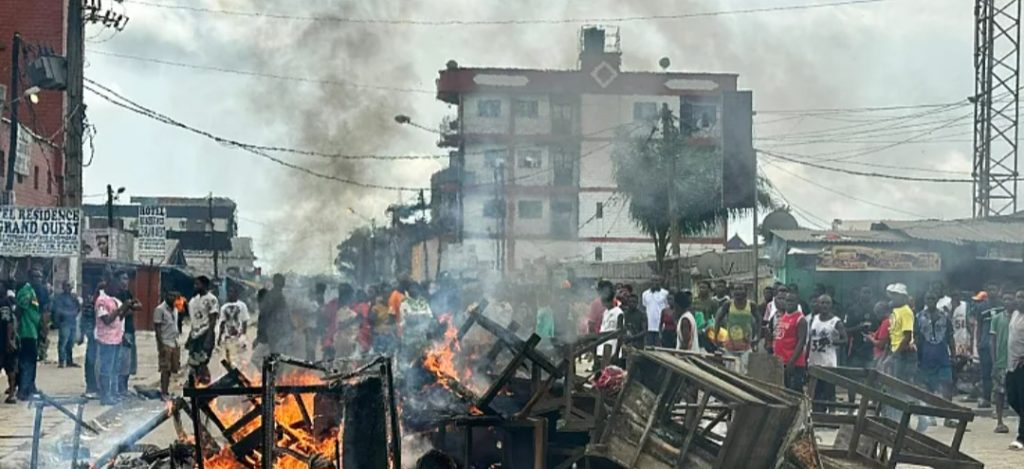
Barricades, fires, and reports of live gunfire marked violent scenes in Douala and several other Cameroonian cities on Monday, shortly after the Constitutional Council declared President Paul Biya, 92, the winner of the country’s presidential election. The announcement secured Biya an unprecedented eighth term in office, extending his rule that began in 1982 and making him one of the world’s longest-serving leaders.
The results, which came after a tense and closely watched vote, sparked outrage across the nation. Protests that began on Sunday, October 26, in Douala quickly spread to other major urban centers, including Yaoundé, Bafoussam, and Bamenda. Demonstrators took to the streets to denounce what they called a “sham election,” accusing the government of widespread fraud and intimidation during the voting process.
In Douala, the economic capital, angry residents set up barricades, burned tires, and clashed with security forces. Witnesses reported hearing bursts of live ammunition as police and soldiers attempted to disperse crowds using tear gas and rubber bullets. The military presence has since intensified, with armored vehicles stationed at major intersections and checkpoints.
Opposition candidate Issa Tchiroma Bakary rejected the results almost immediately after their announcement, alleging gross irregularities and calling for an independent review of the vote. “This is not democracy; this is domination,” Bakary said in a statement released late Monday. “The will of the Cameroonian people has once again been stolen.”
Residents described a city on edge. “I was crushed when I heard the news about the results,” said Max Ndongmo, a resident of Douala. “It was so shocking that I almost broke my TV. What they are doing is hypocrisy. To this government, I want to say — stop.”
Shops and schools in Douala remained closed on Tuesday as fears of further unrest grew. Public transportation was largely paralyzed, with most taxi drivers staying off the roads. The usually busy Akwa and Bonaberi districts were eerily quiet, except for the presence of heavily armed soldiers patrolling the streets.
Local human rights groups have condemned the government’s handling of the protests, warning against the excessive use of force. “We call on authorities to respect citizens’ right to peaceful assembly and to avoid further bloodshed,” said a spokesperson for the Cameroon Human Rights Network.
Meanwhile, international observers have expressed concern over the conduct of the election and the violent response to the outcome. The African Union and European Union both urged calm and called for dialogue between the government and opposition parties to prevent the situation from deteriorating further.
As of Tuesday morning, the government had not released an official statement on casualties or arrests. Unconfirmed reports from local media suggest that several people have been injured, and dozens detained, in clashes with security forces.
President Biya, often referred to as the “Sphinx of Etoudi” for his secretive and unyielding style of leadership, has faced repeated accusations of authoritarianism and electoral manipulation during his four-decade rule. Despite economic stagnation and persistent unrest, especially in the country’s Anglophone regions, he has maintained a firm grip on power through a loyal military and a tightly controlled political system.
Analysts warn that the latest protests could mark a new phase of instability in Cameroon if the grievances of the population are not addressed. For now, the streets of Douala remain tense — a city caught between anger and fear as its residents await what comes next in the long reign of Paul Biya.