
Iliyasu Abdullahi Bah
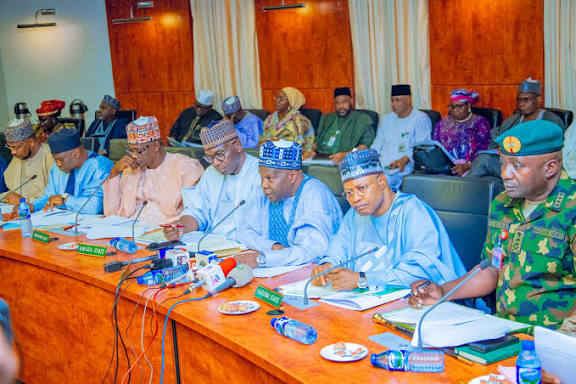
In a rare show of unified political and traditional authority on Monday, December 1, 2025, the 19 governors of Northern Nigeria, in collaboration with the Northern Traditional Rulers’ Council, unveiled a sweeping security blueprint and placed far-reaching demands before the Federal Government to address the region’s worsening insecurity.
The resolutions were reached at an emergency summit held at the Sir Kashim Ibrahim House in Kaduna and represent the strongest collective regional intervention yet against the intertwined threats of banditry, terrorism, kidnapping and illegal mining.
In a key decision, the forum directly linked the surge in illegal mining activities to the financing and arming of criminal networks. In a joint communiqué issued after the meeting, the leaders urged President Bola Ahmed Tinubu to issue an executive order directing the Minister of Solid Minerals Development to suspend all mining activities across Northern states for an initial period of six months.
They further demanded an immediate and comprehensive revalidation of all existing mining licences, insisting that the process must be conducted in strict partnership with state governments, which they said are better positioned to identify illegitimate operators. The proposed suspension is aimed at cutting off a major funding source for non-state armed groups and enabling the creation of a regulated and secure mining framework.
In a move reflecting a major financial commitment to regional self-reliance, the governors and traditional rulers also announced the establishment of a Northern Regional Security Trust Fund. Under the proposed funding structure, each of the 19 Northern states will contribute N1 billion monthly, while every local government area within the states will also make a yet-to-be-determined proportional contribution.
The fund, expected to generate tens of billions of naira monthly, will be used to finance regional security operations, including the acquisition of advanced surveillance equipment, coordinated aerial patrols, expanded community policing and logistical support for security agencies operating across the North.
The forum also reaffirmed its longstanding call for the creation of state police. The leaders urged all federal and state lawmakers from the region to urgently prioritize and fast-track the constitutional amendments required to legalize state policing. They argued that localized police forces, accountable to state authorities, are critical to addressing community-level security challenges that overstretched federal agencies can no longer effectively manage on their own.
While advancing these demands, the communiqué struck a conciliatory tone, commending the efforts of the Tinubu administration and the sacrifices of the Nigerian Armed Forces. The leaders specifically acknowledged the recent successful rescue of abducted schoolchildren as evidence of improving operational capacity.
The governors warned that the success of the new security strategy will depend largely on the Federal Government’s response. They noted that accepting the proposals would mark a decisive shift towards cooperative federalism in security management, while any rejection or delay could deepen regional-federal tensions and prompt unilateral actions by state governments.
The coming weeks, the leaders said, will be critical in determining whether the Northern security blueprint evolves into a sustainable model for regional stabilization or becomes another flashpoint in intergovernmental relations.