
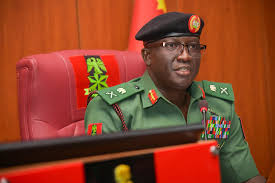
The Senate will today, Wednesday, December 3, 2025, screen retired General Christopher Gwabin Musa following his nomination by President Bola Ahmed Tinubu as Minister of Defence, in a move aimed at strengthening Nigeria’s security architecture amid worsening insecurity.
The nomination was transmitted to the Senate on Tuesday, December 2, 2025, through a formal letter addressed to Senate President Godswill Akpabio, coming barely 24 hours after the resignation of former minister Mohammed Badaru Abubakar on Monday, December 1, 2025. Badaru, who assumed office in August 2023 after serving two terms as Jigawa State governor, stepped down on health grounds. Official State House records confirmed that his resignation took immediate effect.
Announcing the accelerated screening, Senate Leader Opeyemi Bamidele told lawmakers during plenary that the upper chamber would give urgent attention to the request in view of the country’s security situation.
“We cannot delay such a request, especially at this crucial time in the history of our fatherland,” Bamidele said.
The process will follow constitutional provisions under Section 147 of the 1999 Constitution (as amended), which requires Senate confirmation of all ministerial nominees.
General Musa, who turns 58 on December 25, 2025, was born in 1967 in Sokoto State and hails from Zangon Kataf, Kaduna State. He is a graduate of the Nigerian Defence Academy, commissioned as a Second Lieutenant in 1991.
His career spans over three decades and includes appointments as General Staff Officer 1 (Training and Operations) at 81 Division Headquarters, Commanding Officer of 73 Battalion, and Assistant Director, Operational Requirements at Army Headquarters. In 2021, he served as Sector 3 Commander of Operation Lafiya Dole, later becoming Force Commander of the Multinational Joint Task Force (MNJTF) in the Lake Chad Basin.
Between 2021 and 2023, he served as Theatre Commander of Operation Hadin Kai, leading counter-insurgency efforts against Boko Haram and ISWAP. He was appointed Chief of Defence Staff (CDS) by President Tinubu in June 2023, a position he held until his retirement on October 31, 2025, marked by a pull-out parade at Mogadishu Cantonment, Abuja.
During his tenure as CDS, Musa championed joint military operations, including the 2024 coordinated army, navy, and air force operations in Zamfara State targeting banditry. He is a recipient of the Colin Powell Award for Soldiering (2012).
Musa’s nomination comes against the backdrop of heightened insecurity nationwide. On November 26, 2025, President Tinubu declared a national security emergency following a surge in kidnappings and bandit attacks across Kebbi, Borno, Zamfara, Niger, Yobe, and Kwara States.
In the broadcast, the President ordered mass recruitment into the Army and Police, and directed the redeployment of over 100,000 officers previously attached to VIP protection to frontline duties. The Department of State Services (DSS) was also tasked with deploying trained forest rangers to dismantle criminal camps.
Government records from the same period confirm the rescue of 24 schoolgirls in Kebbi State and 38 worshippers in Kwara State, though several victims remain in captivity, including pupils abducted from Catholic schools in Niger State.
The Ministry of Defence, restructured under the 1979 Constitution and refined in 1999, has traditionally balanced civilian oversight with military expertise. Former ministers include Lt. Gen. Theophilus Danjuma (rtd.), who served in the 1970s.
Under Badaru’s leadership, defence procurement dominated the ministry’s focus, with the 2024 federal budget allocating N3.25 trillion to arms acquisition and military platforms. However, persistent insurgency, banditry, and farmer-herder clashes led to renewed urgency for strategic reforms.
Presidential spokesperson Bayo Onanuga said Musa’s nomination was informed by his experience in inter-agency coordination and battlefield operations, urging the Senate to approve him without delay.
If confirmed, Musa will oversee defence operations at a time of intense pressure on security forces, expanding recruitment drives, and growing collaboration with regional outfits such as Amotekun. With 2026 budget negotiations and pre-election security planning on the horizon, his performance will be closely watched as Nigeria confronts persistent internal threats.