
Temitayo Olumofe
It is a common sight in Nigeria for a young university graduate, clutching a worn CV, navigating the city in search of a job that doesn’t exist. This scene of bright potential dimmed by an outdated education system is not just a personal tragedy; it is a national economic crisis. For too long, the white-collar dream, often disconnected from the realities of the labour market, has overshadowed the dignity and power of skilled trades.
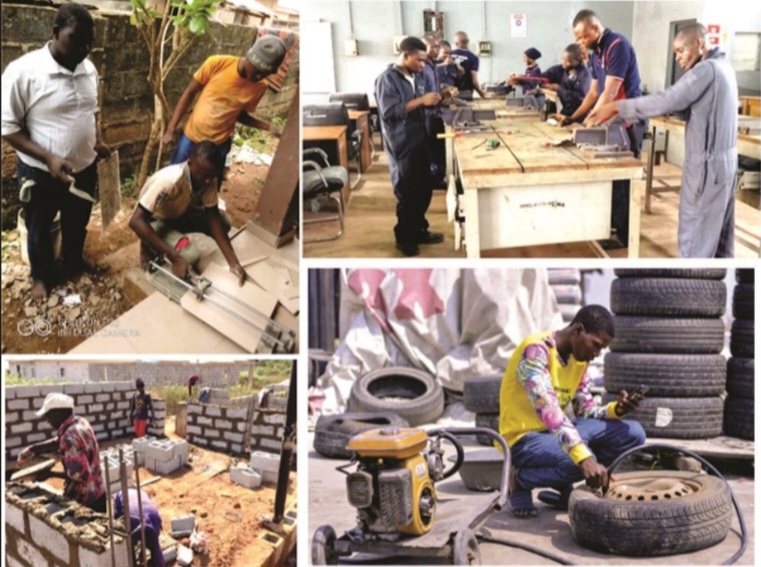
However, a seismic shift is underway. The Federal Government has thrown a massive anchor into the waters of vocational training, officially unveiling and equipping 1,600 Technical and Vocational Education and Training (TVET) centres across the country. This isn’t just a policy announcement; it’s a direct challenge to the endemic problem of youth unemployment and a decisive pivot toward a productive, skill-based economy. It is the moment Nigeria decided to rebuild itself, not from the top down with degrees, but from the ground up with expert hands.
The journey to this monumental rollout began with an initial push under the current administration’s Renewed Hope Agenda. While the initiative’s formal launch for registration began in May 2025, the official confirmation of the expansive scale of 1,600 accredited centres ready for training was highlighted in the months that followed, gaining significant attention around December 2025 as payments commenced.
The scope of this initiative is staggering. The Federal Ministry of Education confirmed that over 1.3 million Nigerian youths completed applications for the program shortly after the portal opened, highlighting the massive latent demand for practical skills. As of the recent updates in early December 2025, over 250,000 trainees are already enrolled in the first cohort, undergoing practical, hands-on training across these centres nationwide.
Education Minister, Dr. Maruf Tunji Alausa, has been the face of this ambitious project, consistently emphasising its core philosophy. He was quoted as saying:
“The rapid commencement of payments under the TVET initiative is a clear execution of the President’s directive to invest aggressively in our young people. Equipping our youth with in-demand, practical skills is the fastest way to drive job creation, entrepreneurship, and national economic growth.”
This focus on in-demand skills is crucial. The programme concentrates on 28 key skill areas, including essential trades such as fashion and garment making, livestock production, GSM repair, plumbing, tiling, and automotive services. Critically, the curriculum is structured to be 90 percent practical and 10 percent theoretical, a radical departure from the theory-heavy models of the past.
The government’s commitment was further cemented with the disbursement of the first tranche of payments in early December 2025. This saw over 42,000 students receive a monthly stipend of ₦22,500 to cover transportation and basic upkeep, with over 600 independent training centres receiving direct payments for the instructional services they provide. This dual approach of supporting both the student and the training institution is designed to maintain momentum and quality.
The announcement has been met with a wave of cautious optimism from key stakeholders, while also raising critical questions about sustainability and quality control.
For industry leaders, this is seen as a long-overdue intervention. Mr. Oluwatobi Ajayi, the Chairman and CEO of NORD Motors, and other manufacturers have been actively invited to partner with the Ministry. The expectation is that this partnership will provide company facilities as accredited centres, offer technical support for curriculum alignment, and facilitate industrial attachments for trainees.
The National Board for Technical Education (NBTE) has consistently argued that revitalising TVET is crucial for national development, urging Nigeria to follow the paths taken by industrialised nations. They stress that the initiative, combined with the new Nigerian Education Loan Fund, which offers financial support for technical students, will make technical careers genuinely attractive.
The scale is the biggest win here. Hitting 1,600 centres simultaneously sends a powerful signal that the government is serious. For too long, TVET has been treated as a backup plan. By giving these students a stipend and linking them directly with industry, the administration is effectively rebranding the artisan, transforming the plumber, welder, and technician into the valuable backbone of our economy. This is perhaps the most practical, results-oriented youth initiative in a decade.
The biggest legal and structural hurdle remains accreditation and quality control across such a large, diverse network of centres. While the NBTE has clear guidelines for the establishment of private technical institutions, the rapid onboarding of 1,600 centres, which includes both existing institutions and newly accredited facilities, raises the spectre of ‘mushroom’ centres that lack the necessary modern equipment or qualified instructors.
A recent memo sighted by The PUNCH newspaper, which revealed plans to engage retired teachers as tutors, speaks to the critical human capital gap. While retired teachers bring experience, the question is whether their skills align with the 90 percent practical, industry-relevant modern curriculum in fields such as renewable energy installation or digital economy skills. The Minister’s letter noted that part of the partnership with the private sector includes “knowledge-exchange initiatives to improve instructional quality and trainer capacity.” This needs rigorous legal backing and execution to ensure training standards don’t dip.
Furthermore, a significant concern raised by employment experts focuses on the programme’s sustainability and funding. Past vocational training initiatives have often collapsed due to inconsistent funding, policy abandonment mid-stream, and inadequate maintenance of equipment. A commentator from an industry body, speaking on condition of anonymity, noted:
“The money for stipends and centres is a good start, but what guarantees that a new administration, or even a reshuffling of the cabinet, won’t pull the plug? The legal framework must enshrine a sustained, non-partisan funding mechanism for TVET, perhaps through a dedicated skills development levy on major corporations.”
This perspective is crucial, especially considering a contrasting and concerning report from late 2025 about the purported closure of 1,600 vocational centres due to “budgetary constraints,” a claim that directly contradicts the active payment and accreditation news. Though this report appears to relate to a different, perhaps older initiative or a false alarm, it underscores the public’s anxiety about policy continuity in Nigeria. The current administration must ensure that the legal and budgetary commitments for this Renewed TVET Initiative are iron-clad, ensuring it is ring-fenced from future political vagaries.
This network of 1,600 centres, therefore, represents more than an educational reform. It is the clearest blueprint yet for how Nigeria intends to achieve industrialisation in the 21st century: one trained, competent artisan at a time. The nation is watching, hoping that this time the policy does not kick off strongly but last long, permanently transforming the destiny of millions of its most valuable asset, its youth.