
Modupe Olalere
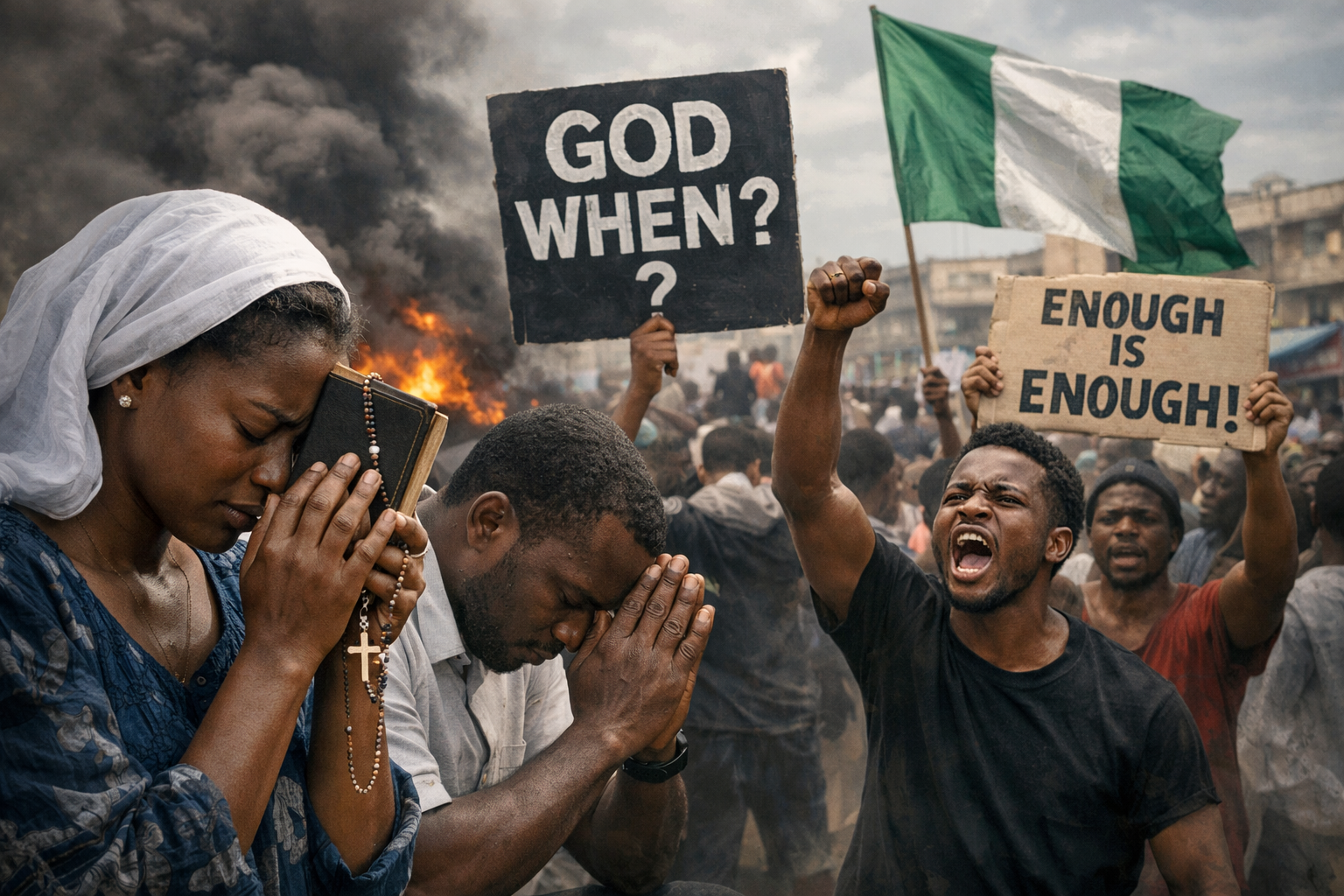
In Nigeria, the question “God, when?” is whispered in churches, shouted in protests, and scrawled across social media feeds. It is more than a question; it is a reflection of the tension between unwavering religious faith and a pressing need for social action. Nigerians are navigating a reality where praying for justice often exists side by side with marching for it, revealing a society where spiritual belief and civic engagement are constantly in conversation.
Prayer as a First Response
For many Nigerians, prayer is the default response to injustice. Churches, mosques, and shrines serve as gathering points where communities collectively seek divine intervention. According to a 2021 Pew Research Center survey, more than 90% of Nigerians identify as religious, and a large proportion believes that spiritual action can influence daily life and societal outcomes. Religious leaders often emphasize patience and faith. Pastor Enoch Adeboye of the Redeemed Christian Church of God once said, “We must pray and believe that God is working, even when the situation seems hopeless.”
Prayer’s role is also reflected online. Social media platforms are flooded with hashtags like #PrayForNigeria, where citizens combine personal supplication with calls for accountability. Scholars note that this virtual piety is part of a broader civic expression. Dr. Biodun Jeyifo, a Nigerian social scientist, observes, “Prayers in the digital age are not just spiritual acts; they signal moral outrage and societal expectation.” The act of praying becomes a public declaration that injustice is being noticed, and moral attention is being directed at those responsible.
Protest as Public Pressure
Yet, alongside prayer, Nigerians have long turned to protest when faith alone does not seem to produce change. From the 2012 Occupy Nigeria movement over fuel subsidies to the End SARS protests against police brutality in 2020, demonstrations have punctuated the national dialogue. These movements show that faith in God does not preclude a belief in civic responsibility.
During the End SARS protests, organizers often invoked religious imagery to underscore their moral stance. One banner read, “Our prayers will not protect us if the system fails us.” The statement captures a key tension: citizens maintain spiritual belief while insisting on social accountability. Historian Toyin Falola points out, “The Nigerian psyche integrates religious expectation with public action. Belief in divine justice is frequently intertwined with a demand for human enforcement of rights.”
Protests also serve as a feedback loop for religious communities. Religious organizations sometimes act as mediators or amplifiers for civic demands. During the 2020 End SARS movement, some church groups provided safe spaces for protestors and organized post-protest debriefings that combined prayer with civic education. This demonstrates how faith-based initiatives can adapt to the needs of a socially aware populace, bridging the gap between spiritual solace and public activism.
Read Also: The “Sapa” Economy: How Nigerians Are Innovating Survival in a Cashless Crisis
The Tension Between Faith and Action
However, the coexistence of prayer and protest is not always harmonious. Tensions arise when religious authorities urge patience while citizens demand immediate justice. Critics argue that excessive reliance on prayer can normalize inaction or even perpetuate injustice. Activist Chimamanda Ngozi Adichie has remarked, “We are a nation that prays a lot, but acts too little when action is required.” This critique points to a challenge within the Nigerian psyche: balancing devotion with accountability.
The interplay between faith and action also appears in education and policy. Students, community leaders, and civil servants frequently navigate conflicting messages about moral duty and practical intervention. Scholars suggest that teaching civic engagement alongside moral reasoning can harmonize these seemingly opposing forces. Professor Adebayo Olukoshi of the Institute of African Studies explains, “Nigerians are capable of integrating spiritual belief with civic responsibility. The key is cultivating practical skills alongside moral insight.”
The tension extends to media representation. Newspapers and television often highlight both prayer campaigns and street demonstrations, illustrating a national narrative that values spiritual guidance and social mobilization equally. Religious faith and social action feed into each other: prayer provides hope and moral framing, while protest channels frustration into visible, collective demands. This synergy is visible in rural and urban settings alike, showing that religious belief does not diminish the impulse to act.
Prayer and Protest in Everyday Life
In daily Nigerian life, this balance manifests in personal decisions as well. A mother may pray for her child’s safety while joining a local campaign against underfunded schools. Young professionals might attend church services for guidance while participating in community cleanups or advocacy programs. The dual approach demonstrates an understanding that spiritual and social responsibilities are interdependent.
Digital platforms amplify these actions. Twitter, Instagram, and WhatsApp are spaces where prayers, petitions, and protest plans coexist. Hashtags, videos, and memes link personal devotion to civic mobilization, creating a culture where online religiosity informs offline action. Sociologist Dr. Amina Yusuf explains, “In Nigeria, the digital public sphere blurs the line between prayer and protest, making both visible and mutually reinforcing.” By integrating spiritual expression with civic engagement, Nigerians navigate injustice with both hope and action.
Even cultural productions, like music and film, reflect this interplay. Gospel artists often address societal issues, weaving prayers into messages of resistance, while filmmakers portray characters who oscillate between faith-based patience and direct activism. These creative expressions reinforce the notion that religious faith and social action are not mutually exclusive but are part of a continuous dialogue that shapes public consciousness