
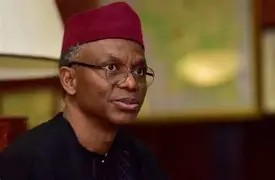
An official from the African Democratic Congress has pressed anti-graft authorities to either file charges against former Kaduna State Governor Nasir El-Rufai or let him go, amid questions over the legality and transparency of his ongoing detention linked to corruption inquiries.
Usman Austin, in a public statement released on Saturday, voiced worries about the handling of El-Rufai’s case by the Independent Corrupt Practices and Other Related Offences Commission, urging strict compliance with legal norms. He drew parallels to recent Department of State Services practices, which have involved court proceedings instead of indefinite holds. “The decision of the DSS to approach a court of law rather than resorting to arbitrary detention is both civil and democratic. The DSS has shown that the proper way to handle such matters is to let the court decide through merit-based arguments from both the prosecutor and the defendant,” Austin said.
Austin insisted that accusations against El-Rufai warrant courtroom scrutiny if valid. “If there are allegations against El-Rufai, they should be addressed in court, stressing the importance of adhering to established legal procedures,” he added. He pointed out El-Rufai’s earlier compliance with an Economic and Financial Crimes Commission summons, portraying him as amenable to scrutiny. “The EFCC is yet to explain the circumstances of this custody—whether Mallam El-Rufai was officially handed over to the ICPC or if he was re-arrested after being granted administrative bail. This ambiguity undermines the rule of law,” Austin noted.
He underscored the principle of presumption of innocence. “Arresting someone before commencing an investigation is a gross abuse of the right to a fair hearing. Anti-corruption agencies must not allow themselves to become willing tools of oppression if they wish to strengthen Nigeria’s democracy. The ICPC must uphold the standards of a civilised society. If there is a case against El-Rufai, let it be argued in court. If not, he must be released immediately,” the statement concluded.
El-Rufai arrived at the EFCC’s Abuja headquarters around 10 a.m. on Monday in response to an invitation and remained there until Wednesday. Sources within the EFCC told reporters that he was released but immediately taken into ICPC custody. The ICPC affirmed his presence in a Wednesday statement by its Head of Media and Public Communications, John Odey: “The Independent Corrupt Practices and Other Related Offences Commission (ICPC) writes to state that Malam Nasiru El-Rufai the former Governor of Kaduna state is in our custody as at close of work today Wednesday the 18th day of February, 2026. Malam Nasiru El-Rufai is in the custody of the Commission in connection with investigations.”
By Thursday, El-Rufai had spent a second night at the ICPC, with no public details on charges. That day, ICPC operatives searched his Abuja residence on Aso Drive as part of the probe. His aide, Muyiwa Adekeye, confirmed the raid, while lawyer Ubong Akpan decried it as illegal: “This is illegal and a violation of legal and fundamental rights.” An ICPC official verified El-Rufai’s continued detention but withheld specifics.
Reports vary on DSS involvement, with some indicating operatives assisted in the transfer from EFCC, though the agency has not confirmed. El-Rufai earlier alleged a DSS attempt to abduct him at the airport upon returning from abroad, claiming over 50 agents acted on ICPC orders without an invitation letter. “I asked for a letter of invitation, and none of them had a letter of invitation to present. I refused to follow them without this invitation, and they tried to force me to go with them. One of my aides was beaten up, and my passport was seized from him,” he stated in an interview. He accused National Security Adviser Nuhu Ribadu of orchestrating it: “Nuhu Ribadu made the call and ordered that I must be in custody when I landed.”
The inquiries trace to a 2024 Kaduna State House of Assembly ad-hoc committee report alleging N423 billion in misappropriated loans, abuse of office, contract irregularities, diversion of funds, money laundering, and excessive borrowing during El-Rufai’s 2015-2023 tenure. Speaker Yusuf Liman highlighted the siphoning, leaving heavy debts. The committee recommended probes and prosecutions for El-Rufai and aides. El-Rufai rejected it as politically driven and sued the assembly, challenging the findings.
Separately, the DSS has charged El-Rufai with cybercrime for allegedly bugging Ribadu’s phone, with arraignment slated for February 25. This stems from El-Rufai’s claim of being tipped off about an arrest warrant.
Born February 16, 1960, El-Rufai’s career began in privatization under President Olusegun Obasanjo, serving as Bureau of Public Enterprises Director-General from 1999 and National Council on Privatization Secretary. As FCT Minister (2003-2007), he spearheaded reforms, demolitions, and land digitization but faced graft accusations, leading to 2008 exile; cleared upon return. A founding APC member, he governed Kaduna from 2015, focusing on urban renewal but criticized for demolitions, security lapses in Southern Kaduna (over 4,000 deaths 2011-2015 per Southern Kaduna People’s Union), Shia killings in Zaria (1,000 in 2016), and alleged bias. He admitted compensating foreign Fulani herdsmen in 2016 to avert attacks, sparking outrage. Defected to ADC in November 2025 after APC fallout.
Public reactions on social media include calls for due process, with some viewing it as political persecution. One user noted: “El-Rufai has been in detention for 3 days and Heaven hasn’t fallen? Moral lesson: Don’t allow anybody deceive you that you can fight the government.” Another said: “ICPC, EFCC AND DSS are currently prosecuting El-Rufai simultaneously… Meanwhile, Peter Obi… has not faced a single prosecution.” Supporters like one tweeting: “Free Malam @elrufai or charge him to court.” Critics, including Reno Omokri, demand accountability for the N423 billion claims.