


Man Electrocuted In Awka While Vandalising Transformer
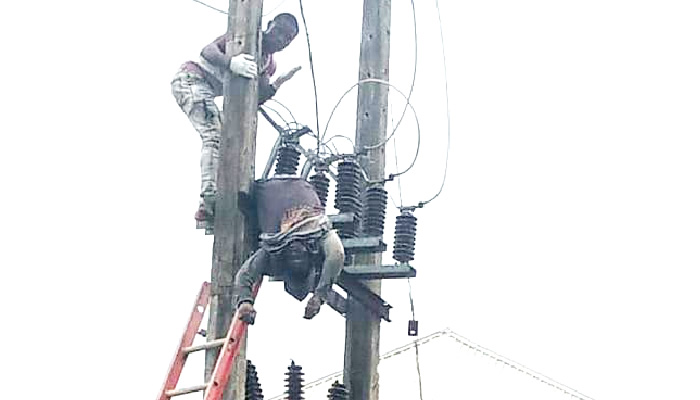
A heavy explosion at a transformer substation in Ogechukwu Street, Awka, claimed the life of an unidentified man suspected of attempting to steal electricity cables from FirstPower Electricity Distribution Company Limited early Tuesday morning.
The incident highlights the ongoing dangers of energy theft in Anambra State’s capital, where the suspected vandal, dressed in a security uniform, was found lifeless after tampering with the infrastructure. Personnel from the distribution company arrived to assess the damage and discovered the body on the substation floor.
In a press statement issued by Izunna Okafor, the head of communications for FirstPower, the company confirmed the event and urged greater community vigilance. “FirstPower Electricity Distribution Company Limited confirms an unfortunate incident that occurred in the early hours of Tuesday, February 24, 2026, at Ogechukwu Street, Awka, involving the electrocution of a suspected vandal,” the statement read in part.
It continued: “Preliminary reports indicate that a heavy explosion occurred at a transformer substation within the area. Upon further assessment, it was discovered that the explosion resulted from unlawful tampering with FirstPower’s electricity network infrastructure by a suspected vandal dressed in security uniform. The yet-to-be-identified individual was immediately electrocuted in the process.”
The statement noted that the Anambra State Police Command had been notified, with operatives evacuating the body and launching an investigation into the circumstances. FirstPower appealed to residents and community leaders to report suspicious activities around electricity installations promptly.
Okechukwu Okafor, the managing director of FirstPower, condemned such acts in the statement, describing them as detrimental to the power sector. “Beyond the significant financial losses and service disruptions caused by such criminal activities, they also endanger the lives of perpetrators and innocent members of the public,” he said.
He added: “FPEDL also appeals to residents and community leaders to remain vigilant and promptly report any suspicious activities around electricity installations via 08161652465 (WhatsApp or SMS), or to the nearest security agency. Protecting power infrastructure is a collective responsibility, and community cooperation remains vital in safeguarding assets meant to serve the public good.”
Okafor further emphasised the company’s commitment: “FirstPower remains committed to delivering safe, efficient, and improved electricity services to our customers. We will continue to work closely with security agencies and stakeholders to curb vandalism and ensure adequate protection of our network facilities.”
This electrocution comes against a backdrop of persistent vandalism plaguing Nigeria’s electricity infrastructure, a problem that has deep roots in the nation’s power sector challenges. Historical records trace widespread energy theft and sabotage back to the early post-independence era, when inadequate infrastructure and economic pressures fueled illegal connections and tampering. By the 1980s, as Nigeria’s population grew and urbanisation accelerated, reports of cable theft and meter bypassing became commonplace, often linked to poverty, unemployment, and the scrap metal trade.
Official data from the Transmission Company of Nigeria (TCN) underscores the scale of the issue. In 2025, TCN recorded 131 cases of infrastructure vandalism across its network from January to November, contributing to frequent grid collapses and service disruptions. Within the same year, vandals destroyed 128 transmission towers over 11 months, exacerbating power outages nationwide. Earlier statistics from TCN indicate that between January and August 2024, 63 power transmission towers were destroyed, primarily in northern regions, though incidents span the country.
The economic toll is staggering. According to sector reports, Nigeria’s power industry loses billions of naira annually to electricity theft and vandalism, hindering GDP growth and infrastructure development. The National Bureau of Statistics has linked power supply issues, worsened by such crimes, to broader economic setbacks. A surge in attacks was noted in early 2025, with over 18 transmission towers vandalised between January 9 and 14 alone. By mid-2025, TCN reported at least 42 acts of vandalism affecting 178 towers.
In Anambra State, where this latest incident occurred, vandalism reflects national trends, often involving scavengers targeting cables and transformers for resale. Studies on the causes of such acts point to economic hardship, weak enforcement, and the lucrative black market for stolen materials as key drivers. Mitigation efforts have included community sensitisation, enhanced security patrols, and collaborations between distribution companies like FirstPower and law enforcement, but challenges persist amid funding gaps and vast networks.
Pipeline vandalism in the oil sector, which shares parallels with electricity sabotage, has cost Nigeria over 300,000 barrels per day in losses, as per historical analyses, further straining energy resources. Overall, experts from bodies like the Athena Centre note that infrastructure deficits are compounded by vandalism, calling for stronger legal frameworks and public awareness campaigns.