

Tinubu in London for Historic State Visit
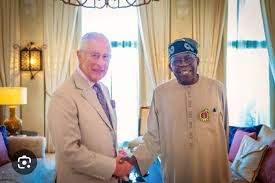
President Bola Tinubu arrived in London on Tuesday for a state visit hosted by King Charles III, marking the first formal state engagement between Nigeria and the United Kingdom in nearly four decades as both nations seek to deepen economic, security, and diplomatic cooperation amid shifting global alliances.
The three-day visit, which begins with an official welcome ceremony on Wednesday, represents a significant elevation of bilateral relations between Africa’s most populous nation and its former colonial ruler, coming at a time when Nigeria is navigating complex domestic challenges and Britain is recalibrating its post-Brexit engagement with Commonwealth partners.
Tinubu and First Lady Oluremi Tinubu will be received on Wednesday by Prince William and Catherine, Princess of Wales, before the Nigerian president proceeds to Windsor Castle for a formal audience with King Charles III. The day will culminate in a state banquet hosted by the British monarch, an honour reserved for heads of state with whom Britain maintains special relationships.
On Thursday, Tinubu is scheduled to hold high-level talks with British Prime Minister Keir Starmer at Downing Street and will meet representatives of the Nigerian diaspora community in the United Kingdom, which numbers over 200,000 according to the latest UK Office for National Statistics data. King Charles hosted a reception for members of the Nigerian diaspora at St James’s Palace last week in preparation for the state visit.
The visit provides both governments an opportunity to advance discussions on trade expansion, security cooperation, infrastructure financing, and governance support ahead of Nigeria’s 2027 presidential election, according to Samuel Orovwuje, a Nigerian public affairs analyst and member of the African Development Studies Centre.
“We have a good trading relationship with the UK, but if you look at the balance of trade, it has always been in the favour of the UK,” Orovwuje told Agence France-Presse.
Trade between the two nations reached £8.1 billion in the year ending September 2025, representing an 11.4 percent year-on-year increase, according to UK government trade statistics. However, the balance has consistently favoured Britain, with Nigerian imports from the UK exceeding its exports to the former colonial power.
London and Abuja concluded a strategic partnership framework in November 2024 aimed at strengthening economic cooperation, immigration management, and security collaboration. The agreement built on an economic cooperation pact signed in early 2024 under Britain’s previous Conservative government, which facilitated increased investment flows and regulatory harmonization in key sectors including banking, energy, and telecommunications.
Several major Nigerian banks, including Guaranty Trust Bank, Access Bank, and Zenith Bank, operate subsidiaries in the United Kingdom, serving both the diaspora community and facilitating trade finance between the two economies. The UK remains Nigeria’s second-largest trading partner in Europe after Germany.
A major infrastructure agenda item expected to feature prominently in discussions is the $700 million rehabilitation project for the Apapa and Tin Can Island ports near Lagos, Nigeria’s economic capital. UK Export Finance, Britain’s export credit agency, has provided partial loan guarantees for the project, which aims to modernize cargo handling capacity and reduce congestion at facilities that handle over 60 percent of Nigeria’s maritime trade.
Security cooperation is also high on the agenda following an intensification of jihadist violence across Nigeria’s northern and central regions. Earlier this year, the Nigerian Ministry of Defence announced plans to strengthen defence ties with Britain after a massacre that killed more than 160 people in central Kwara State was attributed to jihadist militants.
Nigeria has confronted a violent insurgency led by Boko Haram and Islamic State West Africa Province since 2009, with the conflict claiming over 350,000 lives and displacing more than three million people across the northeast, according to data from the Armed Conflict Location and Event Data Project. The violence has spread in recent years to the northwest and central regions, complicating security responses.
The insurgency has triggered diplomatic tensions between Nigeria and the United States, a key British ally, after Washington claimed in January 2026 that the violence amounted to a “genocide” of Christians. The Nigerian government strongly rejected the allegations, describing them as “unfounded and inflammatory,” and summoned the US ambassador for consultations. Britain has maintained a more measured position, emphasizing the need for coordinated international support for Nigerian security forces while avoiding characterizations that could escalate diplomatic friction.
However, the state visit is not without potential complications. First Lady Oluremi Tinubu, a Christian pastor, is scheduled to preach at services at Lambeth Palace and meet representatives of the Church of England during the visit. The timing is sensitive, as the Church of England is experiencing a significant rift over the election of Sarah Mullally as Archbishop of Canterbury, the first woman to hold the position of spiritual leader of Anglicans worldwide.
Conservative Anglicans, predominantly from African dioceses, have rejected Mullally’s appointment and convened in Abuja earlier this month under the Global Anglican Future Conference, which describes itself as a movement of “authentic” Anglicans. The gathering elected Laurent Mbanda, the Archbishop of Rwanda, as chairman of their alternative leadership structure, deepening the schism within global Anglicanism. Observers have noted that First Lady Tinubu’s church engagements could be interpreted as a signal of Nigeria’s position in the ecclesiastical dispute.
Another notable omission from the official schedule is a traditional meeting between President Tinubu and the leader of Britain’s opposition Conservative Party. Kemi Badenoch, who leads the Conservatives and is of Nigerian descent, has repeatedly criticized Nigeria over corruption and governance failures in public remarks since assuming party leadership in 2024. Her comments have drawn backlash from Nigerian officials and diaspora groups who accused her of disparaging her country of birth for political gain in Britain.
Badenoch, born in London to Nigerian parents and raised partly in Lagos, has described Nigeria as a country where “politicians were quite open about the fact that they were stealing money” and suggested that her Nigerian upbringing exposed her to systemic dysfunction. Nigerian government officials have described her remarks as “unfortunate and disrespectful,” though no formal diplomatic protest has been lodged.
The absence of a meeting between Tinubu and Badenoch suggests lingering diplomatic sensitivities, despite the tradition of visiting heads of state engaging opposition leaders during state visits to demonstrate balanced diplomatic engagement.
Historical grievances also loom over the visit. A Nigerian court issued a judgment in February 2026 ordering the British government to pay £420 million in compensation to the families of coal miners killed during a violent suppression of labour protests by colonial authorities in Enugu in 1949. The British government has not publicly responded to the court order, and legal experts have questioned the enforceability of Nigerian court judgments against a sovereign foreign government.
The issue of artefact restitution remains another unresolved tension. While museums across Europe and North America have begun returning looted cultural property to African nations of origin, the British Museum has been a notable holdout, citing legal restrictions under the British Museum Act of 1963, which prohibits the disposal of objects from its collection except in limited circumstances. Nigeria has formally requested the return of hundreds of Benin Bronzes and other cultural artefacts looted during the 1897 British punitive expedition against the Kingdom of Benin, but negotiations have produced limited results.
The current state visit is the first formal engagement of its kind between Nigeria and Britain since 1989, when then-President Ibrahim Babangida was received by Queen Elizabeth II. However, President Tinubu was received by King Charles during a working visit in September 2024, shortly after assuming office, and has made multiple trips to London during his tenure, including private medical visits that have drawn criticism from opposition politicians.
Before the death of his mother, Queen Elizabeth II, in September 2022, King Charles visited Nigeria four times as Prince of Wales, most recently in 2018 when he toured Lagos and Abuja and met with traditional rulers and community leaders. His engagement with Nigeria reflects long-standing personal and institutional ties between the British royal family and Nigerian traditional institutions.
Nigeria gained independence from Britain on October 1, 1960, after more than six decades of colonial rule that began with the formal establishment of the Lagos Colony in 1861 and expanded through military conquest and diplomatic annexation to encompass the entire territory by 1914. The legacy of colonialism continues to shape political, economic, and cultural relations between the two nations, with Britain remaining a major destination for Nigerian students, migrants, and investors.
The state visit is expected to conclude on Thursday evening with President Tinubu’s departure for Abuja. Both governments are expected to issue a joint communiqué outlining areas of enhanced cooperation and specific commitments on trade, security, and development assistance.