
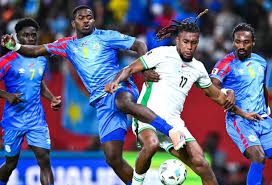
The world football governing body, FIFA, has imposed financial sanctions on both the Nigeria Football Federation and the Congolese Football Association following disciplinary incidents recorded during the African playoff final for the 2026 World Cup qualification held on November 16, 2025 in Rabat, Morocco.
FIFA stated that Nigeria was penalised for a breach relating to order and security at matches, specifically involving the throwing of objects by spectators during the game, and the NFF was consequently fined 1,000 Swiss francs (approximately $1,270) under Articles 17 and 17.2.b of the FIFA Disciplinary Code.
The Congolese federation received a heavier sanction of 5,000 Swiss francs after supporters were found to have used laser pointers or similar electronic devices during the match, a violation of Article 17.2.d of the FIFA Disciplinary Code.
The sanctions were announced in FIFA’s latest disciplinary overview for World Cup qualifying matches and come as the NFF awaits a critical verdict on its formal protest challenging the eligibility of several DR Congo players who featured in the playoff.
The African playoff final ended in dramatic fashion as DR Congo triumphed 4-3 on penalties after extra time following a 1-1 draw, dashing Nigeria’s hopes of qualifying for the World Cup for the first time since 2018. The result eliminated the Super Eagles from automatic qualification and left them dependent on FIFA’s ruling regarding player eligibility to secure a potential route to the inter-continental playoffs.
Following the defeat, the NFF submitted a formal petition to FIFA on December 15, 2025, questioning the eligibility of several DR Congo players, arguing that the Congolese federation misled FIFA by securing nationality switches for several overseas-born players.
Nigeria’s complaint centres on domestic laws in DR Congo that reportedly do not recognise dual citizenship for adults, raising questions over the eligibility of Premier League players such as Aaron Wan-Bissaka and Axel Tuanzebe, both of whom featured in the match.
The protest has created significant uncertainty in African football, as DR Congo has been included in the fixtures for the upcoming inter-continental World Cup playoffs, where they are set to face the winner of the match between New Caledonia and Jamaica on March 31 in Mexico.
NFF General Secretary Mohammed Sanusi earlier explained the federation’s concerns, stating “As far as FIFA is concerned, once you have the passport of your country, you are eligible.” However, the NFF’s argument rests on the constitutional provisions of Congolese law regarding citizenship, which they claim prohibit dual nationality for adults.
If FIFA rules in favour of Nigeria, the result of the playoff could be overturned, potentially disqualifying DR Congo and granting the Super Eagles another route into the 2026 World Cup qualification process.
The sanctions announced by FIFA are separate from the pending eligibility case and reflect violations related to crowd behaviour and spectator conduct during the emotionally charged encounter in Morocco. Moments before DR Congo captain Chancel Mbemba converted the decisive penalty, Super Eagles head coach Eric Chelle accused DR Congo officials of attempting to use voodoo.
Nigeria’s failure to qualify for the 2026 World Cup represents the second consecutive tournament the Super Eagles have missed, following their absence from the Qatar 2022 edition. Nigeria failed to qualify for the 2022 World Cup for the first time in 16 years, losing to Ghana on the away goals rule after drawing 0-0 in Ghana and 1-1 in Nigeria.
The exclusion from consecutive World Cups marks a significant decline for a team that has historically been one of Africa’s most consistent performers on the global stage. Nigeria has qualified for six World Cup tournaments since making their debut in 1994, with appearances in 1994, 1998, 2002, 2010, 2014, and 2018, advancing to the knockout stage on three occasions.
The team’s most recent World Cup appearance was in Russia 2018, where Nigeria was grouped with Croatia, Iceland, and Argentina. They lost their opener 2-0 to Croatia, defeated Iceland 2-0, but were eliminated after a 2-1 loss to Argentina in the final group match.
Nigeria’s inaugural World Cup campaign in 1994 was a breakthrough moment for African football, as the team topped a challenging group ahead of Argentina and advanced to the round of 16 after emphatic victories, including a 3-0 win over Bulgaria. The 1994 squad remains widely regarded as Nigeria’s finest World Cup team.
Nigeria’s current qualification struggles have been compounded by administrative instability, coaching changes, and systemic challenges within Nigerian football. The NFF changed coaches repeatedly during the qualifiers, moving from Jose Peseiro to Finidi George and Austin Eguavoen before settling for Eric Chelle, highlighting confusion and poor administration.
The NFF, led by Ibrahim Gusau, has faced criticism for issues including contract breaches and unpaid bonuses and allowances owed to players and coaches. Both Peseiro and Gernot Rohr approached FIFA to compel the NFF to settle outstanding wages.
The 2026 World Cup will be the first edition to feature 48 teams, with Africa receiving nine automatic qualification slots. Nigeria’s failure to secure any of these spots has been widely criticised, particularly as smaller nations like Cape Verde, Jordan, and Uzbekistan have qualified for their first-ever World Cup finals.
DR Congo are hoping to qualify for the World Cup for the first time since 1974, when the country competed under the name Zaire. Their progression to the inter-continental playoffs represents a historic opportunity, though it now hangs in the balance pending FIFA’s ruling on Nigeria’s eligibility protest.
As FIFA deliberates on Nigeria’s petition, the Super Eagles have shifted focus to international friendlies and rebuilding under coach Chelle. A four-nation invitational tournament involving Nigeria, Iran, Jordan, and Costa Rica has been moved to Antalya, Turkey due to regional security concerns.
According to the schedule, Jordan will face Costa Rica on March 27, while Iran will play Nigeria on the same day. Nigeria will then face Jordan on March 31, while Iran meets Costa Rica again.
For Iran and Jordan, the tournament serves as preparation for the 2026 FIFA World Cup. The competition offers Nigeria an opportunity to maintain match fitness and test emerging talent while awaiting FIFA’s verdict.
The disciplinary sanctions imposed by FIFA reflect the governing body’s commitment to maintaining order at international matches, even as more consequential decisions regarding player eligibility remain pending.
FIFA has not announced a timeline for its ruling on Nigeria’s eligibility challenge, though the decision is expected before the inter-continental playoffs scheduled for late March.
For Nigerian football supporters, the wait continues for what could be either redemption or confirmation of a second consecutive World Cup absence. The financial penalties imposed for crowd-related infractions pale in comparison to the potential consequences of the eligibility ruling, which will determine whether the Super Eagles retain any path to the 2026 tournament in the United States, Canada, and Mexico.