
Opposition Realigns: Gbenga Hashim Meets Makinde
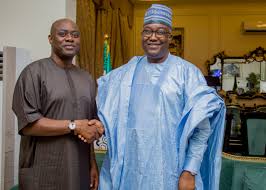
A presidential aspirant on the platform of the Peoples Democratic Party (PDP), Dr Gbenga Olawepo-Hashim, has held a high-level consultation with Oyo State Governor Seyi Makinde in Abuja, in what party insiders describe as part of quiet but strategic moves to rebuild alliances and strengthen the opposition party ahead of the 2027 general elections.
The meeting, which took place on Wednesday in the nation’s capital, signals early efforts by stakeholders to navigate the party’s internal divisions and position key players within a political landscape that remains deeply fragmented following months of leadership crises and defections .
Speaking after the closed-door engagement, Olawepo-Hashim described the discussion with Governor Makinde as productive and forward-looking. He stated that their conversations centred on strengthening unity within the PDP and ensuring the party can play a more effective role in Nigeria’s multi-party democracy .
Olawepo-Hashim commended the Oyo State governor for his commitment to the PDP and for supporting the country’s democratic development. He stressed that unity within the party remains fundamental to its ability to offer credible opposition and national leadership, particularly at a time when Nigeria requires stability, inclusiveness and stronger institutions .
He expressed confidence that continued dialogue among party stakeholders would help resolve differences and reposition the PDP for greater competitiveness in future elections .
Sources familiar with the engagement, however, indicate that beyond the public message of unity, the deliberations also touched on broader strategic concerns. These include internal cohesion among key blocs within the party, questions around leadership direction, and the need to consolidate influence across various regions as the party gradually builds momentum towards the 2027 electoral cycle .
Political observers note that the meeting carries significance given Olawepo-Hashim’s growing influence within the PDP and his perceived role as a figure capable of engaging competing interests within the party . His presidential ambition, which predates the current consultation drive, has been anchored on a platform of bridging regional divides and promoting what his supporters describe as issue-based politics .
Governor Makinde, who along with Bauchi State Governor Bala Mohammed is now one of only two PDP governors remaining after a wave of defections to the All Progressives Congress (APC), has increasingly emerged as a key stabilising force within the opposition party . Since the 2023 general elections, the PDP has lost 10 of its 12 governors to the ruling party, leaving Oyo and Bauchi as the sole states under its control .
The consultation with Olawepo-Hashim comes at a critical juncture for the PDP, which has been grappling with internal leadership disputes that culminated in a Court of Appeal judgment on March 9, 2026, nullifying the party’s national convention held in Ibadan in November 2025 . That convention had produced the Kabiru Tanimu Turaki-led National Working Committee, but the appellate court’s decision further deepened divisions within the party.
In response to the protracted crisis, the PDP Board of Trustees (BoT) convened an expanded emergency meeting on March 10 and 11, 2026, resolving to take immediate steps to reconcile all stakeholders and restore the party to good political health ahead of the 2027 elections . The BoT, in a communique issued after the meeting, acknowledged the “avoidable internal leadership disputes and wranglings leading to damaging litigations” and constituted a special committee to interface with legal teams and stakeholders to foster reconciliation .
The BoT also commended Governors Makinde and Mohammed for their commitment and steadfastness towards the party, even as internal wrangling persisted .
Sources within the party have indicated that both factions are now working towards establishing a caretaker committee to steer the party’s affairs, with discussions suggesting that Turaki may serve as chairman while Senator Samuel Anyanwu takes on the role of secretary . The move, according to insiders, is aimed at meeting Independent National Electoral Commission (INEC) deadlines and preparing for the party’s presidential convention .
The consultations between Olawepo-Hashim and Makinde are seen as part of this broader effort to rebuild bridges and create a more cohesive opposition platform. Political analysts note that the PDP, despite its internal challenges, retains significant strengths, including a national structure and representation in both the Senate and House of Representatives, where it still holds minority leadership roles . The party also demonstrated residual electoral strength in last month’s Federal Capital Territory area council elections, winning the Gwagwalada area council .
However, the path to 2027 remains fraught with obstacles. An analysis of Nigeria’s opposition parties published days before the Olawepo-Hashim-Makinde meeting painted a picture of fragmentation, with the PDP described as a “fading giant” struggling to exploit the governing APC’s vulnerabilities . The party has been labelled a “paper tiger” by some observers, possessing institutional weight but failing to translate it into a compelling political alternative .
The APC, for its part, has sought to capitalise on opposition disarray. Speaking earlier this month, Lagos APC spokesman Seye Oladejo characterised Nigeria’s opposition parties as “merely breathing but not competing,” adding that rather than building strong institutions or policy-driven platforms, the opposition had largely confined itself to “media theatrics and perpetual complaints” . He warned that a weak opposition was unhealthy for Nigeria’s democratic growth, as democracy functions best with a responsible and organised opposition capable of presenting viable alternatives .
Olawepo-Hashim’s entry into the consultation space also brings into focus ongoing debates within the PDP over zoning and regional balance. The party’s national legal adviser, Kamaldeen Ajibade, had clarified in September 2025 that while zoning remains an important principle of fairness and balance in the PDP, it cannot override constitutional provisions guaranteeing every qualified citizen the right to seek elective office . Ajibade stated that even if the party zones its presidential candidate to the South, it would not stop aspirants from any part of the country from showing interest .
That clarification aligned with arguments long advanced by Olawepo-Hashim’s supporters, who had insisted that zoning must not be used to exclude competent leaders, particularly from the North .
Since its formation in 1998, the PDP has operated an informal zoning arrangement between the North and South to balance power and foster national unity. This principle produced a rotation of presidential candidates: Olusegun Obasanjo from the South (1999–2007), Umaru Musa Yar’Adua from the North (2007–2010), and Goodluck Jonathan from the South (2010–2015) . However, the arrangement has also been a source of internal contention, most recently in the lead-up to the 2023 elections when the emergence of Atiku Abubakar, a northern candidate, as the party’s flag bearer reignited debates over the party’s commitment to zoning .
As 2027 approaches, these questions are likely to resurface, and consultations such as the one between Olawepo-Hashim and Makinde are expected to shape the emerging power configuration within the party. Analysts suggest that such high-level interactions could prove pivotal as aspirants and stakeholders begin to test alliances, build consensus, and project influence .
For now, both Olawepo-Hashim and Makinde have maintained a public focus on unity and institutional strengthening. The Oyo governor, speaking at recent party gatherings, has sought to strike an optimistic note, suggesting that the party’s current difficulties will pass. At the BoT emergency meeting, Makinde was quoted as saying, “Weeping may endure for the night but in the morning, joy cometh” .
Turaki, for his part, has called on party leaders to sit down and consider the situation on the ground, coming up with workable options that will save the party and, by extension, Nigeria’s democracy .
Whether these efforts will yield a cohesive and competitive opposition ahead of 2027 remains uncertain. The PDP’s internal wounds are deep, and the party faces the additional challenge of navigating a political environment in which the APC has extended its dominance to 32 of Nigeria’s 36 states . Moreover, the emergence of the African Democratic Congress (ADC) as a potential rallying point for opposition figures, including former Vice-President Atiku Abubakar and former Labour Party presidential candidate Peter Obi, has added a new layer of complexity to opposition politics .
The ADC has attracted a stream of defectors from across the political spectrum and is positioning itself as a potential third force and nucleus of an anti-Tinubu platform. However, it too faces challenges of internal cohesion and has yet to secure any electoral victory since its coalition took shape in July 2025 .
Against this backdrop, the Olawepo-Hashim-Makinde consultation represents one thread in a much larger tapestry of political realignment. It reflects a recognition among some PDP stakeholders that without sustained dialogue and compromise, the party risks entering the 2027 race without a credible presidential candidate, or worse, watching from the sidelines as the opposition space is reshaped by newer coalitions .
For now, both men have signalled their commitment to the PDP and to the broader project of building a viable opposition. Whether that commitment will translate into a unified and competitive party in time for the next general election is a question that only the coming months will answer.