
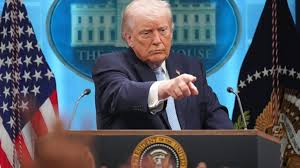
US President Donald Trump agreed Tuesday to suspend military attacks against Iran for two weeks, pulling back from threats to destroy Iranian “civilization” just hours before his self-imposed deadline expired. The conditional ceasefire, announced via social media, hinges on Tehran’s commitment to reopen the Strait of Hormuz for safe international shipping .
“Subject to the Islamic Republic of Iran agreeing to the COMPLETE, IMMEDIATE, and SAFE OPENING of the Strait of Hormuz, I agree to suspend the bombing and attack of Iran for a period of two weeks,” Trump posted on Truth Social approximately one hour before the 8 p.m. ET deadline he had set for catastrophic strikes .
The dramatic de-escalation followed an eleventh-hour diplomatic push by Pakistan, whose Prime Minister Shehbaz Sharif personally urged Trump to extend the deadline to allow negotiations to advance . Pakistani military leadership, including Field Marshal Asim Munir, participated in the mediation efforts that produced the temporary truce .
Trump characterized the agreement as a “double sided CEASEFIRE” and claimed the United States had “already met and exceeded all Military objectives” in the conflict that began in February 2026 . He described a 10-point proposal received from Iran as a “workable basis on which to negotiate,” stating that “almost all of the various points of past contention have been agreed to between the United States and Iran” .
Iran’s Supreme National Security Council confirmed its acceptance of the ceasefire and declared that “nearly all the objectives of the war have been achieved” . The council announced that formal negotiations with US representatives would commence Friday in Islamabad, Pakistan . Iranian Foreign Minister Abbas Araghchi specified that safe passage through the Strait of Hormuz would be permitted “via coordination with Iran’s Armed Forces and with due consideration of technical limitations” .
The 10-point Iranian proposal, details of which emerged through official channels, includes demands for the withdrawal of US combat forces from regional bases, complete lifting of primary and secondary sanctions, release of frozen Iranian assets abroad, and US acceptance of Iran’s right to uranium enrichment . The plan also calls for “ending the war against all components of the Axis of Resistance,” Tehran’s term for regional militant groups including Hezbollah .
Israeli Prime Minister Benjamin Netanyahu’s office issued a statement supporting Trump’s decision while clarifying that the ceasefire “does not include Lebanon,” where Israeli forces continue operations against Hezbollah . Israel conditioned its participation on Iran immediately opening the strait and halting all attacks on US, Israeli, and regional targets .
The announcement triggered immediate global market reactions, with US crude oil prices plunging approximately 8-9 percent to around 96-103 per barrel after trading as high as 117 earlier Tuesday . Stock futures surged, with Dow futures jumping over 900 points and S&P 500 futures rising 2.4 percent .
Earlier Tuesday, Trump had warned that “a whole civilization will die tonight, never to be brought back again” if Iran failed to meet his demands . The expansive threat, which did not appear to account for civilian casualties, drew criticism from Democratic lawmakers and UN officials who suggested such strikes would violate international law .
Regional uncertainty persisted despite the announced truce, with missile alerts sounding in Bahrain and continued Israeli strikes reported in Iran following the ceasefire announcement . Gulf states including Kuwait, Qatar, and the United Arab Emirates reported missile attacks after the deal was publicized .
The conflict, which began with US and Israeli attacks targeting Iran’s military capabilities, leadership, and nuclear program in February 2026, has seen Iran respond with strikes on Israel and Gulf Arab neighbors, causing significant regional disruption . Iran’s closure of the Strait of Hormuz—a chokepoint through which approximately 20 percent of global oil and natural gas passes—has roiled world energy markets and intensified pressure for a diplomatic resolution .
German Chancellor Friedrich Merz and Foreign Minister Johann Wadephul welcomed the ceasefire, with Merz thanking Pakistan for its mediation role and stating that Germany would assist in brokering any long-term peace agreement . Oman also praised the agreement and Pakistan’s diplomatic efforts .
Senator Lindsey Graham, Republican of South Carolina, called for congressional review of any permanent agreement, referencing the Senate process used to evaluate the 2015 Iran nuclear deal .