


Artemis II Crew Returns Safely After Historic Moon Flyby
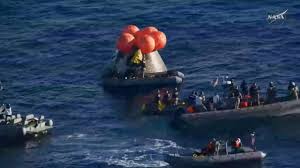
Four astronauts safely splashed down off the California coast late Friday, completing the first crewed lunar flyby in more than 50 years and marking a pivotal milestone for NASA’s Artemis programme.
The spacecraft carrying three Americans and one Canadian returned without incident. Mission commander Reid Wiseman reported the crew — himself, Christina Koch, Victor Glover and Jeremy Hansen — were “stable” and “green.” “They’re in great condition, that’s what that means,” said NASA public affairs official Rob Navias during the agency’s livestream.
Following an expected communications blackout during high-stakes re-entry, Wiseman confirmed, “We have you loud and clear.” NASA personnel and the US military extracted the astronauts from the bobbing capsule to applause at mission control. Helicopters later lifted them to a recovery ship near San Diego, where all four proved capable of walking unassisted.
NASA administrator Jared Isaacman called the voyage “a perfect mission.” “We’re back in the business of sending astronauts to the moon,” he said, adding, “this is just the beginning.”
During re-entry, the spacecraft reached speeds exceeding 30 times the speed of sound and faced temperatures approximately half as hot as the Sun’s surface. The smooth return served as a key test of the heat shield, following complications during an earlier uncrewed trial that prompted engineers to adjust the return trajectory. “If you didn’t have anxiety bringing this spacecraft home, you probably didn’t have a pulse,” said flight director Rick Henfling.
The Orion capsule will now undergo detailed examination to assess its performance.
US President Donald Trump praised the astronauts for their “spectacular” trip, saying he “could not be more proud,” while looking ahead to deeper space exploration. “Next step, Mars!” he wrote on social media.
Artemis II, NASA’s inaugural crewed lunar mission, lasted nine days, one hour, 31 minutes and 35 seconds — rounded to 10 days by NASA. Launched from Florida on April 1, the crew became the first humans to travel furthest from Earth, reaching 252,756 miles (406,771 kilometres). They captured thousands of photographs, witnessed a solar eclipse, and observed meteorite strikes on the lunar surface.
Historic firsts marked the mission: Glover became the first person of colour to fly around the Moon, Koch the first woman, and Canadian Hansen the first non-American.
Astronomer Derek Buzasi of the University of Chicago told AFP the mission was “an almost flawless success,” adding he now has “fresh confidence” in returning to the Moon to stay.
NASA aims to land astronauts on the lunar surface by 2028. However, experts have expressed scepticism that lunar landers under development by SpaceX and Blue Origin will be ready in time. Meanwhile, China is advancing its own programme targeting 2030 for crewed lunar landings.
Clayton Swope of the Centre for Strategic and International Studies told AFP the mission stands as “proof that when America keeps its eye on the prize, it can still do very great things.”