
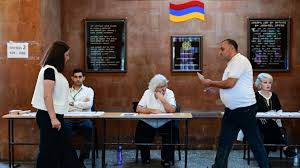
Armenians went to the polls on Sunday in a parliamentary election widely viewed as a referendum on Prime Minister Nikol Pashinyan’s pivot toward the West, a shift that has strained the country’s traditional alliance with former imperial ruler Russia.
The election is seen as a test of the government’s efforts to forge a peace deal after a crushing military defeat by Azerbaijan three years ago. Armenia and Russia remain technical allies, but Moscow has likened the small Caucasus country’s European ambitions to the path it claims triggered its 2022 invasion of Ukraine.
Polls have shown Pashinyan’s ruling Civil Contract party leading, backed by up to 32 percent of voters, with the pro-Russian Strong Armenia party trailing in second place. A late survey suggested an even wider margin, with one projection putting Civil Contract at nearly 65 percent of decided voters, pointing to a possible landslide and a considerable parliamentary majority. The contest features a fragmented opposition, with 18 political parties and alliances competing for nearly 2.5 million eligible voters in the country’s first regularly scheduled elections since 2017.
The vote unfolds against the backdrop of upheaval since Pashinyan rode a 2018 street revolution to power. The country is still reeling from Azerbaijan’s 2023 military takeover of the Karabakh region, which ended the conflict and drove out most of the Armenian population. Pashinyan has framed the ballot as a choice between lasting peace with Azerbaijan or a return to war, warning voters of a possible “catastrophic war” within months if Civil Contract fails to win a strong majority. His opponents dismiss the warning as fearmongering.
The 51-year-old leader has frozen participation in a Russia-led security bloc while deepening ties with the European Union and the United States. A historic peace agreement with Azerbaijan over Karabakh was signed at the White House last year with President Ilham Aliyev, ending decades of conflict.
“We will accept any choice made by the people,” Pashinyan told journalists after casting his ballot in Yerevan, insisting there was “no question of choosing” between Russia and the West.
US President Donald Trump offered his “TOTAL Endorsement for Re-Election” of his “great friend,” while French President Emmanuel Macron embraced Pashinyan during a high-profile visit in May. In a pointed warning, Russian President Vladimir Putin said in May: “We all see what is happening with Ukraine now. How did it all begin? With Ukraine’s attempt to join the EU.”
The Kremlin has been accused of seeking to sway the vote through misinformation, hacker activity and Russia-friendly narratives. Weeks before the ballot, Russia banned imports of several Armenian products, a move seen as economic pressure.
Samvel Karapetyan, the billionaire Russian-Armenian businessman behind Strong Armenia, rejected claims he would pull Armenia back into Moscow’s orbit but cautioned against Pashinyan’s “reckless rush” to the West. He has been under house arrest since last year on coup-plotting charges he calls politically motivated.
Pashinyan’s democratic record is also at stake, with the former reformer facing mounting accusations of backsliding eight years after pledging to dismantle Armenia’s oligarchic system.