
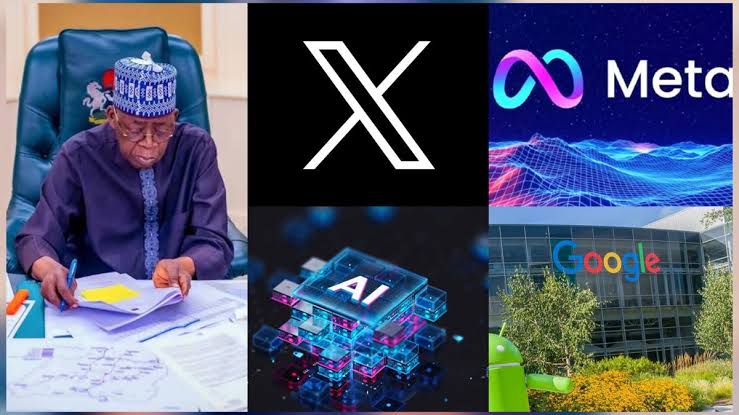
Nigeria has opened one of its most consequential regulatory battles with the world’s biggest technology companies, after President Bola Tinubu directed the Federal Competition and Consumer Protection Commission to investigate Meta, Alphabet, X and a number of Generative Artificial Intelligence platforms over allegations that they are exploiting Nigerian journalism without paying for it and squeezing the life out of the country’s media industry in the process.
The order, made public on Monday, 6 July 2026, in a statement by the FCCPC’s Director of Corporate Affairs, Ondaje Ijagwu, follows a joint petition sent to the Presidency by the Nigerian Press Organisation, the umbrella body that brings together the Newspaper Proprietors’ Association of Nigeria, the Nigeria Union of Journalists, the Broadcasting Organisations of Nigeria, the Nigerian Guild of Editors and the Guild of Corporate Online Publishers. The directive was conveyed to the commission through the Minister of Information and National Orientation, Mohammed Idris.
At the heart of the complaint is a grievance that has been building in newsrooms for years. The publishers argue that platforms such as Meta, which owns Facebook, Instagram and WhatsApp, Alphabet, the parent company of Google, and Elon Musk’s X, formerly Twitter, have grown into gatekeepers of the digital information economy while local media houses that produce the news watch their revenues collapse. The rise of Generative AI has sharpened that anxiety, because the systems that now answer questions directly for users are trained on vast troves of online writing, much of it lifted from news websites, and increasingly keep readers from ever clicking through to the original reports.
According to the commission, the inquiry will focus on several strands. It will examine allegations of market dominance and anticompetitive conduct, the unauthorised extraction, scraping, ingestion and commercial use of copyrighted news articles, broadcast material and other original journalistic work to develop and train Generative AI models, and the absence of fair commercial agreements that would allow Nigerian publishers to negotiate proper compensation for the content that feeds these platforms.
The FCCPC’s Executive Vice Chairman and Chief Executive Officer, Tunji Bello, sought to strike a measured tone, insisting the commission was not out to punish anyone before the facts were established. “We recognise the strategic importance of the media to Nigeria’s democracy and the equally significant role of technology in driving innovation and economic growth,” he said in the statement. “Our responsibility is to objectively determine the facts and ensure that competition within the digital ecosystem remains fair, transparent, and consistent with Nigerian law.”
Bello added that the exercise should not be read as a presumption of guilt against any company, stressing that every party would be given the chance to present its case before conclusions were drawn. The commission, he said, would determine whether any conduct breached the Federal Competition and Consumer Protection Act 2018 or any other applicable law.
The roots of Monday’s directive stretch back to March, when President Tinubu hosted a high level delegation of media proprietors and executives at an interfaith dinner and gave his word that government would act. That delegation was led by the NPO President and Publisher of The Guardian, Lady Maiden Alex-Ibru, and included some of the most recognisable names in the Nigerian press, among them Aremo Olusegun Osoba, the Vanguard publisher Sam Amuka, the Chairman of THISDAY and ARISE News, Prince Nduka Obaigbena, the Chairman of Channels Television, Dr John Momoh, the Director General of the Nigerian Television Authority, Saliu Abdulhamid Dembos, and the President of the Nigerian Guild of Editors, Eze Anaba.
Speaking on behalf of the organisation at that gathering, the Deputy President of the Newspaper Proprietors’ Association of Nigeria and Publisher of BusinessDay, Frank Aigbogun, put figures to the frustration. He accused some technology companies of routinely scraping proprietary creative content to train AI models, at times by breaking through digital paywalls, and asked the President to direct the FCCPC to work with the media on complaints that Big Tech dominance and anticompetitive practices were costing local outlets at least 70 per cent of their legitimate income, a loss some estimates place in the hundreds of millions of dollars, alongside vanishing jobs and opportunities.
This is not the commission’s first encounter with the tech giants. Less than a year ago, in 2025, the FCCPC secured a landmark judgment against Meta over violations of the same competition and consumer protection law, including data privacy breaches, and imposed a penalty of 220 million dollars. Meta has appealed that ruling, and the matter remains a live reminder of how bruising these confrontations can become.
Nigeria is also stepping onto a road that other nations have already travelled. The FCCPC itself pointed to South Africa, where concerns raised by media organisations prompted an inquiry by that country’s Competition Commission that, in the regulator’s telling, produced an agreement requiring Google to compensate news publishers. Beyond the continent, Australia’s News Media Bargaining Code, introduced in 2021, forced platforms to strike payment deals with publishers, while Canada’s Online News Act of 2023 pushed Google into a yearly funding arrangement and prompted Meta to block news on its platforms altogether. The European Union has likewise created a neighbouring right for press publishers under its copyright rules. Nigeria’s move places it firmly within that widening global effort to rebalance the relationship between journalism and the platforms that distribute and profit from it.
How the companies will respond is, for now, an open question. It has been reported that both Google and Meta were contacted for comment and acknowledged the enquiries but had not offered a substantive reaction as of the time those reports were filed. Neither company had issued a formal public statement on the Nigerian investigation at the time of writing.
What is clear is that the outcome could reshape the terms on which global technology firms operate in Africa’s most populous nation and largest media market. Should the FCCPC find that any of the practices amount to a breach of Nigerian law, it holds broad statutory powers to demand internal records, scrutinise commercial agreements and impose penalties. For an industry that has spent the better part of a decade watching its audience and its earnings migrate to platforms it does not control, the investigation represents the most serious attempt yet to claw back some value. For the technology companies, it is another front in a global argument they can no longer treat as distant noise.