
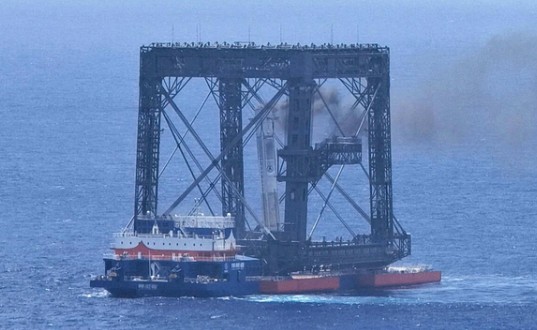
China has successfully recovered an orbital-class rocket booster at sea, marking a critical technical milestone in its aggressive campaign to break American dominance in reusable spaceflight. The Long March 10B carrier rocket lifted off from the Hainan Commercial Space Launch Site on July 10, executing a flawless orbital deployment. Approximately six minutes after stage separation, the first-stage booster performed a controlled vertical descent to a specialized offshore recovery platform. Beijing is rapidly closing the technical gap with Western private entities by deploying an entirely new recovery methodology.
The successful maritime operation relies on an unconventional engineering approach to hardware retrieval. Unlike SpaceX’s Falcon 9, which uses heavy, deployable landing legs to touch down on drone ships autonomously, the Chinese system employs landing hooks that catch a massive net suspended on a floating sea platform. Eliminating traditional landing gear reduces the overall dead weight of the launch vehicle, allowing the rocket to carry heavier commercial payloads to low-Earth orbit. The state broadcaster confirms that engineers intend to refurbish and re-fly this exact booster before the end of the year.
The breakthrough comes amid a massive, state-backed acceleration within the domestic commercial space sector. The China Aerospace Science and Technology Corporation designed the Long March 10B as part of a larger rocket family intended to land astronauts on the Moon before 2030. Simultaneously, Beijing has relaxed initial public offering regulations to inject immense private capital into independent domestic rocket companies like LandSpace and Space Pioneer. This synchronized multi-agency push follows consecutive recovery failures late last year, transforming previous technical lessons into operational reality.
Sustaining a highly frequent, low-cost launch cycle is essential for China’s broader geopolitical ambitions in orbit. Beijing is currently racing to build massive national satellite constellations, including the Guowang internet megaconstellation, to challenge Western broadband networks. Traditional expendable rockets are far too expensive to sustain the deployment of tens of thousands of orbital communication nodes. By mastering booster recovery, China can drastically reduce launch costs from historic baselines. The achievement moves the global space economy away from a unipolar American market into a fierce bipolar race.