


Argentina Risk FIFA Sanction Over Falklands Banner After Semifinal Win
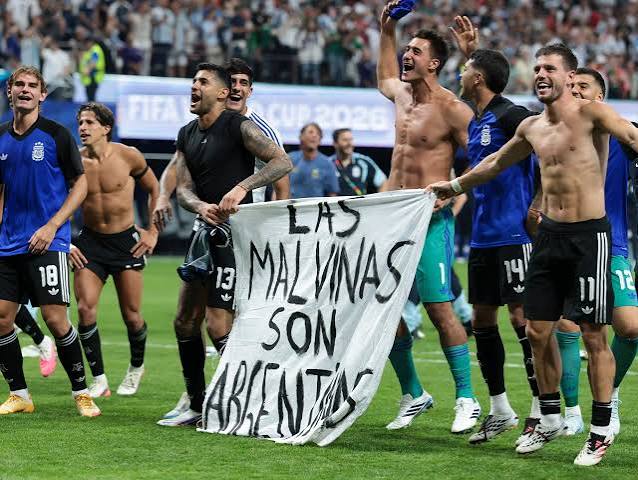
Barely minutes after booking their place in a second straight World Cup final, Argentina’s players turned a night of sporting triumph into a diplomatic flashpoint, unfurling a banner in Atlanta that reasserted their country’s claim to the Falkland Islands and drew the reigning world champions into the path of a possible FIFA sanction.
The banner, bearing the words “Las Malvinas son Argentinas”, meaning “The Falklands are Argentine”, was held aloft on the pitch after the final whistle of Wednesday’s semifinal against England. According to match reports, defender Lisandro Martínez and midfielder Giovani Lo Celso raised it before the players left it on the turf, a gesture that world football’s governing body may treat as a breach of its rules on political messaging.
Argentina had come from behind to win 2-1 in a bruising contest at Atlanta Stadium. Data from the fixture shows England took the lead in the 55th minute, reportedly through Anthony Gordon, and held it deep into the closing stages before Argentina struck twice in the final five minutes, the equaliser arriving in the 85th minute and the winner in the 90th, sending Lionel Scaloni’s side through to Sunday’s final against Spain. The match statistics underline how one-sided the balance of play was despite the tight scoreline. Argentina dominated possession with 64 percent to England’s 36, and out-shot the Three Lions 14 to 6, registering six shots on target to England’s three. It was also a fractious encounter, producing 26 fouls and four yellow cards, three of them shown to Argentine players.
The political dimension, however, quickly overshadowed the football. The Falkland Islands, a British Overseas Territory in the South Atlantic lying roughly 480 kilometres east of the Argentine mainland and about 8,000 miles from Britain, have been the subject of a sovereignty dispute stretching back generations. Britain has administered the islands since 1833, and the overwhelming majority of residents have consistently expressed a wish to remain British, including in a 2013 referendum. Argentina maintains that it inherited the territory from Spain following independence in 1816 and that Britain seized control unlawfully.
That long-running disagreement erupted into open conflict in 1982, when Argentina’s then military government invaded the islands, triggering a 74 day war. By widely cited counts, 649 Argentine service members, 255 British service members and three islanders were killed before Britain retook the territory. The rivalry acquired an additional sporting charge four years later at the 1986 World Cup, when Diego Maradona’s “Hand of God” goal and his subsequent solo effort knocked England out and propelled Argentina towards the title.
FIFA’s regulations leave little ambiguity on displays of this nature. The body’s Stadium Code of Conduct prohibits “banners, flags, flyers, apparel and other paraphernalia that are of a political, offensive, and/or discriminatory nature” inside stadiums. The rulebook of the International Football Association Board, which sets the laws of the game, is similarly firm. “Equipment must not have any political, religious or personal slogans, statements or images,” it states, adding that “for any offence the player and/or the team will be sanctioned by the competition organiser, national football association or by FIFA.”
There is direct precedent involving the same message and the same nation. In 2014, the Argentine Football Association was fined after players held up an identical banner before a friendly against Slovenia, a penalty reported at the time as around £20,000, or roughly 36,000 dollars. FIFA ruled then that the act contravened its rules on political messaging and team conduct. World football’s ruling body had not issued a formal response to Wednesday’s incident at the time of filing.
The banner did not emerge in isolation. Argentina’s players had already drawn attention earlier in the tournament, singing chants referencing the Falklands, alongside tributes to Maradona and Lionel Messi, after their round of 16 win over Egypt. Political figures at home amplified the sentiment. Argentina’s Vice-President, Victoria Villarruel, posted on X after the victory, “It wasn’t just another match”, alongside a video that appeared to show Argentine soldiers. “The Falklands are Argentine. They banned bringing them to the stadium and forgot that we carry them in our blood and our hearts,” she wrote. Before the game, she had framed the fixture in similarly charged terms, describing it as being “about putting the invaders in their place.”
Scaloni had sought to hold the line between sport and politics. Speaking at a press conference ahead of the tie, the Argentina head coach declined to cast the match as a continuation of the conflict. “The reality is that this is a football match. I can’t mix things up, especially out of respect for what happened so many years ago,” he said. “It was a very sad period in our history, and there isn’t much we can do about it, that’s the reality.” He added, “Things are happening elsewhere in the world, and we criticise the existence of war. We certainly remember those people, of course. But it is a football match, we shouldn’t confuse the two.”
Given the heightened sensitivities, the semifinal itself was staged under reinforced security. For now, attention turns to two fronts. On the pitch, Argentina prepare to meet Spain in the final at MetLife Stadium in New Jersey on Sunday, chasing back to back world titles. Off it, the football world waits to see whether FIFA’s disciplinary committee will open proceedings, and whether the precedent set in 2014 points to another fine for an association that has been here before.