
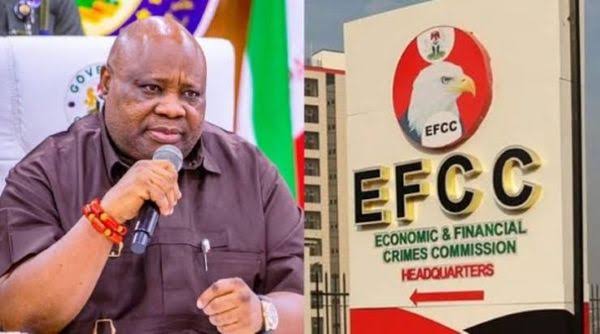
A single letter to a bank has pushed Osun State into the sharpest confrontation yet between a subnational government and Nigeria’s foremost anti graft agency, ten days before voters choose a governor on August 15.
The Economic and Financial Crimes Commission on Wednesday directed First Bank to place a “Post No Debit” restriction on an Osun State Government account, a directive the state says it received through its banker the same morning. According to the letter dated August 5, 2026, referenced 3000/EFCC/ABJ/HQ/PFS/TA/OSUN/VOL.17/666 and signed by an Assistant Commander of the Commission, Adenike Babalola, for the Director of Investigation, the restriction was to remain pending the conclusion of an ongoing investigation. The letter, addressed to the Managing Director of First Bank with attention to the Chief Compliance Officer, identified the affected account as “Osun State Government Statutory Allocation”, numbered 2017170947, and referred to an earlier correspondence dated April 15, 2026. Reports of the account’s function differed, with some describing it as the state’s salary account and others as its statutory allocation account.
The Commission grounded the request in statute rather than a court order. The letter cited Section 38 (1) and (2) of the Economic and Financial Crimes Commission (Establishment) Act, 2004, and Section 24 of the Money Laundering (Prevention and Prohibition) Act, 2022, although at least one newspaper reported the provision as Section 36 (1) and (2). The same Section 38 was cited by the Commission in May, when its Director of Investigation, Abdulkarim Chukkol, invited the Executive Chairman of the Osun State Universal Basic Education Board, Ibukun Fadipe, over what the agency described as “the utilisation of counterpart grants and execution of projects under the Universal Basic Education Commission scheme in Osun State from 2024 to date.”
Governor Ademola Adeleke, addressing journalists at the Government House in Osogbo, framed the action as constitutional trespass. “This action was taken without any court order. We are supposed to be in a democracy, where the Rule of Law must always prevail. We will therefore not accept a situation where federal agencies trample on the constitutional rights of subnational governments,” he said. He added, “All I ask is for the EFCC chairman to explain to the good people of Osun State and to Nigerians in general why he froze Osun State Government Account, and show proof to support whatever reason he presents,” and said he had instructed the state Attorney General to challenge the matter at the Federal High Court, Osogbo. Asked whether officials had been questioned beforehand, the governor said several had been invited and cleared before the freeze.
He also placed the blame politically, alleging: “All these intimidation and attacks were carried out on the order of Gboyega Oyetola over an election his candidate cannot win.” Oyetola, his predecessor and now Minister of Marine and Blue Economy, has not personally responded to the allegation. The Osun chapter of the All Progressives Congress, through its Director of Media and Information, Kola Olabisi, had a day earlier described the governor’s claims of political victimisation against President Bola Tinubu and Oyetola as “misplaced and frivolous.”
The Attorney General and Commissioner for Justice, Oluwole Jimi Bada (SAN), confirmed the mandate to litigate. “I have the mandate of the governor to proceed to the Federal High Court to challenge this move. EFCC can investigate the accounts, but it can’t freeze the accounts without an order of court,” he said, adding that “this step will affect government running.” The Commissioner for Finance, Sola Ogungbile, alleged that police operatives stormed the main branch of First Bank in Osogbo and arrested staff, and said state funds were not being used for the governor’s campaign.
The Commission has not issued a public statement. Its spokesperson, Dele Oyewale, promised a reaction to one newspaper and did not revert, while calls and messages from another went unanswered. Sources within the agency, said the investigation predates the campaign season. “We have been investigating the government for over a year. In fact, some top officials of the government had been invited; they came and wrote statements. So it is not because of the forthcoming election,” one said. Neither account has been independently verified.
Nigerian law on administrative freezes remains contested. Section 34 (1) of the EFCC Act requires the Chairman or an authorised officer to apply ex parte to court before instructing a bank examiner to freeze an account. The Money Laundering (Prevention and Prohibition) Act, 2022 permits a temporary stop of up to 72 hours for investigative purposes, after which practitioners generally hold that a court order becomes necessary. Appellate decisions including UBA Plc v Antai (2018) and NPG Properties and Construction Works Limited v Zenith Bank Plc (2023) have held that banks should not restrict customer accounts without a court order or the customer’s instruction. Whether Sections 38 and 24, which deal principally with the Commission’s powers to demand information and records, can independently sustain an open ended restriction is precisely the issue the state has signalled it will place before the Federal High Court.
Precedent exists, though with a different procedural route. On August 31, 2021, Justice Tijjani Garba Ringim of the Federal High Court in Lagos froze a Kogi State salary bailout account numbered 0073572696 at Sterling Bank following an EFCC ex parte application over a N20 billion loan. Kogi later sued the Commission seeking N35 billion in damages. In that case, the freeze followed a court order.
The fiscal stakes are substantial. Federation Account Allocation Committee data show Osun received N141.48 billion in 2023, N97.21 billion in 2024 and N144.94 billion in 2025, with N40.1 billion in the first quarter of 2026, bringing receipts to about N423.7 billion over the 39 month period. Osun ranked sixth lowest nationally in 2025 FAAC receipts. Its 2026 budget was approved at N723.45 billion, resting on projected recurrent revenue of N421.25 billion, capital receipts of N286.01 billion and an opening balance of N16.19 billion, a structure that leaves federal transfers central to salaries and debt service. The APC candidate, Bola Oyebamiji, argued in a newspaper interview that monthly allocation rose from roughly N2.6 billion at the end of the Oyetola administration to about N16 billion today without commensurate results, a characterisation the state government disputes.
The freeze also lands on a state already fighting over money at the council level. Following the Federal High Court judgment nullifying the October 2022 council elections and Court of Appeal decisions in February and June 2025, fresh polls were held on February 22, 2025. Adeleke said in a January broadcast that about N130 billion in council allocations had been withheld since February 2025. The Supreme Court struck out the state’s suit against the Attorney General of the Federation in December 2025. On June 15, 2026, Justice Adefunmilola Demi Ajayi dismissed suit FHC/OS/CS/147/2025 with N200,000 in costs, holding that the councils’ tenure ended in October 2025. An appeal was filed the next day and is pending.
The Independent National Electoral Commission says 2,339,233 voters are registered across 30 local governments, 332 registration areas and 3,763 polling units, with 14 parties on the ballot. Registration rose from 1,954,800, adding more than 384,000 voters. PVC collection was extended to July 31 after 322,822 new registrants, about 62 per cent, had collected theirs, and a mock accreditation on August 1 in 12 local governments recorded BVAS failures. INEC Chairman Joash Amupitan told stakeholders in Osogbo, “The ballot box, not the bullet, will decide Osun’s future.”
Adeleke, who polled 403,371 votes to Oyetola’s 375,027 in July 2022 and won 17 of 30 councils, now seeks re election on the Accord platform after leaving the PDP in November 2025. He faces Oyebamiji of the APC and Najeem Salaam of the ADC in what observers describe as a tight race. Whether the restriction survives judicial scrutiny, and whether it is lifted before August 15, will now shape both the campaign and the argument over how far federal enforcement powers may reach into state treasuries.