

N80,000 A Day: Paid Mascots Set Early Tone For 2027 Campaign
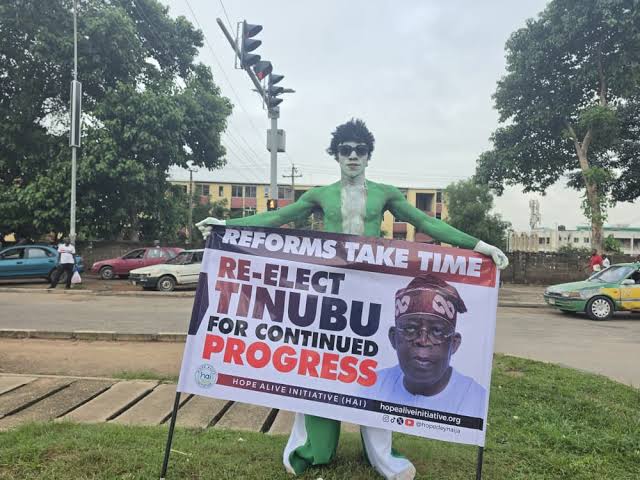
Paid Mascots , The Transactional Face Of Nigeria’s 2027 Campaign
Paid mascots parading pro-Tinubu banners across Abuja have become an early and telling image of Nigeria’s 2027 campaign season, which opened formally on 19 August after the Independent National Electoral Commission lifted its embargo on public campaigns for the presidential and National Assembly elections.
Figures in costume were reported at busy points in the capital, among them the City Gate, the Federal Secretariat, Wuse 2 and the Central Area, holding placards urging voters to re-elect President Bola Ahmed Tinubu on the platform of the All Progressives Congress. One, in a video that circulated widely online, said he had been paid N80,000 to carry a campaign poster and would abandon it for a better offer. The claim could not be independently verified, but it struck a nerve, drawing mixed reactions from Nigerians who questioned whether the enthusiasm on display was genuine or simply bought.
That question sits at the centre of a season that will run for months. Under INEC’s revised timetable, campaigns for the presidential and National Assembly elections began on 19 August 2026 and must close 24 hours before polling on 16 January 2027. Campaigns for the governorship and State Houses of Assembly elections are scheduled to start on 9 September and close ahead of the 6 February 2027 vote. The dates flow from Section 98(1) of the Electoral Act 2026, which provides that public campaigns may commence 150 days before an election and must end the day before it. The Act, signed into law by President Tinubu in February 2026, replaced the Electoral Act 2022 and adjusted several statutory timelines.
The commission has framed 2027 as a benchmark exercise. INEC projects that the number of registered voters will pass 100 million for the first time, and its chairman, Professor Joash Amupitan, has stressed measures aimed at wider participation and accessibility. The scale of that electorate raises the stakes of how parties mobilise, and whether they persuade voters with ideas or with cash and crowd-for-hire tactics.
The ruling party has moved carefully. The APC has clarified that 19 August marked the legal window for campaigns to begin rather than a directive to launch rallies at once. Its national publicity secretary, Felix Morka, noted there was no law compelling any party to start on that day, and party officials indicated that a full nationwide programme would be unveiled later. In practice, that left surrogate groups and informal displays, including the Abuja mascots, to set the early tone before the formal machinery came alive.
The mascot episode is minor in itself, but it reflects a durable feature of Nigerian electioneering. Paid mobilisation, branded merchandise, transported crowds and small cash inducements have long blurred the line between voluntary support and hired visibility. Critics argue that such spending distorts the picture of a candidate’s genuine backing and diverts attention from record and policy. Some of the online reactions to the Abuja display made exactly that point, suggesting that a government performing well would not need to pay for endorsement, while others treated the payments as a routine transaction in a difficult economy where N80,000 is real money.
The economic backdrop sharpens that reading. With many households squeezed by high living costs, offers of a few thousand naira for a day’s display, or a vote, carry weight they might not in easier times. This is why campaign finance and vote-buying rules matter beyond the letter of the law. INEC’s guidelines require that fees for billboards, posters, rallies and the use of public facilities be reasonable and applied uniformly, and that state resources not be used to advantage any party. Enforcing those principles across a long campaign will test the commission.
There has, at least, been an attempt to set a tone of restraint. On 18 August, a day before campaigns opened, political parties and candidates signed a national peace accord in Abuja, organised by the National Peace Committee in partnership with The Kukah Centre, committing to issue-based campaigns and to shun violence, hate speech and misinformation. The event drew the INEC chairman, the Inspector General of Police, Olatunji Disu, and party leaders. President Tinubu, seeking re-election, used the occasion to warn against misinformation, including content generated by artificial intelligence.
What is confirmed is that the campaign has begun, the timetable is fixed, and the contest will feature familiar figures including Tinubu, Atiku Abubakar and Peter Obi. What remains open is whether the season is defined by the substance the peace accord invoked, or by the transactional theatre the Abuja mascots so vividly captured. On present evidence, both are already on the streets.